
Reviewed · ANCIENT OLYMPIA TOURS
Olympia: Tour with Virtual Reality and Audio
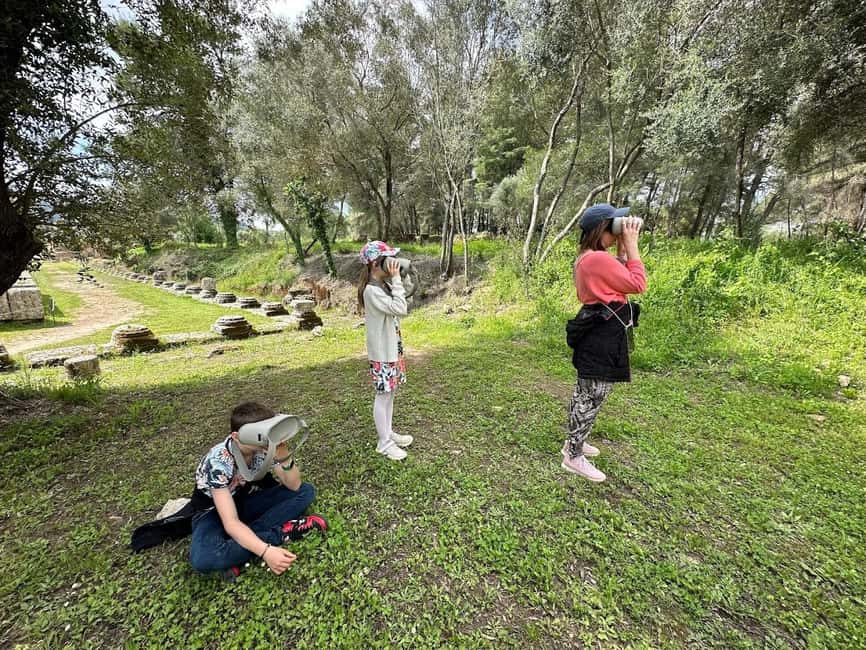
Ancient Olympia can be hard to read at first. The stones are real, but much of the city that hosted the first Olympic Games has disappeared. This two-hour VR tour rebuilds the temples, training grounds, and stadium in front of you, so the ruins make sense instead of looking like a collection of fallen blocks.
I like two things right away: the self-guided pace, which lets you stop and look without following a group, and the audio commentary, which adds short facts as you approach each monument. The virtual map also helps you find your way through the site. The catch is that the glasses can occasionally lose their position, and the pickup office is in town rather than directly beside the archaeological entrance.
Key points to know before you book
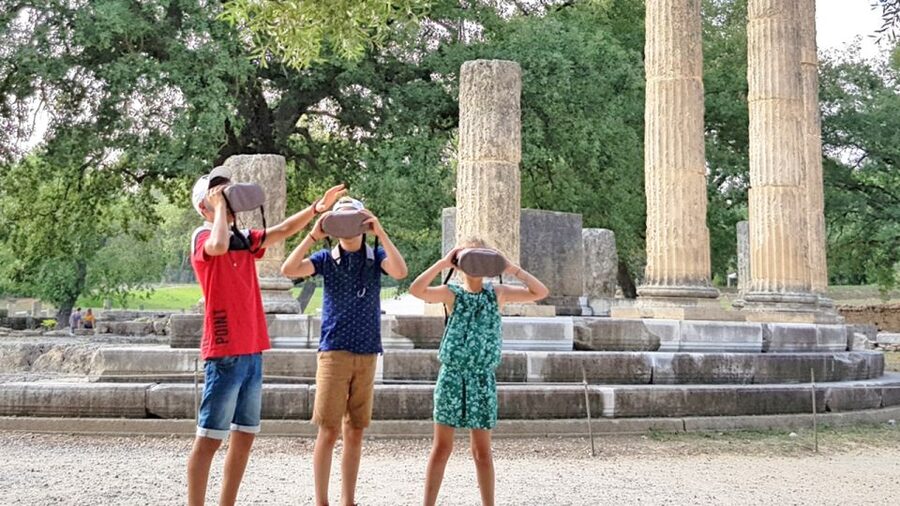
- Ancient Olympia returns in 3D: See temples, fountains, workshops, and sporting scenes reconstructed over the existing ruins.
- Fifteen monuments are included: The route covers the Gymnasium, Palestra, Phidias Workshop, Temple of Zeus, Stadium, Nymphaeum, and more.
- You control the pace: The tour is self-guided, with an audio guide and virtual map rather than a large walking group.
- The Olympic story is central: Watch ancient athletes train and compete, then see how the Olympic Flame was lit in antiquity.
- Allow time for the office walk: Collect the glasses at the Olympia Back in Time office across from the church, then walk to the archaeological site.
- Expect helpful technology, not perfect technology: GPS guidance usually works well, but you may need to reorient the glasses or restart them.
Why the VR glasses make Olympia easier to understand
The archaeological site at Olympia rewards imagination. You see foundations, columns, scattered stones, and broad open spaces, but it can take work to picture the buildings that once filled them. The glasses supply that missing picture with 3D reconstructions placed over the ruins.
This is not a photographic recreation. The images have a video-game quality, which is useful to know before you arrive. Their purpose is scale and shape. You can see where a roof once sat, how tall a temple was, and how a training ground fit into the wider sanctuary.
I like this approach because you are not trapped inside a moving film. You walk through the actual site while the virtual version appears in the right place. You can pause, look around, and listen again if a detail catches your attention.
The audio guide works alongside the glasses. As you approach the monuments, it explains what you are seeing and adds stories about the ancient Olympic Games. The audio is available in Greek, English, French, German, Spanish, Italian, and Dutch. The live explanation at the office is given in English, French, or Greek.
Other classical sites from Greece:
- 4-Day Classical Greece Tour: Epidaurus, Mycenae, Olympia, Delphi, Meteora
★ 4.5 · 732 reviews - Ancient Olympia: Archaeological Site and Museum Entry Ticket
★ 4.3 · 555 reviews - Katakolo Port: Transfer to Ancient Olympia and VR Audio Tour
★ 4.1 · 403 reviews
Collecting the equipment in Olympia
Your visit begins at the local partner’s office, called Olympia Back in Time. It is on Olympia’s main street, across from the church. You can also search for Olympia Back in Time on Google Maps.
The office is not at the archaeological entrance. Plan on about a 20-minute walk from the coach area to the office, then allow another walk to the site and back. One detailed timing tip is especially useful for people arriving by cruise transfer or organized transport: leave enough time to return the glasses before your departure. The activity ends back at the same meeting point.
At the office, the team explains how to use the glasses and gives a short live demonstration. This matters because the navigation takes a little practice. You follow a blue arrow in the glasses, even if your body is facing a different direction. The display adjusts after a few seconds, so it is worth waiting rather than turning sharply and losing your bearings.
A passport, driving licence, or ID card is required as a deposit. Bring comfortable shoes, since the activity involves walking outdoors over an archaeological site. The tour itself is wheelchair accessible, though you should still consider the surface and route at the site when planning your visit.
The Gymnasium and Palestra: where athletes prepared
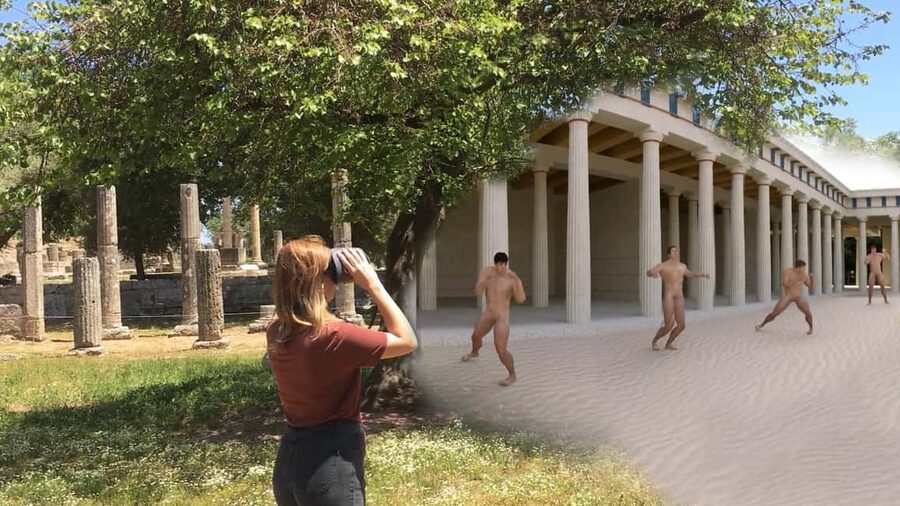
The route begins with the Ancient Gymnasium. This was a training area for athletes preparing for the Olympic Games. With the virtual reconstruction, you get a better sense of the size of the space and the physical preparation behind the contests.
The next stop is the Palestra, used by boxers and wrestlers. These were not just empty courtyards. They were working training spaces tied directly to the athletic events that made Olympia famous. The audio helps connect the stones under your feet with the daily activity that once took place there.
This early part of the tour is a good test of how you like the technology. You will be walking, looking through the glasses, and listening at the same time. If you prefer to take photographs or study every exposed stone, you may need to pause the audio and remove the glasses now and then.
The Phidias Workshop and a lost wonder

The route then reaches the Phidias Workshop. Phidias created the Statue of Zeus, one of the seven wonders of the ancient world, and this is where the virtual material becomes especially useful.
The workshop ruins alone do not give you a full picture of the statue’s scale or importance. The reconstruction helps connect the building to the artist and to the giant image that once occupied the Temple of Zeus. You can see how the workshop fits into the story rather than treating it as another stop with a name on a sign.
The audio guide adds context without requiring you to keep pace with a guide. If one part interests you more than another, you can spend extra time there. That freedom is one of the strongest reasons to choose this format instead of a fixed group walk.
A few more things to do in Greece worth a look
- Athens: Acropolis Ticket with Optional Audio or Live Guide
★ 4.2 · 11,055 reviews - Athens: Cape Sounio & Poseidon Temple Trip with Audio Guide
★ 4.4 · 4,521 reviews - Athens: Acropolis Ticket with Audio Guide
★ 4.0 · 3,575 reviews - From Athens: Delphi Full Day V.R. Audio Guided Tour
★ 4.6 · 3,028 reviews
The Temple of Zeus and its missing statue
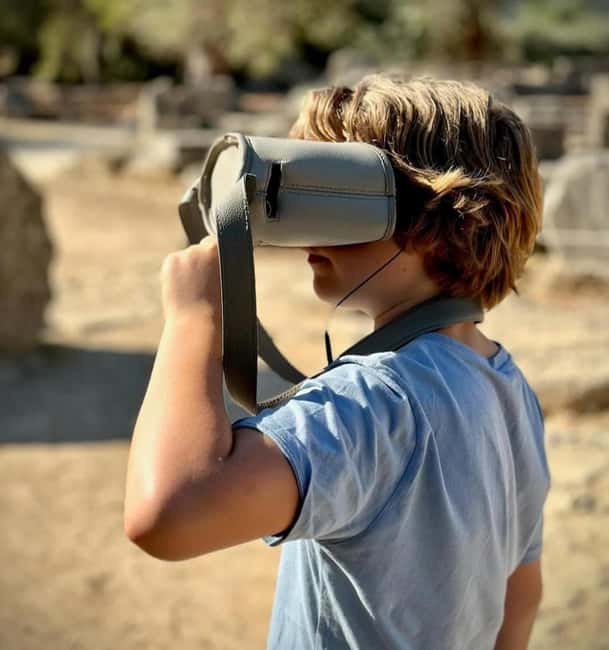
The Temple of Zeus is one of the main moments of the route. Today, you see the remains of a major temple, but the virtual experience lets you view it as a complete building and then enter it in 3D.
Inside, the glasses show the magnificent Statue of Zeus. This is where VR solves a problem that ordinary ruin viewing cannot. The statue is no longer in Olympia, and no physical reconstruction can place it back in its original setting. The digital version gives you a sense of the interior and the connection between the temple and the cult image.
You should keep your expectations realistic. The graphics are interpretive rather than museum-grade photographs. Still, seeing the temple restored to its intended height and form gives you a much better idea of what the sanctuary meant to people who arrived here in antiquity.
The Ancient Stadium and the Olympic contest
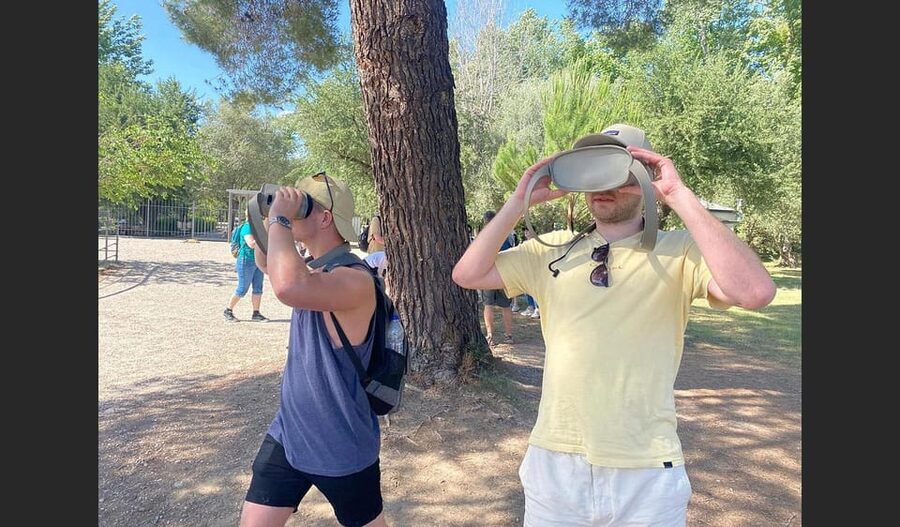
The Ancient Stadium is likely to be the most memorable stop for many people. Here, the glasses show athletes training and competing in the Olympic Games. You can watch the action from the finishing line, a particularly effective viewpoint because it puts you close to the moment of competition.
The value is not just visual. The stadium becomes a place where events happened, not simply a long strip of earth surrounded by banks. The audio explains the setting while the virtual scenes show how the space functioned.
Families often find this part easy to enjoy because the sporting action gives children something clear to watch. Adults who already know the Olympic story will also get a stronger sense of scale. You can picture the athletes moving through the stadium rather than relying on a modern sports arena as a mental comparison.
The one practical concern is crowd movement. Looking through the glasses can make you less aware of people around you, especially when the site is busy. Walk slowly, keep one ear and part of your attention on the real path, and stop at the side when you need to reorient yourself.
The Nymphaeum of Herodes of Atticus
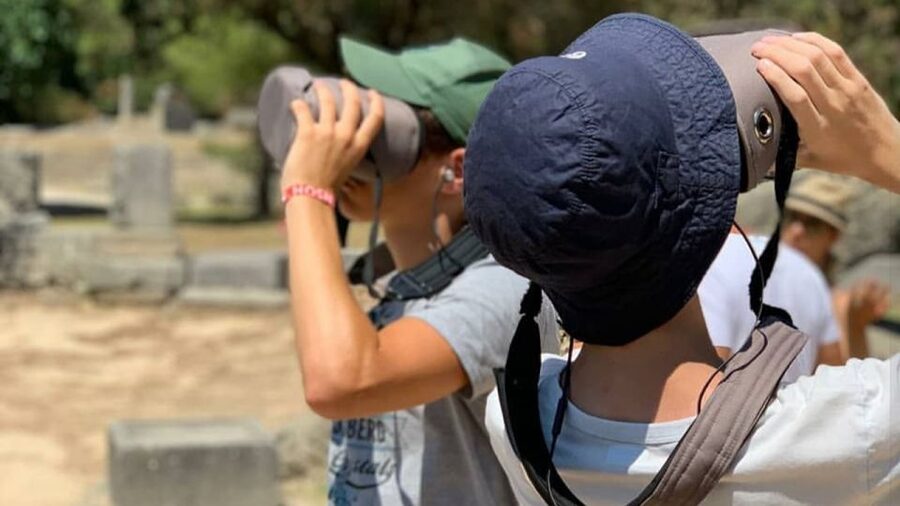
The route continues to the Nymphaeum of Herodes of Atticus. The ruins are brought back to their full grandeur through the glasses, showing how much more elaborate the structure was in antiquity.
This stop is a good example of why the tour works best when you compare the digital image with the physical remains. Look at the surviving stones first, then use the reconstruction to fill in the missing levels and decoration. You get both the archaeological evidence and a visual proposal for the complete building.
The audio keeps the visit moving, but you do not have to hurry from one point to the next. You can pause to examine the real masonry and then resume the commentary.
The Olympic Flame and an old tradition
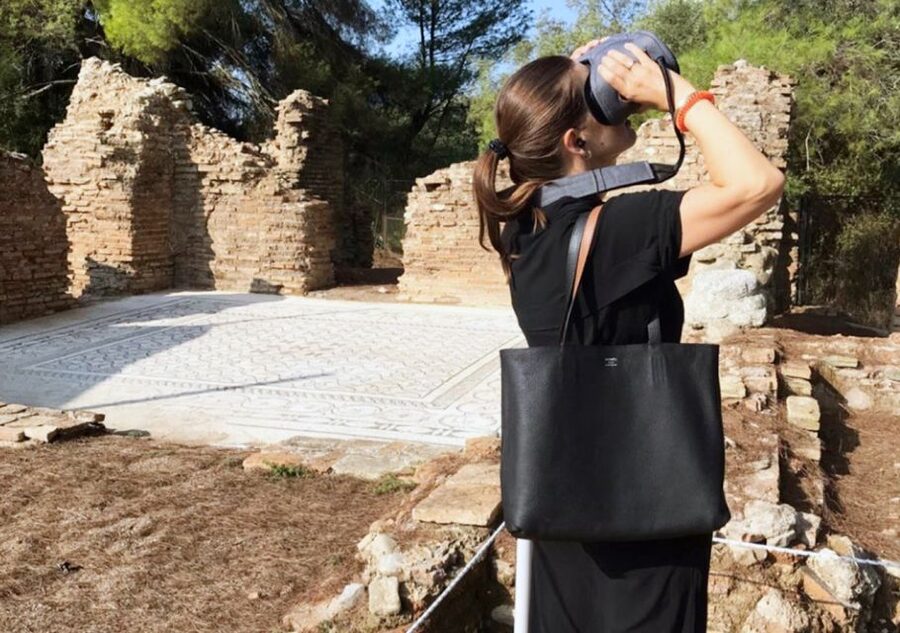
Near the end, the tour shows the lighting of the Olympic Flame in ancient times. This creates a direct link between Olympia’s ancient ceremonies and a tradition recognized around the world today.
The experience does not suggest that every modern Olympic custom is unchanged. Instead, it gives you a clear visual link between the ancient sanctuary and the continuing symbolism of the flame. After seeing athletes compete in the stadium, this final scene gives the visit a fitting ceremonial close.
It is also one of the more useful moments for visitors who know little about Olympia before arriving. The tour ties the buildings, athletic contests, and rituals into one story rather than presenting fifteen unrelated monuments.
How the navigation works in practice
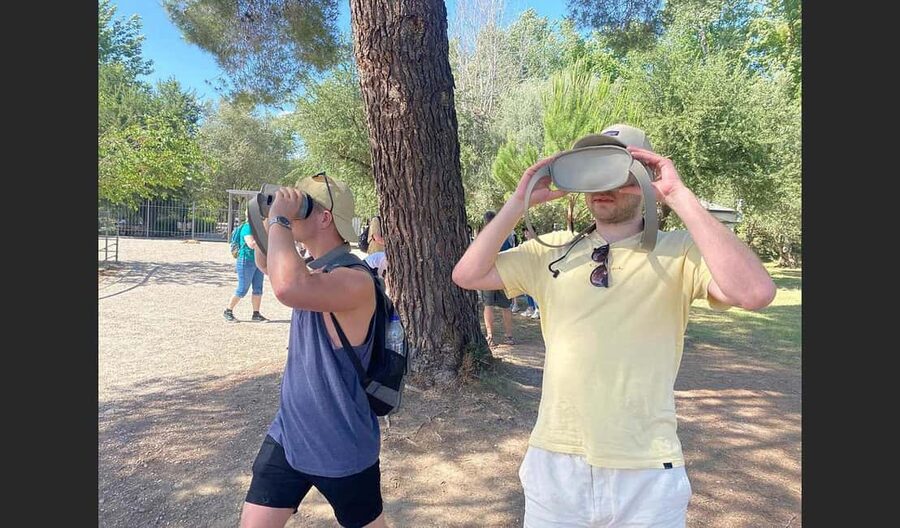
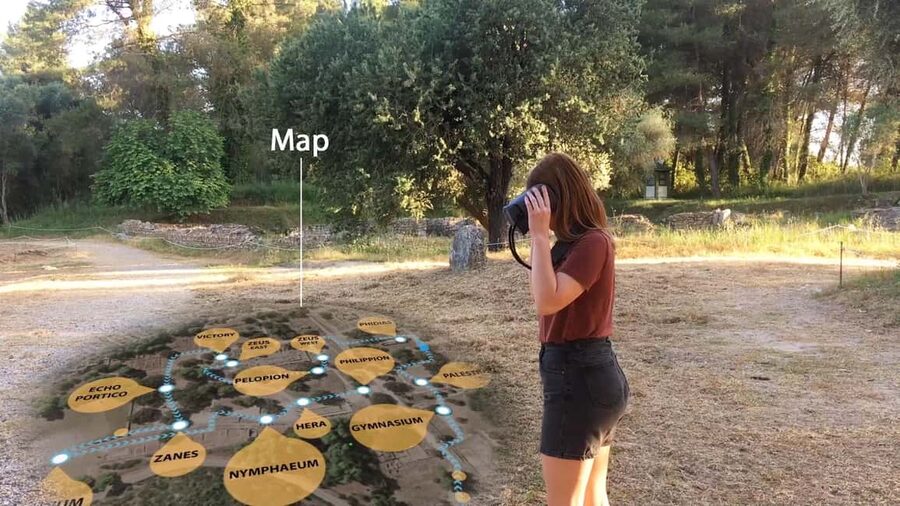
A virtual map helps guide you through the archaeological site. The route is designed to lead you from one monument to the next, and the audio begins as you reach the relevant areas.
Most of the time, the system should make the site easier to follow. Still, GPS is not flawless. The glasses may occasionally fail to recognize your position, or they may need to be reoriented. The practical fix is simple: stop, follow the instructions from the office, and give the display a moment to adjust.
If the glasses shut down, wait for them to restart and follow the support instructions. Technical support and information are included, so you are not left to solve every problem alone. The staff are also available at the office before and after your walk.
For the smoothest visit, start with the outdoor archaeological site while you have the equipment. If you are also visiting the museum and have a fixed return time, it is easy to lose track of the two-hour slot. The glasses are most valuable in the open ruins, where the reconstruction changes how you read the site.
Price, timing, and practical value
At $28.23 per person, this is not just an admission ticket. Entrance to the archaeological site is separate, so include that extra cost in your budget. You are paying for the glasses, the audio guide, the demonstration, technical help, and a self-guided route through fifteen monuments.
I think the value is strongest if this is your first visit to Olympia or if ancient ruins often blur together for you. The technology turns the site into a connected story and may save you the cost of hiring a private guide. It is less useful if you mainly want a quiet walk among the ruins with no added commentary.
The stated duration is two hours. Check the available starting times when booking, and remember that the office is away from the archaeological entrance. Returns between 1:30 pm and 3:00 pm are not available because of the provider’s working schedule, so plan your day around that restriction.
You can cancel up to 24 hours ahead for a full refund, and the reserve-now, pay-later option keeps your plans flexible. Late arrivals of more than 45 minutes without contacting the team are canceled without a refund.
Who should choose this Olympia tour?
I would choose this experience for families, first-time visitors, and anyone who wants the ruins explained without joining a large group. Children can follow the athletes and reconstructed buildings, while adults can listen to the history at their own pace.
It also suits visitors arriving on a tight schedule, provided you allow time for the office walk and equipment return. The route is self-guided, so you are not waiting for a group to gather at each monument.
You may prefer a traditional guide if you want a live conversation, detailed questions answered on the spot, or a slower discussion of archaeology. You may also want to skip the glasses if you find wearable screens distracting. The audio and VR route require you to divide your attention between the digital display and the uneven outdoor site.
Should you book the VR experience?
Yes, if you want to understand what Olympia looked like before its buildings became ruins. The Temple of Zeus, Phidias Workshop, Ancient Stadium, and Olympic Flame sequence give the visit a clear shape, while the map and audio let you explore independently.
Book it with three rules in mind: collect the glasses early enough, wear comfortable shoes, and keep a little patience for GPS adjustments. The technology is not perfect, but it does something important. It gives scale, movement, and purpose to a site that can otherwise be difficult to read.
If you want the most from Ancient Olympia for about two hours, this is a strong choice. If you want only silent contemplation or a live scholar-led discussion, choose another format.
FAQ
How long does the Olympia VR tour last?
The activity lasts two hours. Check availability for the starting times offered on your date.
Where do I meet the host?
Meet at the Olympia Back in Time office on Olympia’s main street, across from the church. You can search for Olympia Back in Time on Google Maps.
Does the tour include admission to the archaeological site?
No. Admission tickets to the archaeological site are not included in the activity price.
What does the tour include?
It includes rental of the virtual reality glasses, an audio guide, a live demonstration, technical support, and information.
Which languages are available for the audio guide?
The audio guide is available in Greek, English, French, German, Spanish, Italian, and Dutch.
Which languages are available from the instructor?
The instructor can provide the live explanation in English, French, or Greek.
Do I need identification?
Yes. A passport, driving licence, or ID card is required as a deposit for the equipment.
Is the activity wheelchair accessible?
Yes, the activity is listed as wheelchair accessible.
What should I bring?
Bring comfortable shoes and a passport or ID card for the equipment deposit.
Can I cancel the booking?
You can cancel up to 24 hours in advance for a full refund. Late arrivals of more than 45 minutes without contacting the provider are canceled without a refund.
More Audio Tours in Greece
- Athens: Acropolis Museum Ticket with optional Audio Guide
★ 4.4 · 2,652 reviews - Athens: Acropolis Ticket & Optional Self-Guided Audio Tours
★ 4.1 · 2,542 reviews - Parthenon & Acropolis Museum with Audio or Live Tour Option
★ 4.1 · 2,446 reviews - Crete: Knossos Palace Entry Ticket with Optional Audio Guide
★ 3.9 · 2,251 reviews
Just added in Greece
- Lindos: Submarine Cruise with Swimming Stop at Navarone Bay★ 4.7 · 120 reviews
- Lefkada Kayak : Explore Blue Cave with a Taste of Greece★ 5.0 · 149 reviews
- BL | A boat Trip To Blue Lagoon★ 5.0 · 211 reviews
- Agios Nikolaos: Spinalonga PM Catamaran Cruise with Dinner★ 4.8 · 88 reviews
- Catamaran Semi Cruise Paros Antiparos includes Food and Drinks★ 5.0 · 208 reviews
- Ouranoupoli: Mount Athos Peninsula Sightseeing Cruise★ 4.3 · 305 reviews
- Rhodes Wine & Food Tour: 10 Meal Course Lunch, Wine Tasting, Cooking Class★ 5.0 · 109 reviews
- Chalkidiki: Blue Lagoon & Ammouliani Island Cruise & Lunch★ 4.6 · 269 reviews
Ancient Olympia Tours, compared.
4-Day Classical Greece Tour: Epidaurus, Mycenae, Olympia, Delphi, Meteora
Read our review →
Ancient Olympia: Archaeological Site and Museum Entry Ticket
Read our review →
Katakolo Port: Transfer to Ancient Olympia and VR Audio Tour
Read our review →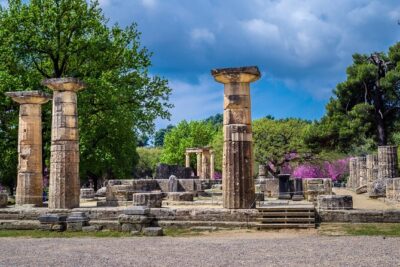
Ancient Olympia Half-Day Tour from Katakolo Cruise Port
Read our review →
Browse the lists this tour appears in