
Reviewed · ANCIENT CORINTH, MYCENAE & NAFPLIO TOURS
Ancient Corinth, Mycenae, Epidaurus, Nafplio full day private tour from Athens
Mycenae’s Lion Gate, the theater at Epidaurus, and the cliffs of the Corinth Canal pack more than 3,000 years of Greek history into one long day. You’ll also get time in Nafplio, a handsome harbor town that gives the ancient ruins a welcome change of pace. This is the Peloponnese in fast-forward.
I like the private car and flexible schedule, especially when summer heat makes a cool vehicle, bottled water, and Wi-Fi feel less like extras and more like basic survival gear. I also like the local drivers, including names such as George, Panos, Spiros, Notis, and Michael, who add stories and practical advice between the sites.
The trade-off is simple: this is a packed day with several archaeological stops and plenty of uneven ground. You’ll see a remarkable amount, but you won’t have the leisurely pace of a multiday visit. Entrance fees are also extra, and the drivers cannot guide you inside the ruins unless you arrange a licensed guide.
Key points to know before booking
- A private 9 to 10 hour day: Your group travels alone, with hotel, airport, or port pickup and return.
- Four major destinations: See Corinth, Mycenae, Epidaurus, and Nafplio in one outing from Athens.
- Excellent driver support: English-speaking drivers provide historical commentary but are not licensed site guides.
- Optional Greek lunch: Add a traditional meal, often arranged at a local restaurant in or near Nafplio.
- Extra entrance costs: Budget €15 for Ancient Corinth, €20 for Mycenae and the Treasury of Atreus, and €20 for Epidaurus.
- Bring sturdy shoes: Mycenae and Corinth involve hills, rocks, and uneven walking surfaces.
Why this private Peloponnese day trip works
This experience is built around convenience. Your driver collects you at your Athens hotel, apartment, airport, or port, then handles the long road loop through the northeastern Peloponnese. You avoid figuring out regional buses, parking, and several separate taxi rides.
The vehicle is air-conditioned and includes Wi-Fi and bottled water. That matters in July and August, when temperatures can reach the upper 90s or higher. Several stops expose you to full sun, so returning to a cool car between sites is a genuine comfort.
The private format also gives you room to adjust the day. Pickup time is flexible, and the schedule can be shifted when conditions require it. A cruise passenger with a delayed ship, for example, was able to adjust the plan. Your driver may also suggest a small extra stop if time and road conditions allow, but the four main destinations remain the heart of the day.
The most important limitation is the driver’s role. Drivers such as George, Panos, Spiros, and Notis are praised for their English, safe driving, local knowledge, and historical stories. They do not enter the archaeological grounds as licensed guides. You will generally receive an introduction before entering, then explore the monuments on your own unless you request a licensed guide in advance and one is available.
More Peloponnese days from Athens:
- From Athens: Mycenae, Epidaurus & Nafplio Full Day Trip
★ 4.8 · 2,438 reviews - From Athens: Mycenae, Epidaurus & Nafplio Full-Day Tour
★ 4.5 · 1,580 reviews - From Athens: Ancient Corinth Day Trip with Canal & VR Guide
★ 4.6 · 1,073 reviews
Crossing the Corinth Canal
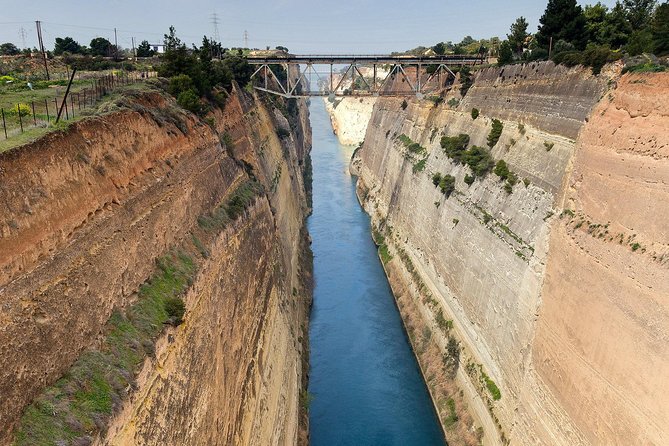
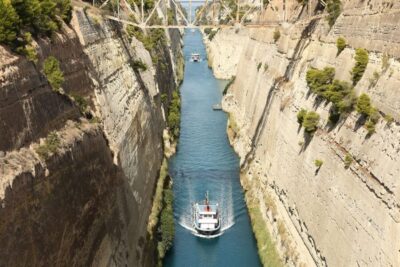
The first stop is the Corinth Canal, about 6.4 kilometers long and only 21.4 meters wide at its base. It cuts through the Isthmus of Corinth, separating the Peloponnese from mainland Greece and linking the Gulf of Corinth with the Saronic Gulf.
You’ll stop at a high viewpoint for about 15 minutes. From here, the canal looks almost impossibly narrow, with steep limestone walls dropping toward the water. Boats sometimes pass below, making the scale easier to understand.
This is a quick photo stop, not a full attraction visit. Fifteen minutes is usually enough. The canal’s engineering story is interesting, but the viewpoint itself does not require a long stay. If you are trying to shorten the day, this is one of the few stops that can be handled quickly without losing much.
Ancient Corinth and the Roman world
Ancient Corinth gives you the first substantial archaeological visit, usually about an hour, followed by time in its museum. Corinth occupied a powerful position on the narrow isthmus between northern Greece and the Peloponnese. Its location helped make it wealthy, strategic, and politically important.
The city you see today reflects several eras. Rome destroyed Corinth in 146 BC, then rebuilt it in 44 BC. The Roman city later became the provincial capital of Greece. Corinth is also tied to Saint Paul, who lived and preached here, making the site especially meaningful if you have read the New Testament.
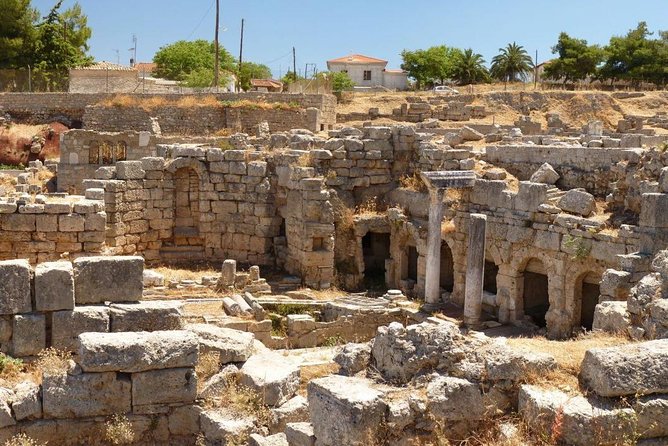
Look for the remains of the agora, the Lechaion Road, the Basilica, the Fountain of Peirene, the theater, and the Odeon. The Archaeological Museum of Ancient Corinth helps put the scattered stones into context, with objects from the excavations displayed inside the archaeological area.
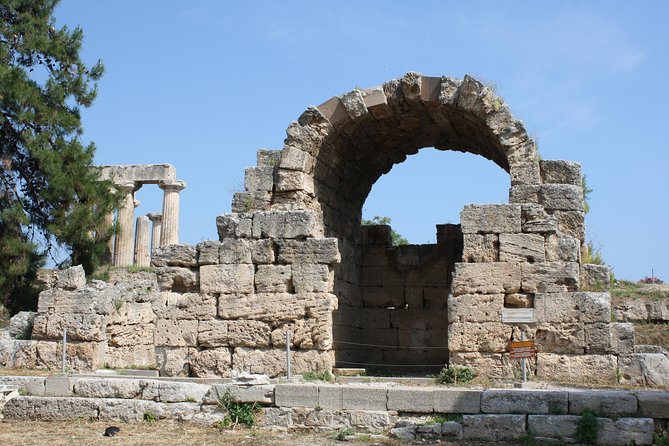
The Temple of Apollo is the visual star. Built around 550 BC, its surviving columns are among the clearest reminders of the earlier Greek city. The tour description gives the temple its own short stop, but in practice it forms part of your Ancient Corinth visit.
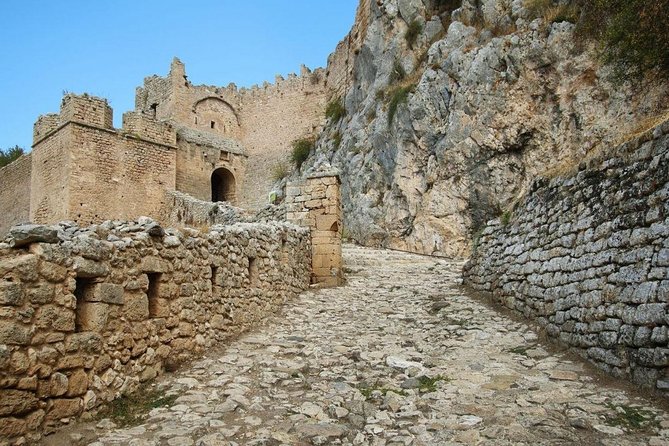
The entrance fee for Ancient Corinth and its museum is €15 per person. That is not included in the tour price, so keep cash or a payment card ready. If you want to climb to Acrocorinth, ask your driver about timing. One possible version of the day includes it, but the ascent is steep, rocky, and slippery in wet weather. Reaching the upper fortress can take a couple of hours, so it does not fit easily into a packed schedule.
Mycenae, Agamemnon, and the Lion Gate
Mycenae is the emotional center of the day for many people. The fortified citadel sits high above the surrounding countryside, and its walls, tombs, and gateway connect archaeology with the stories of Homer.
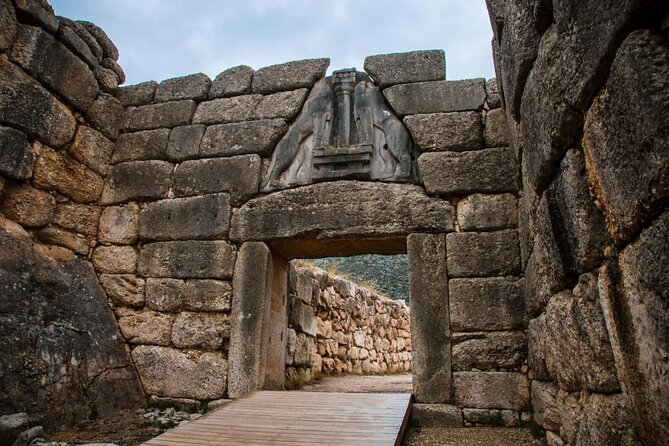
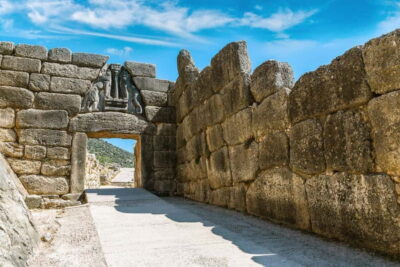
You enter through the Lion Gate, built around 1250 BC. Above the entrance, two lions or lionesses face one another beneath a triangular relief. It is the only surviving monumental sculpture of Mycenaean Greece and remains one of the most memorable entrances in the ancient world.
The walls are called Cyclopean because later Greeks believed only the Cyclopes could have moved such enormous stones. The citadel reached its height around 1350 to 1200 BC, when Mycenae controlled a wide area of southern Greece and influenced places as far away as Crete, the Cyclades, and parts of southwest Anatolia.
Give yourself time to walk beyond the gateway. The site includes the acropolis, funerary areas, habitation remains, and views over the surrounding hills. The ground is uneven and the route rises and falls. You will get more from the visit if you slow down near the walls and imagine the citadel as a working fortified center rather than a collection of ruins.
The small Archaeological Museum of Mycenae sits near the entrance, just before the Lion Gate. It displays objects that help explain burial customs, architecture, and daily life. The museum is compact, so it does not take long, but it is worth entering if you want more than photographs.
The Treasury of Atreus, also called the Tomb of Agamemnon, is a separate highlight. This beehive-shaped tholos tomb was built around 1250 BC. Its huge stone lintel weighs about 120 tons, an astonishing piece of Bronze Age construction. The tomb is dark and austere inside, while the approach gives you a clear sense of the engineering involved.
The combined entrance for Mycenae, its museum, and the Treasury of Atreus is €20 per person. The official stop times are fairly short, so ask your driver to help protect enough time for the Lion Gate and the tomb. Mycenae is too good to rush past in pursuit of every minor stop.
A few more things to do in Athens worth a look
- All Day Cruise -3 Islands to Agistri,Moni, Aegina with lunch and drinks included
★ 5.0 · 4,958 reviews - From Athens: Delphi Full Day V.R. Audio Guided Tour
★ 4.6 · 3,028 reviews - Athens Full Day Private Tour
★ 5.0 · 2,903 reviews - Athens Greece Full Day private tour
★ 5.0 · 785 reviews
Epidaurus and the perfect ancient theater
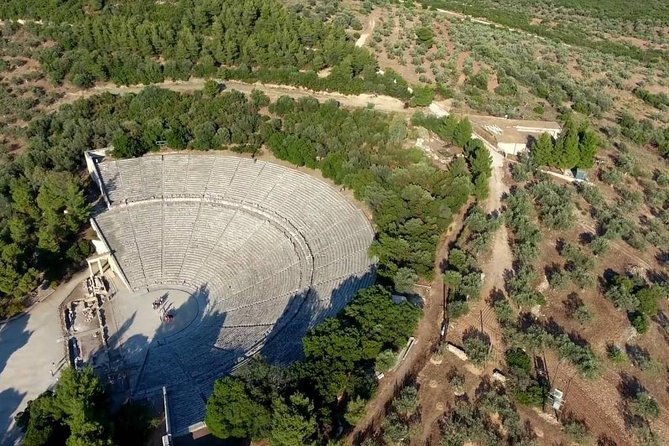
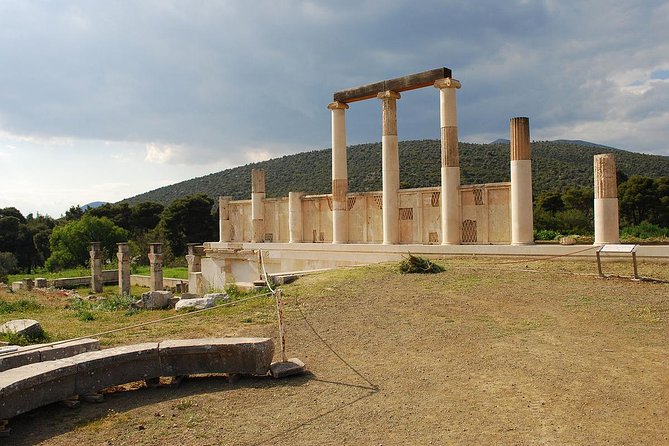
Epidaurus changes the mood. After the fortress and tombs of Mycenae, you enter a sanctuary devoted to Asclepius, the ancient Greek god of medicine. People came here seeking healing, and the sanctuary once included temples, treatment areas, athletic facilities, and places for rest.
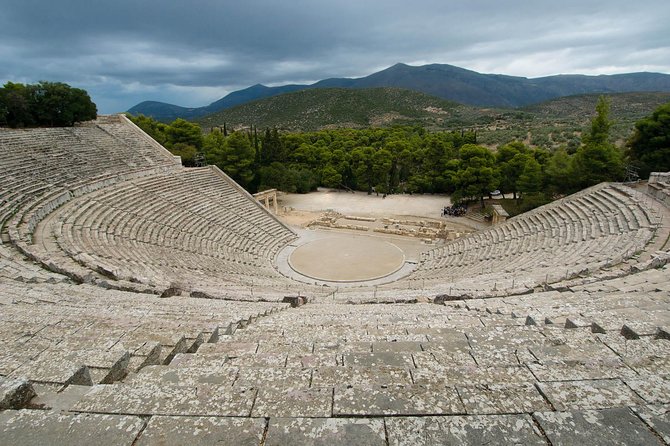
The Ancient Theatre of Epidaurus is the star attraction. Built in the fourth century BC and later enlarged, it is famous for its balance, clean design, and remarkable acoustics. Stand near the center of the orchestra and speak quietly. Someone sitting high in the stone seats may still hear you.
The theater retains its classic three-part structure: the seating area, the circular orchestra, and the stage building. Unlike many Greek theaters, it was not heavily changed during Roman times. That helps explain why its shape feels so complete.
The Archaeological Museum of Epidaurus displays columns, inscriptions, architectural pieces, and reconstructions from the sanctuary. The museum is useful because the site itself is spread across a broad area, and many of the original buildings are now reduced to foundations.
The listed visit gives roughly 30 minutes to the museum, 30 minutes to the theater, and 15 minutes to the Sanctuary of Asclepius. That is enough for a strong overview, but not enough to examine every corner. The entrance fee for Epidaurus and its museum is €20 per person.
Nafplio gives the day breathing room
Nafplio is the reward after the archaeological sites. The town served as the capital of the First Hellenic Republic and the Kingdom of Greece from 1821 to 1834. Venetian and Ottoman influence remains visible in the architecture, fortifications, harbor, and street plan.
You get about 90 minutes here for lunch, coffee, shopping, or a walk beside the water. I recommend using the time for a proper meal rather than treating Nafplio as another rushed photo stop. The optional traditional Greek lunch is a useful upgrade, and drivers have recommended restaurants with seaside settings and accommodating service.
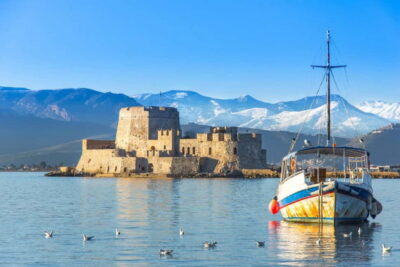
The harbor gives you a clear view of Bourtzi, the small Venetian fortress built on an island in the bay. You will not tour the interior on this visit, but the view from the waterfront is photogenic, especially with the mountains behind the town.
Acronauplia forms the oldest part of Nafplio. Its fortifications once enclosed a separate town before the Franks and Venetians expanded the defenses. A hotel complex now occupies part of the old prison area, and the heights provide views across the harbor.
Palamidi Castle rises above the town on a 216-meter hill. The fortress was built by the Venetians during their second period of rule, from 1686 to 1715. It commands wide views over Nafplio and the Argolic Gulf.
The famous staircase from town is often counted as 913 steps, though local tradition says there are 999. The tour generally allows about 30 minutes at Palamidi, so you should not plan to climb from the waterfront and explore every bastion in that time. If you want the fortress to be a major part of your visit, confirm how you will reach it and how much time can be assigned.
Price, entrance fees, and real value
The listed price is $265.70 per person. That is a serious cost, but the value depends on how many people share the vehicle and how much you value time.
For a couple, the price buys private transport, hotel pickup and return, air-conditioning, water, Wi-Fi, and a full day covering places that are difficult to combine by public transport. For a family or small group, the per-person cost may compare more favorably with arranging several taxis or booking separate excursions.
Plan on another €55 per person for the three sets of entrance fees if you visit all the included archaeological sites and museums. Lunch is optional, so the final cost depends on the meal you choose. A licensed guide is also extra if you want formal guiding inside each site.
The strongest value is convenience and coverage, not depth at every monument. You can see Corinth, Mycenae, Epidaurus, and Nafplio in a single day, but a specialist history guide or a multiday Peloponnese trip would give you more time at each place.
Who will enjoy this day most
This tour suits you if you have limited time in Athens and want one major day outside the city. It is also a good choice if you are arriving by cruise ship or prefer not to drive unfamiliar Greek roads.
You should be comfortable with a long day, repeated vehicle transfers, heat, and uneven stone paths. Mycenae and Corinth include hills and rough surfaces, and Acrocorinth is particularly demanding. If mobility is a concern, discuss the stops with the operator before booking.
The private format is useful for families, couples, and groups with different interests. One person can spend longer at the museum while another takes photographs, provided the overall schedule still works. Your driver can also help rearrange stops when timing changes.
The tour is offered in English. Confirmation is provided at booking, and cancellation is free up to 24 hours before the start time. Changes made later are not accepted, so check your schedule carefully.
Should you book the Corinth, Mycenae, Epidaurus, and Nafplio tour?
Book it if you want a wide view of the Peloponnese in one day, value door-to-door transport, and like having a local driver who can explain the countryside and adjust the pace. The combination is unusually strong: Roman Corinth, Bronze Age Mycenae, a Greek healing sanctuary, a world-famous theater, and elegant Nafplio.
Skip it if you want slow archaeological study, a licensed guide at every site, or a relaxed lunch with no clock to watch. This is a full day, and the entrance fees add up.
For most first-time visitors with only a few days in Athens, I think the tour earns its price. Choose the lunch option if you want the day to feel less mechanical, wear firm walking shoes, and ask for the longest practical visit at Mycenae. That small bit of planning will help turn a very busy day into a rewarding one.
FAQ
How long does the private tour last?
The tour lasts approximately 9 to 10 hours.
Does the tour include hotel pickup and drop-off?
Yes. Pickup and return are available at Athens hotels, apartments, the airport, or the port. The pickup time can be adjusted on request.
Is the tour private?
Yes. Only your group participates in the vehicle and tour.
Are entrance fees included?
No. Ancient Corinth and its museum cost €15 per person, Mycenae, its museum, and the Treasury of Atreus cost €20, and Epidaurus and its museum cost €20.
Is lunch included?
A traditional Greek lunch is available as an upgrade. The tour also provides free time in Nafplio for lunch, coffee, or shopping.
Is the driver a licensed tour guide?
No. The drivers are English-speaking and can provide historical commentary, but they are not licensed to accompany you inside the archaeological sites. A licensed guide may be requested, subject to availability.
Just added in Athens
- Ceramic and Pottery Creative Workshop with Two Local Artists★ 4.0 · 57 reviews
- Small-Group Women History in Ancient Greece Walking Tour★ 5.0 · 38 reviews
- Athens Old City Private Photoshoot Tour / 2 hrs★ 5.0 · 109 reviews
- Athens: Wine Workshop Create your Own Wine under the Acropolis★ 5.0 · 77 reviews
- Athens: Greek Wines Tasting with Sommelier and Acropolis Views★ 5.0 · 88 reviews
- Wine Trails Private Tour/ Nemea visit 3 wineries from Athens or Nafplion (10 h)★ 5.0 · 44 reviews
- FLYING DRESS Photoshoot in Athens – Greece★ 5.0 · 47 reviews
- Small-Group Wine Tour in Athens with Tasting★ 5.0 · 33 reviews
Ancient Corinth, Mycenae & Nafplio Tours, compared.
Ancient Corinth Day Trip with Canal & VR Guide
Read our review →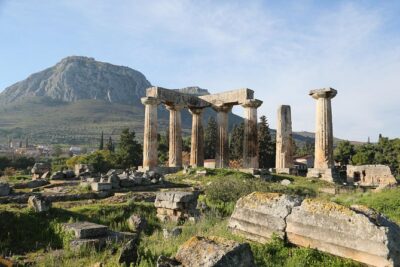
Private Biblical Tour Ancient Corinth & Isthmus Canal from Athens
Read our review →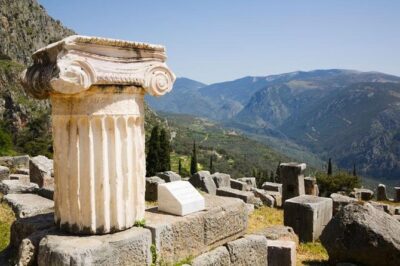
4-Day Classical Greece Tour: Epidaurus, Mycenae, Olympia, Delphi, Meteora
Read our review →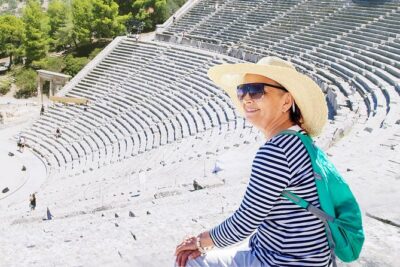
Ancient Corinth & Nafplio Full Day Trip with Swim
Read our review →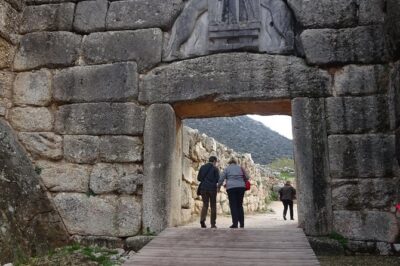
Mycenae and Nafplion Day Trip from Athens with Official guide
Read our review →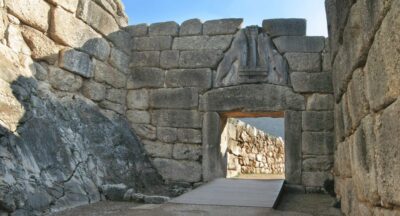
Browse the lists this tour appears in