
Reviewed · HISTORICAL TOURS
Athens: History of Rebellion Walking Tour
Athens is more than ancient stones and sunny viewpoints. This walking tour follows the city’s long story of resistance, from opposition to Ottoman rule and the Greek Revolution to fascism, police violence, protest movements, and the social struggles shaping Exarchia today. Guide Maelle connects famous squares with lesser-known places and asks you to think about who gets remembered, who gets ignored, and how a city carries its past.
I like two things in particular: the clear link between history and present-day Athens, and the chance to explore Exarchia with context instead of treating it as a colorful backdrop. Maelle’s personal recommendations for food, shopping, sights, and other Greek destinations are a useful bonus.
The main consideration is the subject matter. This is a political and socially engaged tour, not a neutral list of dates and monuments. You will also walk and stand for two to three hours, and the route is not suitable for people with mobility impairments.
Key points to know before booking
- The route runs from Monastiraki to Exarchia, connecting Ottoman-era Athens, Syntagma Square, the Parliament, the Academy, and a neighborhood known for activism.
- Maelle leads the experience in English or French, with a warm, personal style and plenty of room for questions.
- Modern Greek history gets the main attention, including resistance, fascism, protest, police repression, and struggles for social justice.
- Small groups and private bookings are available, which suits a discussion-based tour better than a large sightseeing walk.
- The tour costs $44.04 per person and lasts about 2.5 hours, a reasonable price if you want political and social context rather than standard ancient-history sightseeing.
- Wear good shoes and bring water, sunscreen, and a sun hat, since much of the experience takes place outdoors.
Why this is a different Athens walking tour
Most first-time visits to Athens focus on the Acropolis, the Agora, temples, and marble statues. Those places matter, but they can leave you with an incomplete picture of the city. Athens is also a place shaped by occupation, revolution, dictatorship, migration, protest, and constant arguments about power.
This tour gives those subjects the main stage. You begin in Monastiraki, one of the city’s busiest central areas, and move toward Syntagma, the symbolic heart of modern protest. From there, the route continues through Kolonaki and past the Academy of Athens before reaching Exarchia.
That progression is useful. You start with national history, then move toward the public spaces where political events unfolded, and finish in a neighborhood where activism remains part of daily life. Instead of treating history as something locked inside a museum, the tour asks you to notice how it appears in streets, squares, monuments, graffiti, and community spaces.
This is also a good way to get beyond the usual tourist version of Greece. The focus is not only on celebrated leaders or official national stories. You hear about ordinary people, social movements, and individuals whose work may not appear in standard guidebooks.
A few more things to do in Athens worth a look
- Historical Delphi One Day Tour with Arachova Stop & Expert Guide
★ 4.5 · 1,247 reviews - Historic Athens: Small Group Electric Bike Tour
★ 4.9 · 740 reviews - The History of Athens: Greek Mythology Private Tour
★ 5.0 · 138 reviews
Starting in Monastiraki and looking back to Ottoman Athens
Meet in Monastiraki Square, in front of Pantanassa Church. Your guide carries a sign reading Athens City of Rebellion, so the meeting point should be straightforward to find.
The tour begins with Monastiraki itself and the period when Athens was under Ottoman rule. The area is now full of shops, food stalls, passersby, and archaeological reminders, but the opening discussion shifts your attention from shopping and sightseeing to the city’s earlier struggles.
Here you begin to understand the forces that led to the Greek Revolution roughly 200 years ago. The value of this section is not simply learning a few dates. It gives you a starting point for understanding how ideas about independence, identity, authority, and freedom developed in Greece.
The next stop is the Metropolitan Church of Athens, which you pass rather than enter. A shorter stop at a lesser-known location adds another layer to the story. The exact focus can vary with the guide and group discussion, but the route is designed to show that important history does not always come with a large sign or a famous facade.
Expect some standing while Maelle explains the setting. Monastiraki can be busy, so this is not a quiet, museum-like start. That is part of the point: you are hearing about political change in the middle of a living city.
Syntagma Square, Parliament, and the public life of protest
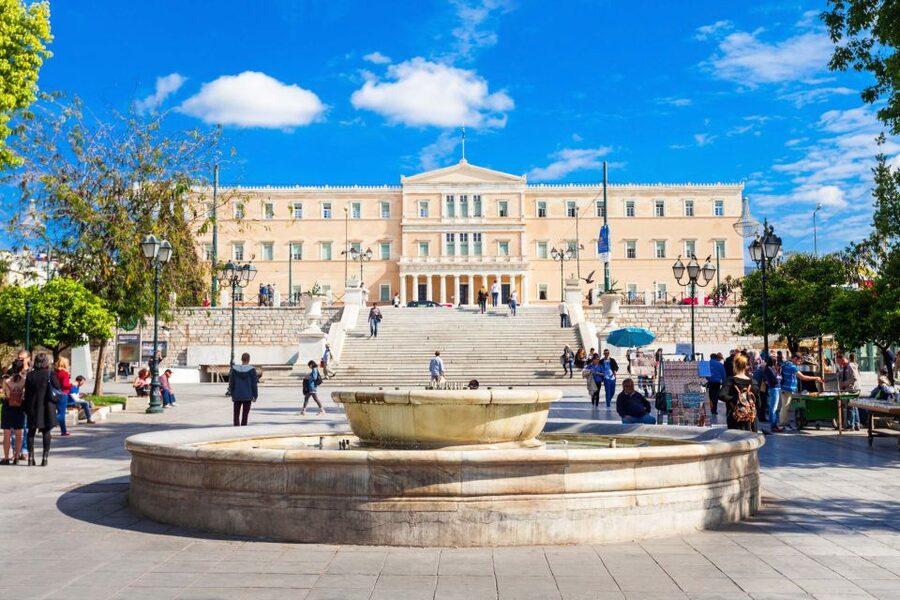
From Monastiraki, you walk toward Syntagma Square. The route takes you past the Metropolitan Church and through central Athens, with stops for stories about people who became symbols of resistance and movements that pushed for freedom under harsh conditions.
Syntagma is one of the most important places on the tour. It is the setting for major demonstrations and public gatherings, and it helps explain how the modern Greek state is experienced by people in the city. You look at the square not only as a central landmark but as a stage for political pressure.
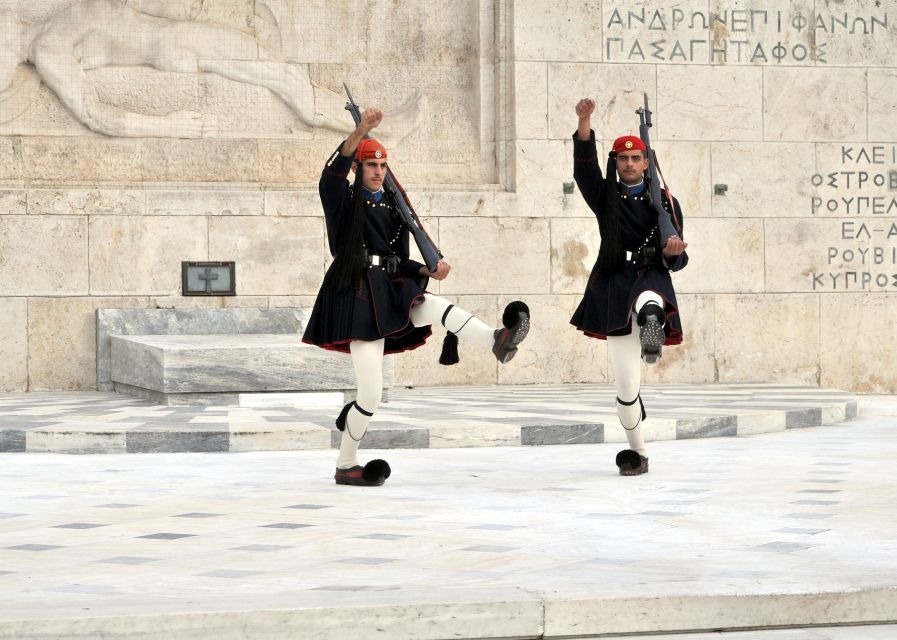
The Hellenic Parliament and the Tomb of the Unknown Soldier add an official side to that story. These sites represent the state, national memory, and public ceremony. The tour places them alongside accounts of popular resistance, which creates a useful contrast between official power and pressure from below.
The short stop at the Tomb of the Unknown Soldier is not meant to replace a formal monument visit. Instead, Maelle uses the location to explain how nations remember sacrifice and how public symbols can carry different meanings for different groups.
You then pass through Kolonaki before reaching the Academy of Athens. This section gives the walk some visual variety, but it also reinforces the contrast between grand institutions and the less formal movements discussed throughout the tour.
The Academy and the gap between official history and lived experience

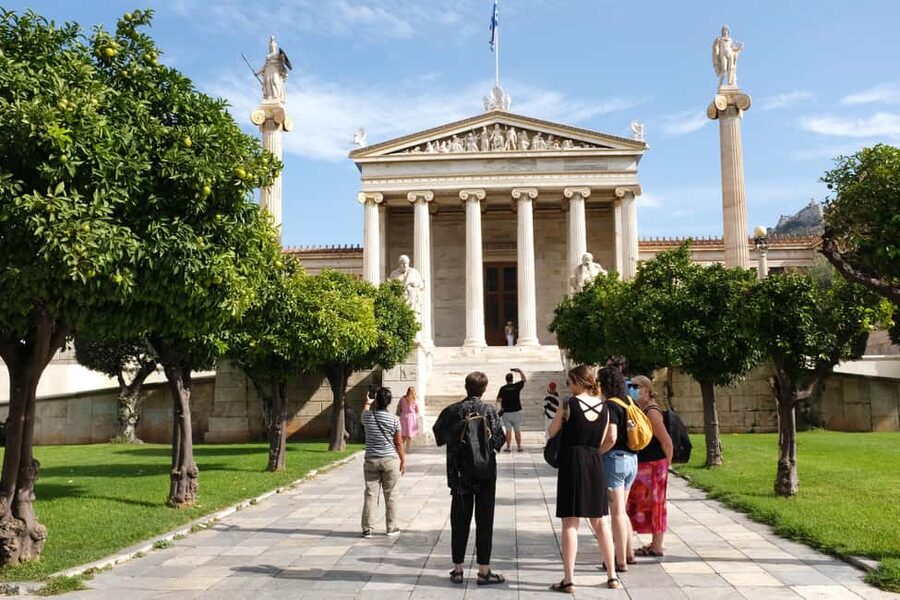
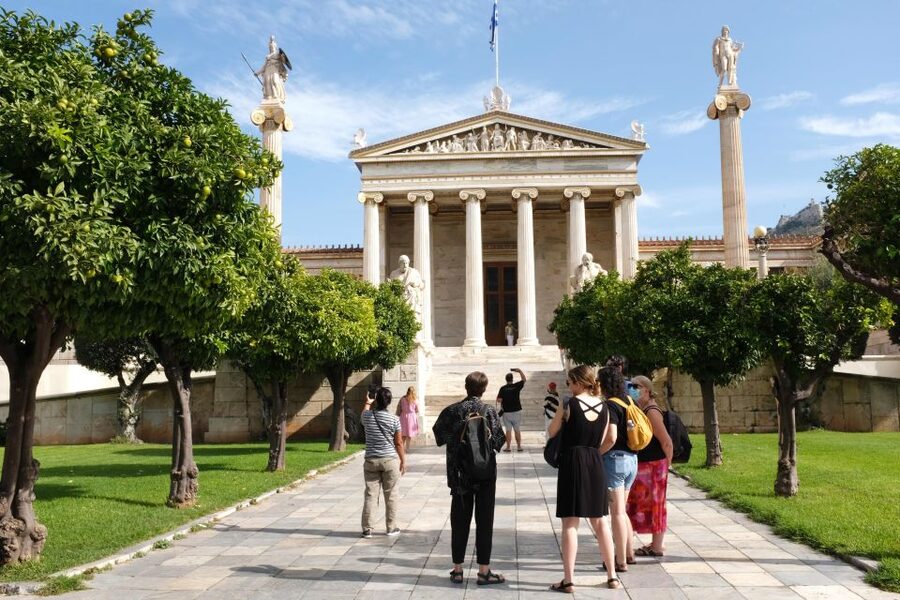
The Academy of Athens is one of the route’s more formal architectural stops. It offers a chance to talk about education, national identity, intellectual life, and the way a country presents itself.
I like this part because it adds balance. The tour is not only about street protest or radical politics. It also looks at the institutions that shape public ideas and national memory. The Academy’s imposing setting can prompt useful questions about whose version of history receives space, prestige, and authority.
The walk does not turn into an architecture tour, and that is important to understand before booking. You are not visiting each monument in depth or spending long periods inside buildings. Instead, the sites serve as physical reference points for a wider discussion about Greek society and political change.
Maelle’s approach is conversational. She explains the background, invites questions, and connects the location to larger issues. Several parts of the experience are designed to leave you thinking rather than simply collecting facts. That may appeal to you if you enjoy history that continues into the present, but it may feel less satisfying if you want a tightly dated lecture or a classic sightseeing checklist.
Same base, a completely different day:
- Athens: Acropolis & up to 5 Archaeological Sites Combo Pass
★ 4.4 · 12,619 reviews - Athens: Acropolis Ticket with Optional Audio or Live Guide
★ 4.2 · 11,055 reviews - Athens: Acropolis, Parthenon & Acropolis Museum Guided Tour
★ 4.8 · 9,316 reviews - Athens: Cape Sounion & Poseidon Temple Sunset Half-Day Trip
★ 4.8 · 8,241 reviews
Entering Exarchia, Athens’s center of activism
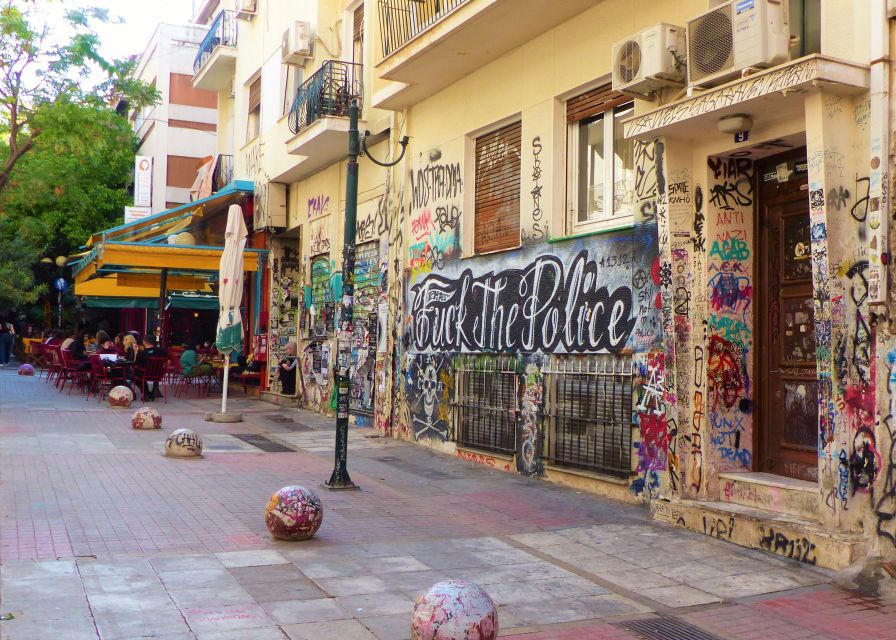
The final portion takes you into Exarchia, a culturally mixed neighborhood associated with anarchists, refugees, artists, LGBT+ residents, students, and social movements. The tour treats Exarchia as a community with a complicated identity, not as a stop for quick photographs.
You visit Exarchia, a secret stop, another lesser-known location, and Exarchion Square. At each place, Maelle explains how the neighborhood’s political culture developed and how residents have confronted police repression, gentrification, and pressure on collective ways of life.
This is where the tour becomes most distinctly local. Exarchia is not presented as a theme park of rebellion. The guide’s role is to help you understand the people and disputes connected to the area while respecting that this is a real neighborhood where people live and work.
You may see street art and signs of political expression, but the purpose is not simply to point out eye-catching walls. Maelle uses public art and the streets themselves to encourage questions about who controls public space and how political ideas become visible.
The discussion includes social justice and the lives of groups that are often left out of conventional city tours. That includes refugees and LGBT+ communities, as well as people involved in anarchist and collectivist movements. The emphasis is explanatory rather than sensational.
Exarchia can be an especially useful stop if you have already seen the Acropolis and want to understand why Athens feels politically alert and socially argumentative. It also helps explain why some parts of the city resist redevelopment while others embrace new investment and tourism.
Maelle’s guiding style and the value of a small group
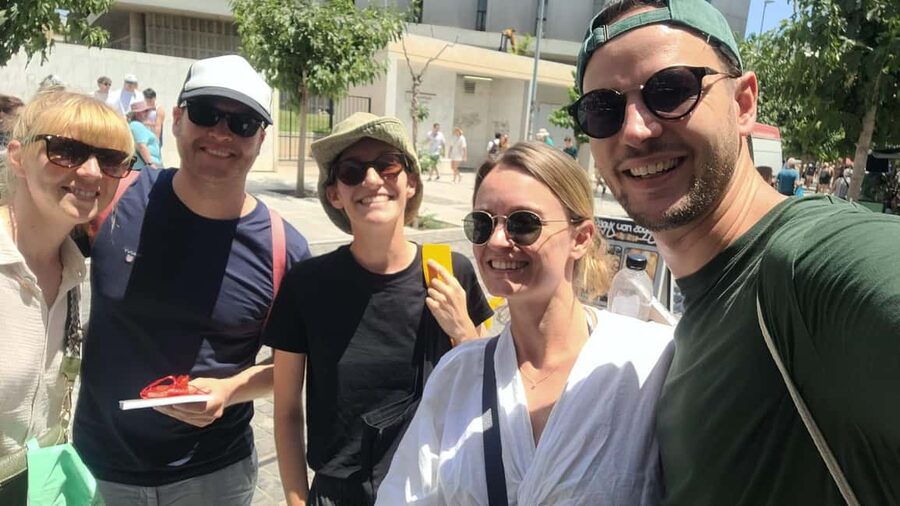
Maelle is the name that comes up repeatedly in connection with this experience. Her strengths are warmth, clarity, humor, and a serious interest in modern Greek history. She is comfortable discussing politics and social movements, but she also makes room for everyday questions about Greek life, food, neighborhoods, and local customs.
The format matters. Small groups and private bookings are available, and this is the sort of tour that benefits from conversation. You can ask about a political event, a piece of street art, or something you noticed during your visit. In a large group, that kind of exchange would be harder.
Past experiences with Maelle have also included practical suggestions for restaurants, shopping, sights, Athens neighborhoods, and Greek islands. I would treat those recommendations as an extra benefit rather than the main reason to book, but they can help you shape the rest of your stay.
The tour is offered in English and French. If you want a guide who simply delivers a memorized speech, this may not be the best match. If you prefer a thoughtful conversation that connects the past with present-day questions, the format should suit you well.
What $44.04 buys you
At $44.04 per person, this is not the cheapest way to spend a morning or afternoon in Athens. You are paying for a 2.5-hour guided walk, not admission to a major archaeological site. There is no museum ticket, meal, or transport included.
The value comes from interpretation. You can walk through Monastiraki, Syntagma, Kolonaki, and Exarchia on your own, but the connections between those places are much harder to build without local guidance. The tour gives you a framework for understanding modern Greece, not just a route through central Athens.
I think the price is fair if you care about politics, social history, community life, or the modern Greek state. It is less compelling if your main goal is ancient archaeology or famous landmarks. In that case, put your money toward a specialized Acropolis or ancient-history tour instead.
The availability of private and small-group formats also affects the value. A private experience can make the discussion more personal, while a small group may give you a good balance of conversation and cost.
Practical advice for the 2.5-hour walk
Wear comfortable shoes. You will be walking between central neighborhoods and stopping on foot, with a total experience of about two and a half hours. The tour is not suitable for people with mobility impairments.
Bring water, sunscreen, and a sun hat. Athens can be hot, and the route is outdoors. There is no reason to arrive overloaded, but a small bottle of water and sun protection will make the experience easier.
The tour starts in Monastiraki Square, in front of Pantanassa Church. The supplied details give two different descriptions of the ending: the route lists Exarchion Square, while the meeting information says the activity ends back at the meeting point. Confirm the final drop-off point when you book, especially if you have a timed reservation afterward.
You can cancel up to 24 hours in advance for a full refund, and the reserve-now, pay-later option keeps your plans flexible. Starting times vary, so check availability before arranging other activities.
Who should book this Athens rebellion tour?
I would choose this tour early in an Athens visit if you want context for everything else you see. After learning about Syntagma, Exarchia, and modern Greek political life, you may look at the city’s monuments and neighborhoods with sharper questions.
It suits people interested in:
- Modern Greek history
- Political movements and social justice
- Street art and public space
- Community activism
- Refugee and LGBT+ issues
- The less formal, less polished side of Athens
- Conversation rather than a one-way lecture
It may not suit young children or anyone who dislikes political discussion. The subject can include fascism, violence, police repression, oppression, and unresolved social conflicts. The walk also requires standing and walking for two to three hours.
Should you book it?
Book this tour if you want to understand Athens as a living city shaped by arguments about freedom, memory, authority, and belonging. Maelle’s personal style, strong grasp of modern Greek history, and willingness to discuss difficult topics make the experience more than a standard city walk.
Skip it if you want ancient ruins, formal museum visits, or a light introduction with no political edge. But if the Acropolis is only one part of the Athens you came to see, this tour offers a useful and uncommon way to meet the rest of the city.
FAQ
How long does the History of Rebellion Walking Tour last?
The tour lasts 2.5 hours. The walking and standing time may amount to two to three hours, so wear comfortable shoes.
Where does the tour start?
It starts in Monastiraki Square, in front of Pantanassa Church. Your guide will carry a sign that says Athens City of Rebellion.
Where does the tour end?
The route lists Exarchion Square as the finish. The meeting information also says the activity ends back at the meeting point, so confirm the final location when booking.
What languages are available?
The tour is offered in English and French.
Who guides the tour?
Maelle is the named guide associated with this experience. She leads discussions about modern Greek history, politics, culture, and social movements.
Is this a private tour?
Private and small-group options are available. Check the booking choices for the date and time you want.
How much does the tour cost?
The listed price is $44.04 per person.
What should I bring?
Bring comfortable shoes, a sun hat, sunscreen, and water.
Can I cancel the booking?
You can cancel up to 24 hours in advance for a full refund. A reserve-now, pay-later option is also available.
Just added in Athens
- Ceramic and Pottery Creative Workshop with Two Local Artists★ 4.0 · 57 reviews
- Small-Group Women History in Ancient Greece Walking Tour★ 5.0 · 38 reviews
- Athens Old City Private Photoshoot Tour / 2 hrs★ 5.0 · 109 reviews
- Athens: Wine Workshop Create your Own Wine under the Acropolis★ 5.0 · 77 reviews
- Athens: Greek Wines Tasting with Sommelier and Acropolis Views★ 5.0 · 88 reviews
- Wine Trails Private Tour/ Nemea visit 3 wineries from Athens or Nafplion (10 h)★ 5.0 · 44 reviews
- FLYING DRESS Photoshoot in Athens – Greece★ 5.0 · 47 reviews
- Small-Group Wine Tour in Athens with Tasting★ 5.0 · 33 reviews
Historical Tours, compared.
Historical Delphi One Day Tour with Arachova Stop & Expert Guide
Read our review →
Historic Athens: Small Group Electric Bike Tour
Read our review →

Throne of Helios: The History of Rhodes in 9D Experience
Read our review →
The History of Athens: Greek Mythology Private Tour
Read our review →

Richtis Waterfall, History, Azoria, OliveTasting, NorthCoast
Read our review →Browse the lists this tour appears in