
Reviewed · HOP-ON HOP-OFF BUS TOURS
Big Bus Athens Hop-On Hop-Off with optional Piraeus & Riviera
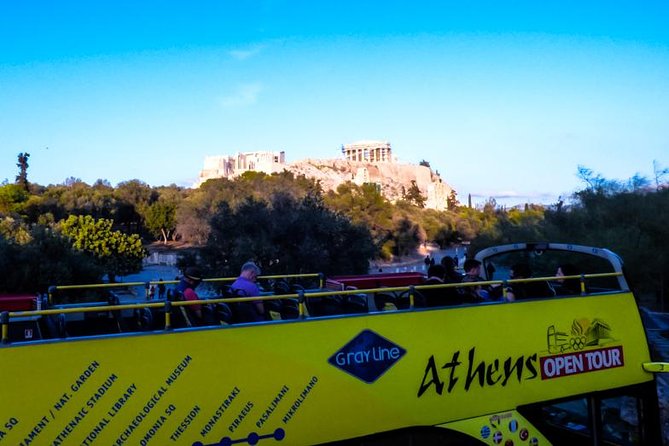
Athens is easier to understand from the top deck of a sightseeing bus, especially on your first day. This pass links the Acropolis, Syntagma Square, the National Archaeological Museum, Piraeus, and the southern coast without forcing you to master the city map at once. The three-route choice is the main attraction.
I like the freedom to hop off near the Temple of Olympian Zeus, Panathenaic Stadium, or Monastiraki Square, then continue when you are ready. I also like the frequent city service, which runs about every 20 minutes. The catch is that Piraeus and Riviera buses are much less frequent, and Athens traffic can turn a short ride into a long wait.
Key points before you board
- Three very different routes: Use the central Athens loop for major sights, the Piraeus route for the port and waterfront, and the Riviera route for beaches and Lake Vouliagmeni.
- Choose 48 or 72 hours: The longer pass makes the coastal routes more practical because they run less often.
- City buses come most often: The central route is reported to run about every 20 minutes, compared with roughly every 80 minutes to Piraeus and every two hours along the Riviera.
- Audio is useful but imperfect: Commentary comes in 14 languages, yet headphone connections and timing have been uneven on some buses.
- Staff are stationed at key stops: This helps with route changes, but always ask which bus you are boarding because the three routes do not share every stop.
- Good value at about $27.56: The pass makes sense if you use it for transport as well as sightseeing, not if you only ride one short loop.
How the Athens city route works
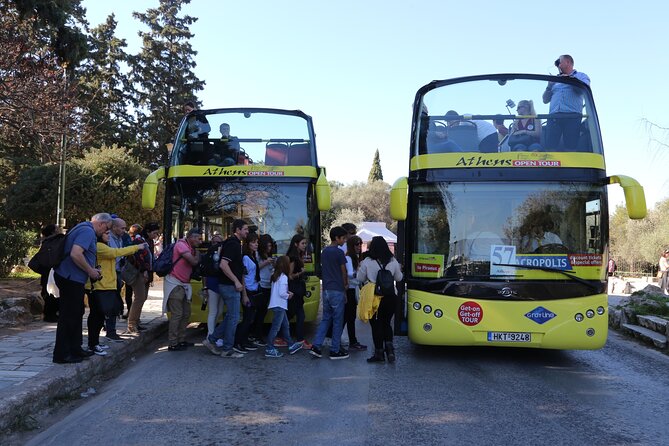
The central Athens route is the practical heart of this experience. A full circuit takes about two hours, though traffic can stretch that time. You can ride the loop once to get your bearings, then return to the stops that deserve a closer look.
The route covers the classic center: Syntagma Square, the Parliament, the Acropolis, Plaka, the Acropolis Museum, the Temple of Olympian Zeus, the Panathenaic Stadium, the National Library, Omonia, Monastiraki, and the Old Parliament. It also reaches the Benaki Museum and National Archaeological Museum.
Syntagma Square is the best place to begin if you want a clear starting point. The stop is listed at 1 Ermou Street, and the area is close to the Parliament and central shopping streets. From here, you can ride the full loop or get off near the Acropolis and begin walking.
The Parliament stop is next to the Hellenic Parliament on Vasilisis Amalias Avenue. It is a useful point for seeing the building and continuing toward the National Garden, although the bus itself does not replace a proper walk through the center.
More easy ways to cover Athens:
- Athens, Piraeus, and Coastline: Blue Hop-On Hop-Off Bus
★ 3.9 · 4,849 reviews - Athens: City Sightseeing Hop-On Hop-Off Bus Tour
★ 4.3 · 4,520 reviews - City Sightseeing Athens, Piraeus & Beach Riviera Hop-On Hop-Off Bus Tours
★ 4.0 · 1,887 reviews
Acropolis stops and the best place to get off
The tour serves more than one Acropolis area. One stop is at Plaka and the Acropolis south entrance, near Melina’s statue. Another is at the Acropolis Museum, while the main Acropolis stop is on Rovertou Galli Street near Dionysos Restaurant.
This matters because the Acropolis is not one compact attraction. The hill, south entrance, Plaka streets, and museum each require different amounts of walking. Ask the driver or stop staff which Acropolis stop fits your plan before you get off.
The bus gives you a useful look at the Acropolis from street level, but it does not include admission or a guided visit inside the archaeological site. You will need separate time for the hill, and the bus schedule should not be your only timing plan if you have a fixed entry reservation.
The Acropolis Museum stop is handy if you want a cooler, more focused look at ancient sculpture and architecture after visiting the hill. If you are trying to see both the Acropolis and museum in one short window, walking between them may be more efficient than waiting for the next bus.
Ancient Athens, museums, and historic squares
The Temple of Olympian Zeus stop is next to the temple entrance. This is one of the strongest hop-off points because the ruins sit close to the Acropolis, the National Garden, and central Athens. You can see the enormous surviving columns, then continue on foot or wait for the next bus.
The Panathenaic Stadium stop is opposite the stadium. The white marble arena is tied to the modern Olympic revival and is one of Athens’s most striking sights. It is also a convenient place to break the bus ride with a short visit.
The Benaki Museum stop is opposite the museum, while the National Archaeological Museum stop is directly in front of that institution. The latter is farther from the Acropolis core, so the bus is especially useful if you want to connect the museum with the central route instead of arranging separate transport.
The National Library and Old Parliament stops add useful context to the city beyond the ancient monuments. Omonia, Kotzia Square, Monastiraki, and Karaiskaki Square show different sides of Athens, but the bus ride through central streets can be slow. I would use these stops selectively rather than hopping off at every one.
Monastiraki, Plaka, and walking Athens
Monastiraki Square is in front of the Nike store. This is one of the most useful stops for combining bus travel with walking. From here, you can reach the Plaka area, the Roman Agora, shopping streets, and restaurants on foot.
Athens is quite walkable around the main historic center, so the bus is not always the fastest way between nearby sights. That is an important value question. I would use the bus for longer connections, orientation, and places such as the National Archaeological Museum, then walk between nearby Acropolis and Monastiraki sights.
The tour’s commentary helps you decide what deserves more time. Several audio tracks provide short facts and historical notes as you pass each area. Still, the timing can be off, and some buses have had weak headphone connections or speakers that did not work well.
Bring the supplied headphones, but test them as soon as you board. If the audio is silent or badly timed, tell staff at a major stop rather than waiting until the end of the loop.
Same base, a completely different day:
- Athens: Acropolis & up to 5 Archaeological Sites Combo Pass
★ 4.4 · 12,619 reviews - Athens: Acropolis Ticket with Optional Audio or Live Guide
★ 4.2 · 11,055 reviews - Athens: Acropolis, Parthenon & Acropolis Museum Guided Tour
★ 4.8 · 9,316 reviews - Athens: Cape Sounion & Poseidon Temple Sunset Half-Day Trip
★ 4.8 · 8,241 reviews
The Piraeus route, port access, and waterfront views
The Piraeus route begins around the Acropolis and Plaka, then runs through Pantios and Stavros Niarchos Park before reaching the port. It serves the Municipal Theatre, Cruise Terminal A at Gate 11, Cruise Terminal B at Gate 12, Pasalimani, Mikrolimano, and the Athens Marriott.
This route is especially useful for cruise passengers who want more than a quick transfer between ship and city. The cruise terminal stops are clearly tied to the two main port areas, but allow extra time. A bus that is delayed by traffic is a poor match for a tight ship departure.
Piraeus has a different feel from central Athens. The port is practical and busy, while Pasalimani and Mikrolimano offer a more relaxed waterfront setting. The route also passes Stavros Niarchos Park, a worthwhile stop if you want modern architecture, open space, and a break from ruins.
The Piraeus service is much less frequent than the Athens route, with about four departures a day and intervals around 80 minutes. Do not hop off without checking the return time. A missed bus can change a quick outing into a long wait.
The Riviera route to Glyfada and Lake Vouliagmeni
The Riviera route is the most scenic addition, but it requires the most patience. From the Acropolis and Pantios, it heads south through Flisvos Marina, Alimos Marina, Agios Kosmas, Glyfada, Kavouri, Astir Beach, Lake Vouliagmeni, and Voula.
This route lets you see a side of Athens that most first-time sightseeing plans miss. The coast is lined with marinas, beaches, hotels, and waterfront roads. Stops include Flisvos Marina, the Phaleron War Cemetery, Edem, Glyfada Beach, and several points around the southern suburbs.
Glyfada Center is a sensible stop for a break, shopping, or a meal, while Lake Vouliagmeni is the route’s most distinctive stop. Admission to the lake is not included, so check the cost before you get off. The same applies to other paid attractions along the coast.
The route takes about an hour to reach the outer coastal area, and service is reported at roughly three buses a day, about two hours apart. That makes a 72-hour pass much better for the Riviera than a short visit. You can spend time at one stop without feeling forced to run back to the bus.
The coastal road is also vulnerable to traffic. If you want a relaxed beach day, use the bus as transport only if you can accept a loose schedule. If you have a cruise departure, airport connection, or timed museum entry, do not build your day around the least frequent route.
What the audio guide and Wi-Fi add
The audio commentary is designed to give you short explanations while you pass the sights. It is available in 14 languages, and the format works well when you want background information without joining a fixed group.
The strongest use of the commentary is orientation. You can hear names, basic history, and descriptions of areas you might otherwise pass without noticing. It is also a good way to identify places you may want to revisit on foot.
The weak point is consistency. Commentary has sometimes failed to match the bus’s exact position, and faulty headphone connections can make the information hard to hear. On a warm day, the open upper deck gives you better views, but a covered lower deck may be more comfortable in strong sun or rain.
Free Wi-Fi is included. I would treat it as a useful extra for checking maps, messages, or the next stop, not as the main reason to book. The supplied headphones are also included, so you do not need to bring your own for the standard audio service.
Timing, traffic, and how to avoid confusion
The route map can feel confusing because stop numbers change from one route to another. For example, Syntagma may be Stop 1 on one route, while the Temple of Olympian Zeus is Stop 5. Use the stop name and destination, not only the number.
At major stops, staff are often available to point you toward the correct bus. Ask one direct question before boarding: Is this the Athens, Piraeus, or Riviera route? That simple check can save you a long ride in the wrong direction.
The city route is the most dependable option because it runs often. Even so, traffic may cause late buses, full buses, or long lines. One useful feature is live tracking through the operator’s app, and online chat support is available if you cannot find a return stop.
A 48-hour pass gives you enough time to ride the central loop and add one coastal outing. The 72-hour version is the better choice if you want both Piraeus and the Riviera, or if your schedule includes a rainy day and you want flexibility.
Is $27.56 good value?
At about $27.56 per person, the pass is reasonably priced if you use it over two or three days. The value comes from combining transportation, orientation, and recorded commentary in one ticket.
It is less attractive if you only plan to ride for two hours and then walk everywhere. Central Athens is compact around the Acropolis, Plaka, Monastiraki, and Syntagma. In that area, your feet may be faster than a bus caught in traffic.
Check the exact ticket option before paying. The experience is presented with 48-hour and 72-hour choices and access to three routes, but some bookings have required an extra payment for all three lines. Do not assume a city-only ticket covers Piraeus and the Riviera. Confirm the route names and inclusions on your voucher.
Free cancellation is available until 24 hours before the start time. Inside that window, changes and refunds are not accepted.
Who should book this Athens bus tour?
I would choose this for a first visit, a short stay, a cruise stop, or anyone who wants a simple overview before choosing which sights deserve a full visit. It is also useful if walking long distances is difficult, since the bus links many major areas with less route planning.
Families may appreciate the easy hop-on, hop-off format, and children must be accompanied by an adult. Service animals are allowed, and the activity is near public transportation. Most people can participate, though the upper deck, stairs, heat, and waiting times may affect comfort.
I would be cautious if you dislike fixed routes, have only a few hours in Athens, or need precise arrival times. Traffic, bus capacity, and audio problems can reduce the experience. A walking plan, taxi, or regular public transport may be better for a tightly timed day.
Should you book it?
Book it if you want a broad view of Athens and expect to use the pass more than once. The central route is the most useful, while Piraeus and the Riviera give the ticket extra value for a longer stay.
Choose 72 hours if you want the coast and port without rushing. Choose 48 hours for the city plus one extra route. Before boarding, confirm your route, test the headphones, check the next departure, and leave generous time around traffic.
For many visitors, this is a practical first look at Athens rather than a substitute for exploring on foot. Used that way, it gives you a helpful map of the city and the freedom to return to the places that catch your interest.
FAQ
How long does the Big Bus Athens experience last?
A complete Athens city loop takes about two hours, but the ticket remains valid for either 48 or 72 hours, depending on the option you choose.
Which routes are included?
The experience offers routes through central Athens, Piraeus, and the Athens Riviera. Check your selected ticket carefully because some bookings have required an added payment for access to all three routes.
How often do the buses run?
The Athens city route runs about every 20 minutes. The Piraeus service runs about four times per day, roughly every 80 minutes, while the Riviera route runs about three times per day, roughly every two hours.
Is audio commentary included?
Yes. Audio commentary is included in 14 languages, along with headphones. The booking information lists English as the offered language, and the audio operates through the bus headphone system.
Is Wi-Fi available?
Yes. Free Wi-Fi is available on board.
Can I cancel for a full refund?
Yes, if you cancel at least 24 hours before the experience start time. Cancellations or changes made within 24 hours are not accepted and are not refunded.
Just added in Athens
- Athens: Half-Day Morning Catamaran Cruise with Meal & Drinks★ 4.9 · 221 reviews
- Athens hotels to Athens airport Private departure transfer★ 5.0 · 285 reviews
- Argolis: Full-Day Tour in Mycenae & Nafplio★ 4.2 · 350 reviews
- Athens: Riviera Catamaran Cruise with Meal and Drinks★ 5.0 · 345 reviews
- Athens: Delphi, Corycian Cave, and 300 Battlefield Day Trip★ 4.8 · 344 reviews
- 3-Day Classical Greece Tour: Epidaurus, Mycenae, Nafplion, Olympia, Delphi★ 4.5 · 342 reviews
- Best of Athens Half Day Private Tour★ 5.0 · 353 reviews
- Electric Bike Tour of Athens by Night★ 5.0 · 355 reviews
Hop-On Hop-Off Bus Tours, compared.

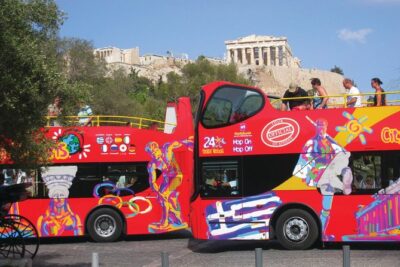
City Sightseeing Athens, Piraeus & Beach Riviera Hop-On Hop-Off Bus Tours
Read our review →
Hop on Hop Off Classic tour of Athens, Piraeus & Beaches
Read our review →
Athens Shore Excursion: Athens and Piraeus Hop-On Hop-Off Bus Tour
Read our review →
City Pass with Acropolis, Museums, Hop-On Hop-Off Bus
Read our review →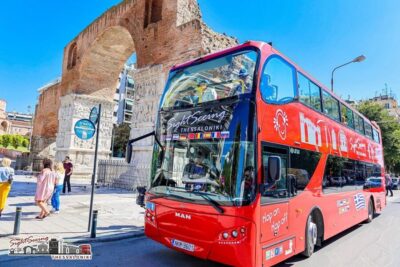
Thessaloniki Hop-on Hop-off Sightseeing Bus Tour
Read our review →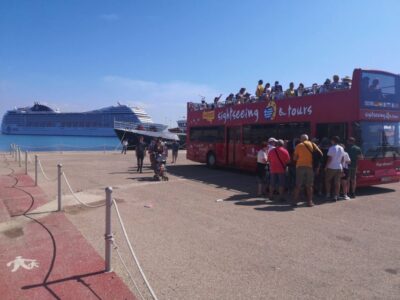
Browse the lists this tour appears in