
Reviewed · TOURS IN ATHENS
Athens: Ancient Agora E-Ticket and Audio Tour
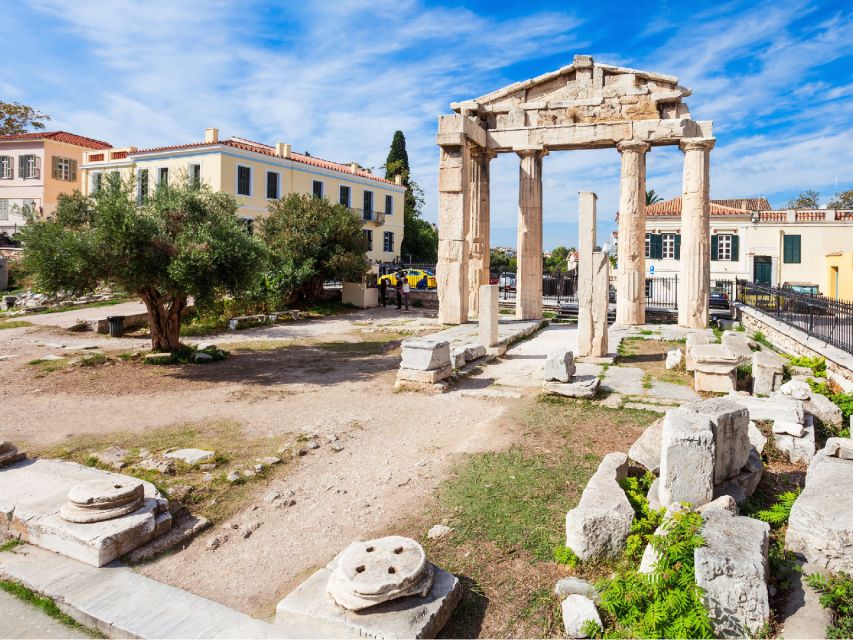
The Ancient Agora is where Athenian democracy moved from bold idea to daily business. This self-guided tour gives that story a useful shape, taking you from Solon’s reforms and the Temple of Hephaestus to the Bouleuterion, where 500 citizens prepared laws. The offline audio guide lets you set your own pace, which is a real advantage in Athens’ heat.
I like two things here: the quick e-ticket entry and the clear focus on people and political life, not just broken stones. Stories about Aristides the Just, Pericles, Socrates, and the Athenians who defended their democracy make the site easier to understand. The main drawback is navigation. Some directions can be vague, and the audio may stop if you zoom in to take a photo.
Key points at a glance
- Follow the birth of democracy: The audio explains Solon, the Bouleuterion, the popular assembly, and the political systems that shaped Athens.
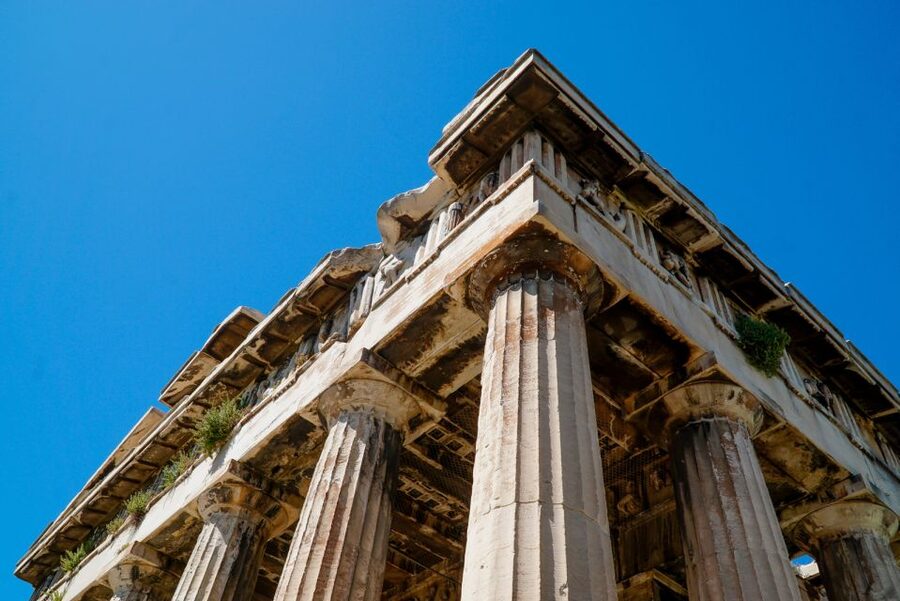
- See the Temple of Hephaestus: This remarkably complete ancient temple provides one of the Agora’s strongest visual moments.
- Use your phone offline: Download the ticket, audio, and interactive map before arrival because there is no internet access inside the archaeological site.
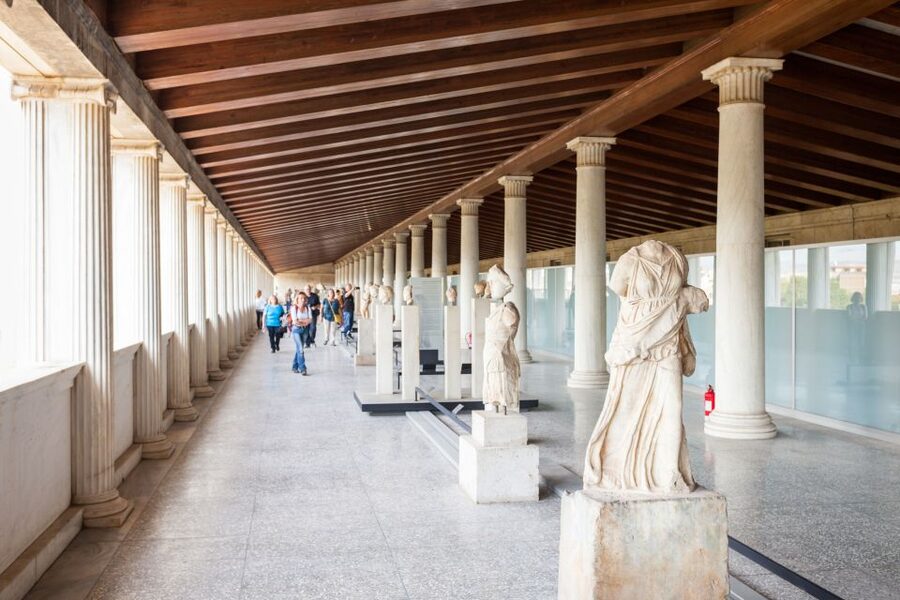
- Visit the Agora Museum: Its displays explain daily life, law, voting, and the sometimes harsh methods used to protect Athenian democracy.
- Expect a self-guided route: There is no live guide, so you control the pace, but you must manage the app and follow the directions yourself.
- Allow up to two hours: Comfortable shoes matter, and some parts of the route are not suitable for wheelchair users.
Why the Ancient Agora deserves your time
Many people rush from the Acropolis to the next major sight. I think the Ancient Agora rewards a slower visit because it shows how Athens worked at ground level. This was not only a place for grand monuments. It was a center for law, trade, public debate, religious activity, and everyday encounters.
The Acropolis presents Athenian power from above. The Agora explains the machinery beneath it. Here, you get closer to the citizens, officials, lawmakers, philosophers, and ordinary people who gave the city its political life.
The $30 price buys an adult admission ticket and the audio tour. That is not the cheapest way to enter if you already qualify for free or reduced admission, but it can be fair value if you want a ready-made explanation without hiring a private guide. The audio is available in English, Italian, Greek, German, Spanish, and French.
You should think of this as a useful independent visit, not a guided group outing. You will not have someone beside you answering questions or pointing out every stone. In exchange, you can pause, take photos, linger in the museum, or move ahead when a section interests you less.
A few more things to do in Athens worth a look
- Athens: Acropolis Ticket with Optional Audio or Live Guide
★ 4.2 · 11,055 reviews - Athens: Cape Sounio & Poseidon Temple Trip with Audio Guide
★ 4.4 · 4,521 reviews - Athens: Acropolis Ticket with Audio Guide
★ 4.0 · 3,575 reviews
Getting through the entrance without confusion
The ticket process is designed to reduce one common Athens headache: arriving at a major archaeological site without the correct admission document. After booking, you receive a separate email from the local partner, Clio Muse Tours, containing the actual e-ticket and instructions for the audio tour.
Check your spam folder if that message does not appear. The GetYourGuide voucher itself is not accepted at the entrance. You need the separate ticket from the local partner, printed or downloaded to your phone.
Before leaving your hotel, download both the ticket and the audio content. The archaeological site has no internet access, so waiting until the gate is a mistake. Also charge your phone fully and bring headphones. Your phone and headphones are not supplied.
The exact meeting point can vary with the option booked, so check your confirmation carefully. There is no hotel pickup or drop-off, and food and drinks are not included. Large bags and luggage are not allowed, so arrive with only what you need for the visit.
Starting below the Temple of Hephaestus
The audio begins with the forces that helped democracy take shape. Solon is central to this opening section. His legal reforms did not create modern democracy in one stroke, but they helped move Athens toward a more organized civil society and wider political participation.
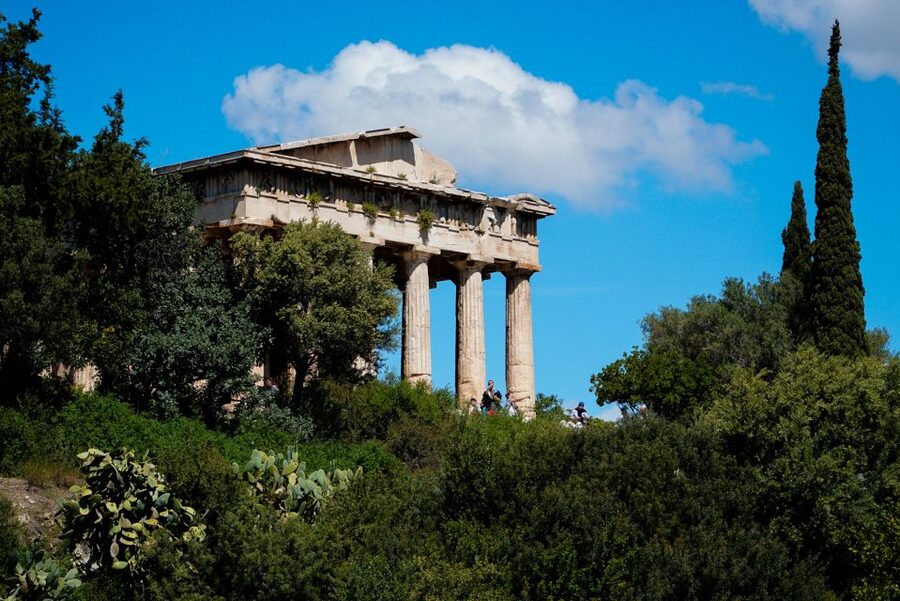
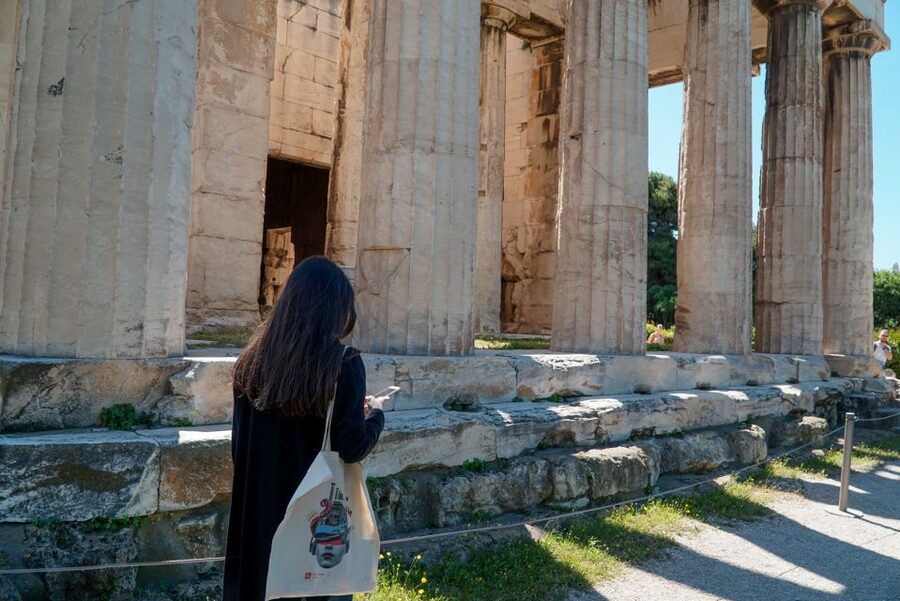
The Temple of Hephaestus gives this introduction a memorable setting. It remains one of the best-preserved ancient temples in Athens, and its position on the Agora hill makes it an easy landmark for getting your bearings.
The audio works best here because the site can initially feel like a wide field of ruins. Without context, columns, foundations, and fragments can blur together. Once you know which buildings handled law, administration, or public gathering, the ground becomes easier to read.
Do not treat the temple as a quick photo stop. Its survival helps you picture the Agora as a working public center rather than a collection of archaeological remains. The commentary also links the physical site to the political changes that took place around it.
The Bouleuterion and the business of government
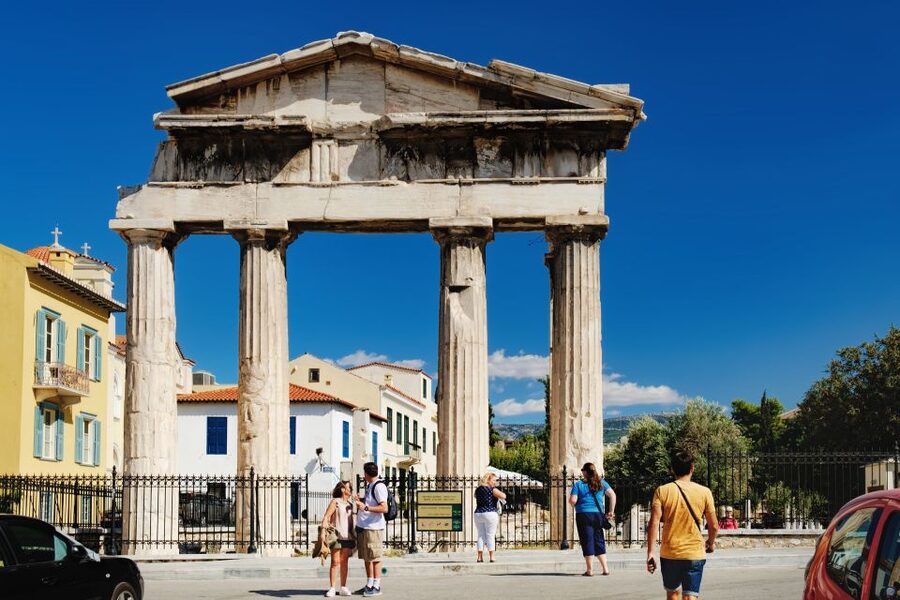
Near the Tholos, the route points you toward the ruined Bouleuterion. This was where the Council of 500 met to prepare laws and proposals for the popular assembly.
That number matters. Athenian democracy was not simply a crowd shouting in a public square. It relied on councils, procedures, officials, and daily preparation. The Bouleuterion helps explain that practical side of politics.
The Tholos also brings the system down to human scale. Government required people to meet, organize, eat, work, and make decisions on a regular schedule. The audio gives you a better sense of this routine than a small sign beside a foundation usually can.
This is one of the strongest parts of the tour for anyone interested in political history. It also helps families and younger visitors understand that democracy is not only a grand principle. It is a collection of jobs, rules, arguments, and compromises.
Same base, a completely different day:
- Athens: Acropolis & up to 5 Archaeological Sites Combo Pass
★ 4.4 · 12,619 reviews - Athens: Acropolis, Parthenon & Acropolis Museum Guided Tour
★ 4.8 · 9,316 reviews - Athens: Cape Sounion & Poseidon Temple Sunset Half-Day Trip
★ 4.8 · 8,241 reviews - Athens: Acropolis and Parthenon Guided Walking Tour
★ 4.6 · 5,882 reviews
Aristides, Pericles, and the people behind the stones
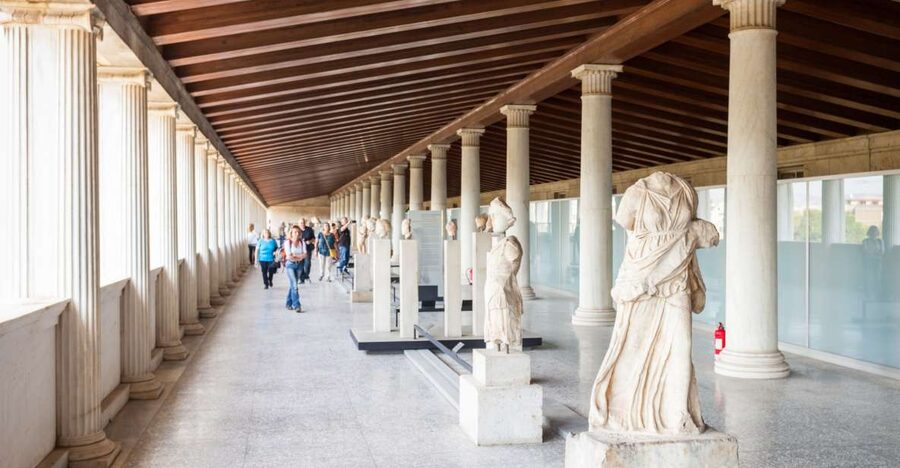
The commentary adds stories about figures such as Aristides the Just and Pericles. These personalities help break up the formal explanation of institutions.
Aristides is tied to the idea of personal reputation and public virtue. Pericles represents the confidence and ambition of classical Athens. Hearing about individuals gives you something concrete to remember after you leave.
The audio’s tone is designed to be lively and approachable rather than a dry list of dates. Still, some of the material assumes that you are comfortable with fairly detailed historical explanation. If you prefer a very simple overview, you may find parts of the narration demanding.
That detail is also one of the tour’s strengths. You are not merely told that Athens invented democracy. You hear about the arguments, personalities, safeguards, and dangers that shaped it.
The Agora Museum and the overlooked second floor
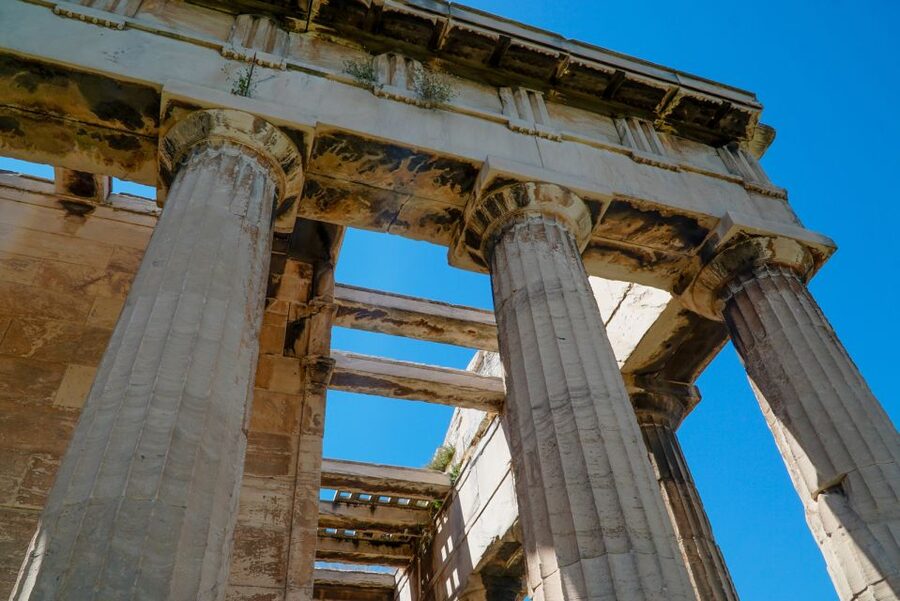
The Museum of the Ancient Agora is a vital stop, not an optional indoor break. Its objects help explain how the political system operated and how Athenians tried to defend it from harmful influence.
The displays cover ingenious and sometimes severe methods used to protect democracy. This is where the idealized picture of Athens gets more complicated. The city valued citizen participation, yet it could also exclude, punish, or remove people in ways that feel harsh today.
Give yourself enough time inside. The museum is also a welcome place to cool down, especially if you visit in summer. One practical tip is to look for the second floor, which can be easy to miss. From there, you get an unusual view over the Panathenaic Way and a different sense of the site’s layout.
That upper-level view is particularly helpful after hearing about the Agora’s buildings. From ground level, the ruins can seem disconnected. Looking down lets you see how roads, structures, and open spaces related to one another.
Pnyx and the view toward the Acropolis
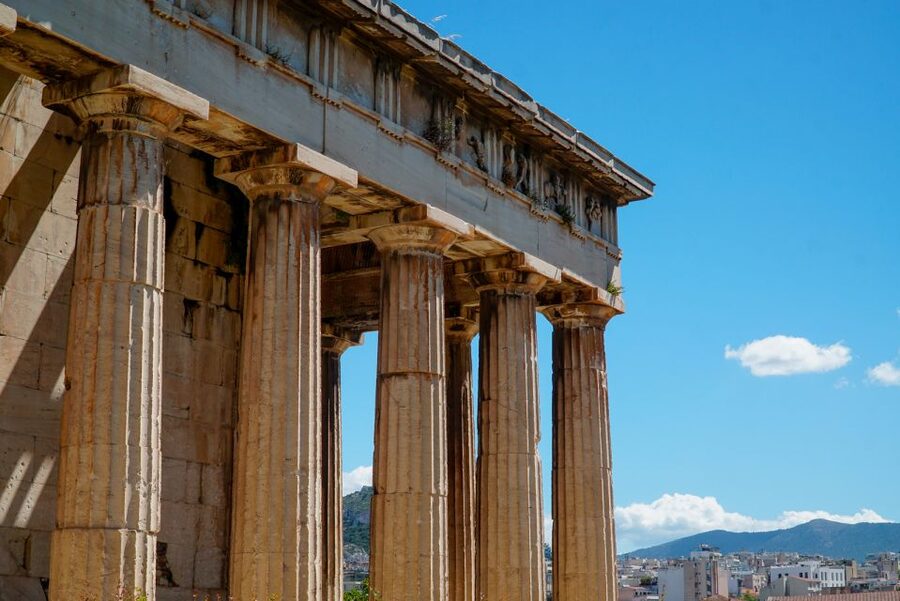
The route then connects the Agora with the wider political world of Athens. At the Pnyx, you consider the place associated with the popular assembly, where citizens gathered to hear speeches and take part in civic decisions.
The hill also gives you one of the better views toward the Acropolis. The Rock of Ares, or Mars Hill, offers another strong viewpoint and ties the political story to the rocky terrain around central Athens.
Bring sturdy, comfortable shoes. The route includes hills and uneven archaeological ground, and some points are not wheelchair accessible. The experience is not suitable for wheelchair users, according to the activity information.
Navigation is the weak spot here. Parallel paths and lightly marked ruins can make it unclear which way to go. The audio map helps, but you should not expect the same certainty you get from walking behind a live guide.
If you are good with maps, this may be only a small nuisance. If you often lose your place in open archaeological sites, download the map in advance and keep checking your position. Avoid rushing while the narration is playing, since the audio can stop when you switch activities to take photos or zoom the map.
Socrates’ prison and the final walk
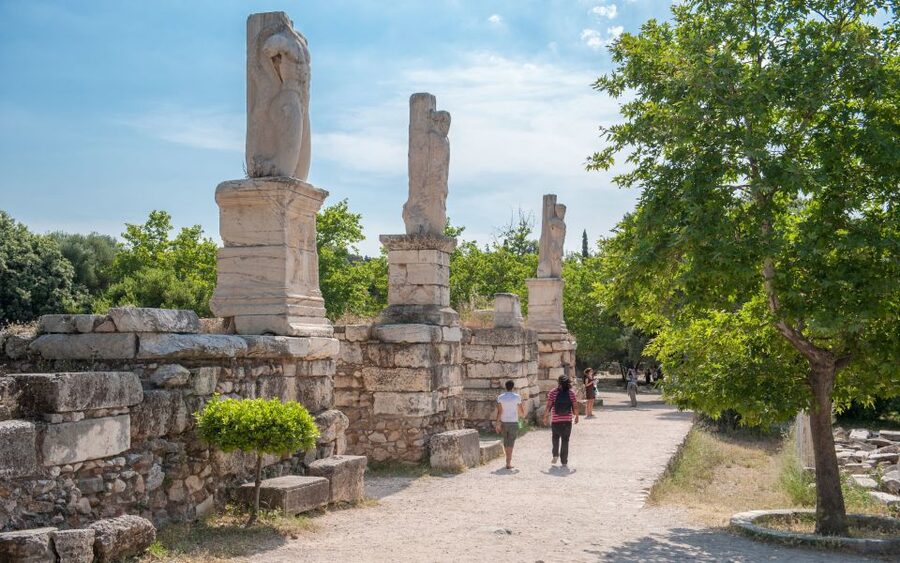
The route continues toward the hill of Philopappos and the place identified as the Prison of Socrates. The site itself is modest, but the subject gives it weight. The audio uses it to discuss the philosopher’s life, death, and place in Athenian thought.
You may also hear the story of Samuel the Cobbler and his connection with Socrates. It is the kind of small human detail that gives the philosophical material a more personal feel.
Keep in mind that archaeological identifications can be debated, and the remains are not a dramatic prison complex. The value here is in the story and the setting, not in expecting a fully preserved building.
The route finishes near the Acropolis archaeological area, in front of the Theatre of Dionysus. This is a fitting ending. The theatre is linked to the works of Aeschylus, Sophocles, and Euripides, and it gives you a final connection between civic life, public performance, and Athenian culture.
The end point is useful if you plan to continue toward the Acropolis or nearby sights. It also means the activity is not simply a short loop around one compact ruin. Pay attention to the route and allow enough time for the hills and stops beyond the main Agora area.
Timing, heat, and how long to allow
The stated duration is 90 minutes to two hours. I would plan for the longer end if you want to listen carefully, visit the museum, take photos, and pause at the viewpoints.
Early morning or late afternoon is the sensible choice in hot weather. The Agora has open ground and limited shade, so midday can make the walk tiring. The museum’s air conditioning provides relief, but it does not replace a cooler start time.
Wear shoes that can handle uneven paths. Carry only a small personal bag, since large luggage is not allowed. You will get more from the audio if you are not distracted by heat, low battery, or a rushed schedule.
The pace is yours, which is a major benefit. You can replay sections or skip ahead, but the tour does not provide a live person to correct a wrong turn. Treat the map as part of the experience, not as an optional extra.
Who gets the best value from this ticket
I would recommend this for independent visitors who want more than labels but do not need a private guide. It suits solo visitors, couples, and families with older children who can listen and walk for up to two hours.
It is also a good choice if you want to focus on how Athens functioned politically. The tour gives more attention to democracy, government, law, and civic life than a basic sightseeing walk usually does.
The value is less clear for EU students and minors, who can enter free with identification after queuing for a zero-value pass. Non-EU students and people over 65 can receive reduced tickets, but they must queue at the ticket office. If you qualify, compare the price before buying this adult package.
You should also consider the Acropolis. A combined Agora and Acropolis ticket may make more financial sense if you plan to visit both, but this activity itself includes only the Ancient Agora admission and audio tour. Do not assume it covers every major archaeological site in Athens.
Should you book the Ancient Agora audio tour?
Book it if you want a clear story, an offline guide, and the freedom to stop when you please. The ticket saves some entrance friction, while the narration turns scattered ruins into a readable account of Athenian public life.
Skip it if you strongly prefer a live guide, need wheelchair access, or dislike navigating with a phone. The directions can be imprecise, some places are not clearly marked, and the experience depends on your battery, headphones, and ability to download the material in advance.
At $30, it is best value for someone who will use the full route, visit the museum, and listen to the political and personal stories. If you only want a quick look at the Temple of Hephaestus, buying an adult audio package may be more than you need. For a curious first-time visitor who wants the Agora to make sense, it is a practical and worthwhile option.
FAQ
How long does the Ancient Agora audio tour take?
The activity takes about 90 minutes to two hours. Allow more time if you want to explore the museum slowly, take photos, or pause at the viewpoints.
What is included in the $30 price?
The price includes an adult e-ticket for the Ancient Agora and a self-guided audio tour for an Android or iOS smartphone. It also includes offline audio content and an offline interactive map.
Is there a live guide?
No. This is a self-guided audio tour, so you follow the route on your own phone and move at your own pace.
Which languages are available?
The audio guide is available in English, Italian, Greek, German, Spanish, and French.
Do I need internet access inside the Agora?
No internet access is available in the archaeological site. Download the e-ticket, audio tour, and map before you arrive.
Is the GetYourGuide voucher accepted at the entrance?
No. You must use the separate e-ticket sent by the local partner. It should be printed or downloaded to your phone.
What should I bring?
Bring a charged smartphone, headphones, and comfortable shoes. Large bags and luggage are not allowed.
Is the activity wheelchair accessible?
No. Some points of interest are not wheelchair accessible, and the activity is listed as unsuitable for wheelchair users.
Can EU students and minors enter for free?
Yes. EU students and minors can enter free with identification, but they must queue to receive a zero-value pass.
Is the audio tour compatible with every phone?
No. It is not compatible with Windows phones, iPhone 5, iPhone 5C or older, iPod Touch 5th generation or older, iPad 4th generation or older, or the first-generation iPad Mini.
More Audio Tours in Athens
- From Athens: Delphi Full Day V.R. Audio Guided Tour
★ 4.6 · 3,028 reviews - Athens: Acropolis Museum Ticket with optional Audio Guide
★ 4.4 · 2,652 reviews - Athens: Acropolis Ticket & Optional Self-Guided Audio Tours
★ 4.1 · 2,542 reviews - Parthenon & Acropolis Museum with Audio or Live Tour Option
★ 4.1 · 2,446 reviews
Just added in Athens
- Athens: Half-Day Morning Catamaran Cruise with Meal & Drinks★ 4.9 · 221 reviews
- Athens hotels to Athens airport Private departure transfer★ 5.0 · 285 reviews
- Argolis: Full-Day Tour in Mycenae & Nafplio★ 4.2 · 350 reviews
- Athens: Riviera Catamaran Cruise with Meal and Drinks★ 5.0 · 345 reviews
- Athens: Delphi, Corycian Cave, and 300 Battlefield Day Trip★ 4.8 · 344 reviews
- 3-Day Classical Greece Tour: Epidaurus, Mycenae, Nafplion, Olympia, Delphi★ 4.5 · 342 reviews
- Best of Athens Half Day Private Tour★ 5.0 · 353 reviews
- Electric Bike Tour of Athens by Night★ 5.0 · 355 reviews
Tours in Athens, compared.
Acropolis & up to 5 Archaeological Sites Combo Pass
Read our review →
Acropolis, Parthenon & Acropolis Museum Guided Tour
Read our review →
Cape Sounion & Poseidon Temple Sunset Half-Day Trip
Read our review →

All Day Cruise -3 Islands to Agistri,Moni, Aegina with lunch and drinks included
Read our review →

Cape Sounio & Poseidon Temple Trip with Audio Guide
Read our review →
Browse the lists this tour appears in