
Reviewed · TOURS IN ATHENS
Biblical Tour Letters ToThe Corinthians St Paul’s Footsteps 6Hour
The heart of this experience is the link between the New Testament and real places. You begin at Athens’ Areopagus Hill, where Paul spoke about the unknown God, then follow the road to Corinth, the city connected with his letters and long stay. By the end, you have seen the Bema where he may have faced Gallio, the ancient port of Cenchreae, and the ruins of Corinth itself.
I like the small private group format, with space for two to six people in a comfortable vehicle. I also like the practical service: hotel, apartment, or cruise-port pickup, bottled water, Wi-Fi, and a driver who can adjust the pace. Chris, Yannis, Panos, Alex, Christos, and other English-speaking drivers are praised for clear storytelling, patience, and personal attention.
The main drawback is time. The route covers many sites in about six hours and 15 minutes, so several stops are brief. Your driver can explain the places, but Greek law does not allow a driver to guide inside archaeological sites. A licensed guide can be added for €160 per booking, subject to availability.
Key points before you book
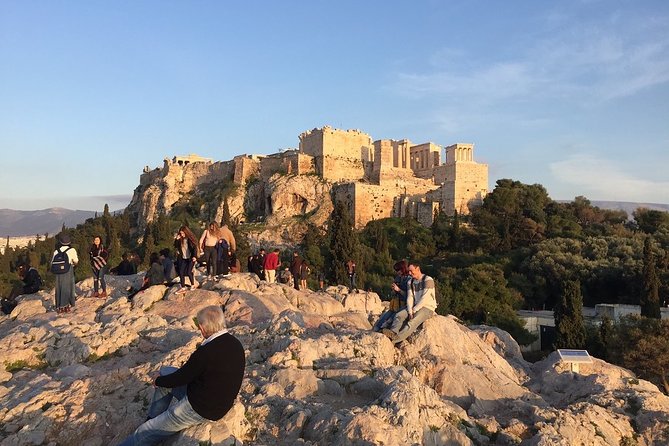
- Paul’s Athens speech begins the day: See Areopagus Hill, the rocky platform beside the Acropolis linked with Paul’s address to the Athenians.
- Ancient Corinth is the main event: Walk among the Roman forum, Temple of Apollo, and Bema connected with Paul’s time in the city.
- The vehicle saves time: Pickup and return are offered from Athens hotels, apartments, and cruise ports in a private, air-conditioned minivan.
- The itinerary is full: The Corinth Canal, Isthmia, Cenchreae, and several archaeological sites are packed into one half-day outing.
- Site commentary has limits: Your English-speaking driver can explain the ruins from outside, but only a licensed guide may accompany you inside.
- Budget for entry fees: Ancient Corinth costs €15 per person, and the Archaeological Site of Isthmia costs €5 per person. Neither is included.
Why Paul’s journey works as a theme
This is not simply a drive from Athens to a famous set of ruins. The route follows the basic shape of Paul’s second missionary journey in Greece, moving from Athens toward the Corinthian isthmus and its busy ports.
That connection gives the ruins a clear purpose. At Areopagus Hill, you can place Paul’s speech in Athens. At Corinth, you can connect the city’s public forum with Acts and the two letters to the Corinthians. At Cenchreae, you reach the port named in the New Testament, where Paul is said to have stopped before sailing for Syria.
You do not need to be a Bible scholar to enjoy the day. Ancient Greek and Roman history is woven through the religious story, and the sites themselves are worthwhile even if you are more interested in archaeology than Scripture.
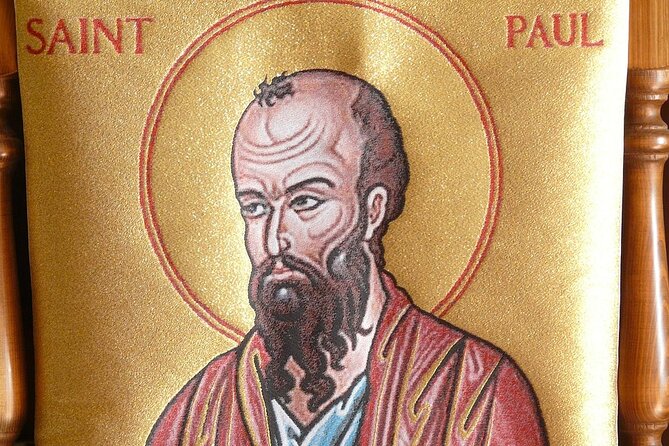
The strongest part is the human scale. Paul was not visiting Corinth as a modern tourist. He spent about a year and a half there, worked as a tent maker, preached among the local population, and became involved in the city’s religious and civic life. Your guide’s commentary helps connect that working life with the monumental ruins around you.
Other days out people book in Athens:
- Athens: Acropolis & up to 5 Archaeological Sites Combo Pass
★ 4.4 · 12,619 reviews - Athens: Acropolis Ticket with Optional Audio or Live Guide
★ 4.2 · 11,055 reviews - Athens: Acropolis, Parthenon & Acropolis Museum Guided Tour
★ 4.8 · 9,316 reviews
From Areopagus Hill to the road out of Athens
The tour starts with pickup from your hotel, apartment, or cruise ship. For a hotel, the driver waits in the lobby. For an apartment, pickup is at the building entrance. Port pickup takes place at the gate with a sign showing your name.
Areopagus Hill is a short but meaningful first stop. You have about 15 minutes here, enough to look across the Athens area and consider the setting of Paul’s speech to the Athenians about the unknown God.
The hill is rocky and uneven, so wear shoes with a firm grip. This is not a long visit, and you should not expect a full Acropolis tour. The focus is the biblical connection, not a broad survey of the monuments on the Acropolis.
The road toward Corinth takes about an hour, depending on traffic. This drive is more useful than dead time because the driver can set out the story of Paul, ancient Greece, and the route ahead. Chris is especially praised for filling this stretch with background about the area and Paul’s life, while guides such as Alex and Yannis are known for answering questions and adjusting their explanations to your interests.
Daphni Monastery adds a Byzantine chapter
The Monastery of Daphni provides a change of period and mood. It is a major Byzantine monument on the slopes of Mount Aigaleo, built on the site of an ancient sanctuary linked with Apollo.
The monastery is surrounded by fortified walls and towers. Its history includes a period under Cistercian monks during Frankish rule, followed by a return to Orthodox control after the Ottoman conquest. Earthquakes damaged the complex, but restoration continues, especially around its famous mosaics.
You have about 20 minutes here. That is enough for an introduction and a look at the setting, but not enough for a slow study of every feature. I see this stop as a useful bridge between the classical world and the Christian history of Greece. If your main goal is Paul and Corinth, Daphni may feel like a side chapter. If you enjoy religious art and architecture, it adds welcome range.
Corinth Canal: an engineering stop with an ancient idea
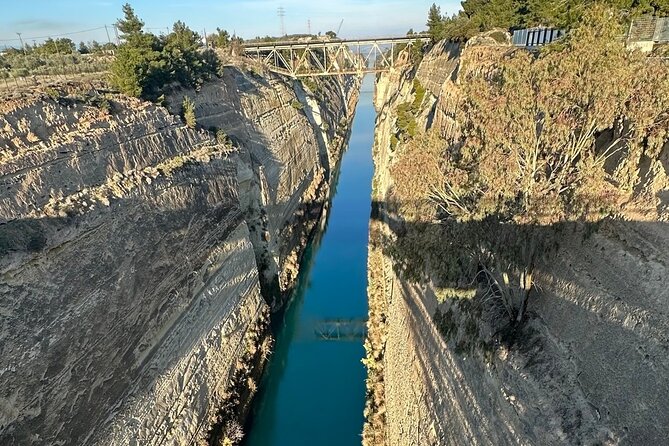
The Corinth Canal is one of the quickest stops, at about 20 minutes, but it is easy to understand why it remains popular. The waterway cuts across the Isthmus of Corinth, joining the Gulf of Corinth with the Saronic Gulf and separating the Peloponnese from mainland Greece.
The modern canal was completed in the late 19th century, yet the idea goes back more than 2,000 years. Periander, the ruler of Corinth, is said to have considered cutting through the isthmus. Instead, ancient engineers created the diolkos, a stone route used to move ships across land on wheeled platforms.
The canal saved ships from sailing around the Peloponnese, a detour of about 185 nautical miles. Your visit is mainly for the view and the explanation. It is not a museum stop, and the included admission is free, so this is an efficient way to see one of Greece’s most striking engineering works.
Same base, a completely different day:
- Athens: Cape Sounion & Poseidon Temple Sunset Half-Day Trip
★ 4.8 · 8,241 reviews - Athens: Acropolis and Parthenon Guided Walking Tour
★ 4.6 · 5,882 reviews - All Day Cruise -3 Islands to Agistri,Moni, Aegina with lunch and drinks included
★ 5.0 · 4,958 reviews - Athens, Piraeus, and Coastline: Blue Hop-On Hop-Off Bus
★ 3.9 · 4,849 reviews
Isthmia and the world of the Isthmian Games
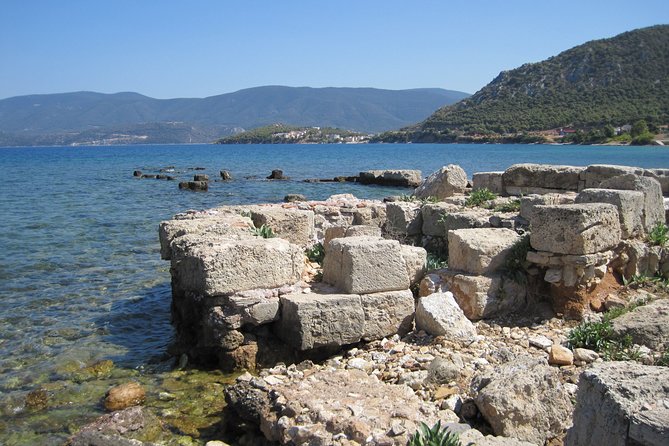
The Isthmia area shows why Corinth was so important. The narrow land bridge between mainland Greece and the Peloponnese made this a natural meeting point for trade, politics, religion, and sport.
The Isthmian Games were among the most important athletic contests in the ancient Greek world, ranked after the Olympic Games at Olympia. The site also had a direct connection to Paul. He is associated with the region as a tent maker serving athletes and visitors, while preaching about Christ to the people who came for the games.
The itinerary allows about an hour at Isthmia, which gives you more time than most of the other stops. You can think about Paul working in a crowded public setting, rather than picturing him only as a speaker in a religious space.
This is also where the route becomes more archaeological. The area included temples, athletic facilities, political meeting places, a theater, and Roman baths. The setting helps explain why Corinth was more than a quiet ancient settlement. It was a regional center with large events and strong connections across Greece.
The Archaeological Museum of Isthmia
The Archaeological Museum of Isthmia is scheduled for about 20 minutes. Admission is not included, so plan on an additional €5 per person for the Archaeological Site of Isthmia. Confirm the current fee when booking, since entrance charges can change.
The collection includes architectural pieces from the Temple of Poseidon, including an Archaic marble pediment from the late seventh century BC. There are also colorful glass pieces from Kechreai, imported from Alexandria in Egypt. Their scenes include harbors, ships, plants, animals, philosophers, and geometric designs.
Other objects include a Roman imperial statue in the form of Zeus, an inscribed stele with a portrait, animal figurines, commercial amphorae, weapons, religious offerings, and finds from Mycenaean and Roman cemeteries.
Twenty minutes is short for a museum, so I would treat this as a focused stop rather than a complete museum visit. Ask your driver which objects best support the story of the area. If you want detailed interpretation inside, this is one place where a licensed guide would make a clear difference.
The Archaeological Site of Isthmia
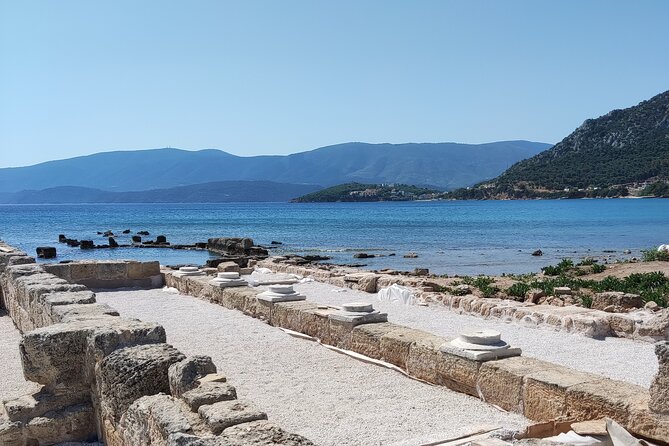
The nearby archaeological site includes the Temple of Poseidon, a stadium, the Sanctuary of Palaimon, and a theater. The monuments are spread across an open area, so comfortable shoes and protection from the sun are useful.
The Temple of Poseidon was first built between about 690 and 650 BC. Fires, wars, Roman damage, and later rebuilding changed the site over the centuries. The sanctuary was eventually abandoned after the Visigoth invasion associated with Alaric.
The stadium began around 550 BC, with a later version built for the Isthmian Games. One especially interesting feature is the preserved ysplex, an ancient starting mechanism for athletes. It offers a rare physical link to how competitions were organized.
The Sanctuary of Palaimon was dedicated to the young Melikertis-Palaimon, regarded as a protector of sailors. In Roman times, ceremonies took place at night and bulls were sacrificed.
The site also hosted major political gatherings. Greek city-states met here to respond to the Persian threat, and leaders such as Philip II and Alexander the Great were proclaimed commanders of the Greeks at Isthmia. That makes this more than a collection of fallen stones. It was a place where religious events, sport, and political power met.
Cenchreae, the port named in Romans
Kechries, or ancient Cenchreae, is a 30-minute stop on the Saronic Gulf side of Corinth. The modern village occupies the area of the ancient port, which was one of Corinth’s two important harbors.
The biblical connection is direct. Acts describes Paul stopping at Cenchreae during his second missionary journey and cutting his hair to fulfill a vow. In Romans, Paul also refers to Phoebe, a woman connected with the local Christian assembly.
This stop is less about grand ruins than about location. You are standing at the kind of port from which Paul and other ancient visitors could leave Greece by sea. The remains are not as extensive as those at Ancient Corinth, so the value comes from the setting and the story your driver provides.
Ancient Corinth and the place of Paul’s trial
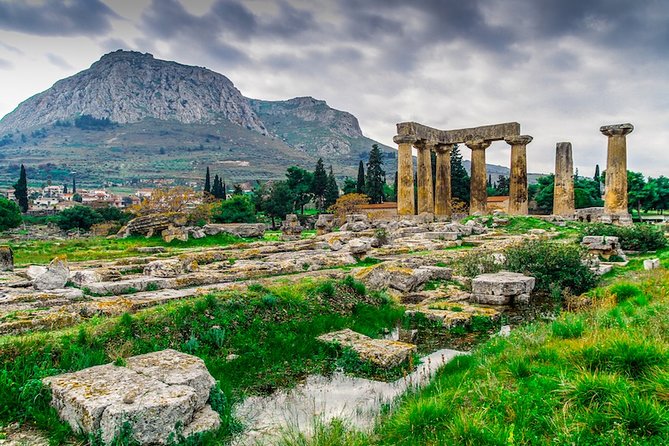
Ancient Corinth is the centerpiece of the day. Allow about an hour for the archaeological site, with an additional €15 per person for admission.
Corinth occupied the narrow route between central Greece and the Peloponnese. Its location gave it access to trade by land and sea, and by 400 BC it was one of the largest cities in Greece, with a reported population of about 90,000.
The city was destroyed by the Romans in 146 BC, rebuilt in 44 BC, and later became the Roman provincial capital of Greece. That mix of Greek and Roman layers is important. Paul arrived in a city shaped by both cultures, not in a simple Greek temple town.
The Roman forum includes shops, temples, altars, and the Bema, a raised platform from which officials addressed the public. Tradition identifies the Bema as the place where Paul was brought before the Roman proconsul Gallio after being accused of unlawful teaching. Gallio refused to treat the matter as a Roman legal case, seeing it as an internal religious dispute.
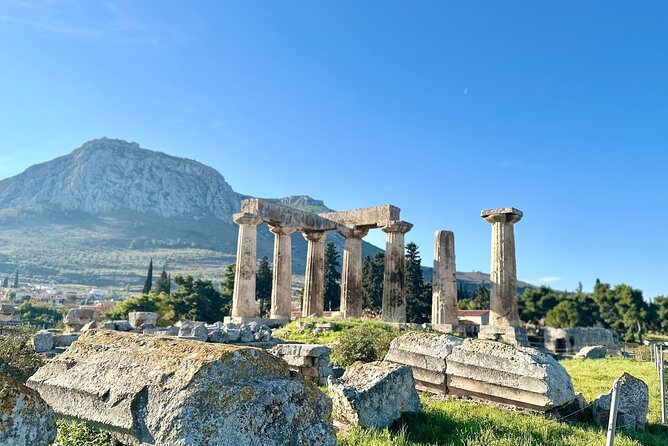
You will also see the Temple of Apollo, one of the earliest Doric temples in the Greek mainland and Peloponnese. Its large monolithic columns date to around 560 BC, giving the site a memorable focal point.
The driver can explain the ruins before you enter and then allow you to explore at your own speed. This arrangement worked particularly well for visitors who wanted time to stop, take photographs, and reflect. But remember the legal limit: the driver cannot function as your guide inside the site. If you want detailed explanations beside individual monuments, arrange the licensed guide in advance.
St. Paul’s Church closes the biblical route
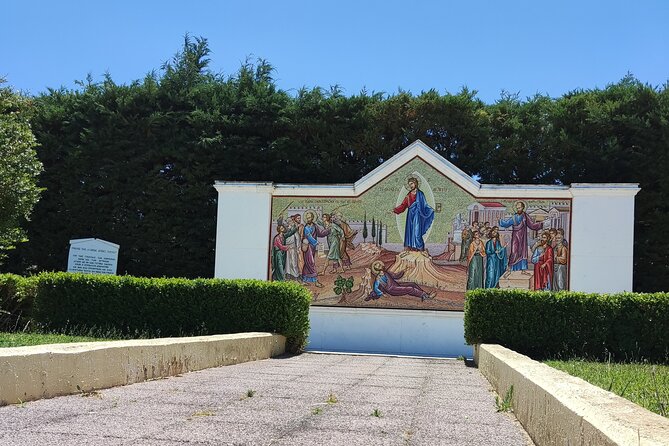
The final stop is Apostolos Pavlos Church in modern Corinth. Paul is associated with Corinth for a stay of about a year and a half in AD 51 to 52, and the local church is linked with his work described in Acts and the two letters to the Corinthians.
The visit lasts about 20 minutes and gives the day a modern Christian ending. After so many ancient remains, a functioning church makes the connection feel less remote. You are no longer looking only at the city where Paul worked. You are also seeing how that memory remains part of Corinth today.
What the private vehicle adds
The price is $170.50 per person, with group discounts available. Value depends heavily on your group size. For two people, the per-person cost is higher, but you are paying for a private vehicle, pickup and return, an English-speaking driver, and a route that would be awkward to manage by public transport in one day.
For a group of four to six, the price becomes easier to justify. The vehicle can hold up to eight people, though the advertised small-group format is generally two to four people. Wi-Fi, air conditioning, bottled water, and luggage storage depending on the amount you carry are practical extras rather than luxury decoration.
Several guides, including Chris, Yannis, Panos, Alex, Christos, and Andreas, are praised for punctual pickup, clean vehicles, friendly conversation, and detailed explanations during the drive. Some have supplied umbrellas, chocolates, and even a jacket during a rainy spell. Those touches are not guaranteed, but they show the kind of attentive service you can request.
Cruise passengers get the strongest value from the arrangement. The driver can collect you at the port, keep the timing tight, and return you to the ship or another agreed location. Still, build in caution. Traffic or parking can force a stop to be shortened or skipped, so tell the operator your departure time clearly.
Who should book this Corinth tour?
You should consider it if you want:
- A Bible-centered view of Athens and Corinth
- Ancient Greek and Roman sites in one efficient outing
- Private transportation beyond Athens
- A relaxed vehicle ride instead of arranging several taxis
- A flexible day for a small family or group of friends
- A cruise-port excursion with return transport
- Commentary on Paul’s life during the journey
You may want another option if you prefer long, quiet visits at each archaeological site. The schedule is ambitious, and the museum and smaller ruins receive limited time. You should also add the licensed guide if detailed interpretation inside the monuments matters to you.
Free cancellation is available up to 24 hours before the start time. Same-day changes and cancellations are not refundable, and poor weather can lead to a new date or a full refund. The tour is offered in English and requires good weather.
Should you book it?
Book this tour if Paul’s connection to Athens and Corinth is central to your trip, or if you want an efficient private route through the Corinthian sites. The strongest reasons are the personal vehicle, flexible pickup, excellent driver commentary, and the chance to connect Acts and the letters to the Corinthians with actual places.
I would book the licensed guide too if you want more than an overview at Ancient Corinth and Isthmia. If you are content with strong explanations on the road and time to explore independently, the driver-led format gives you a good balance of comfort, freedom, and cost. Just accept that this is a packed day, not a slow archaeological study.
FAQ
How long does the tour last?
The tour lasts approximately six hours and 15 minutes.
Where can pickup and drop-off take place?
Pickup and return are offered from an Athens hotel, Airbnb apartment, or cruise port. Airport pickup is also available for an additional €60 per booking.
How many people can join the private tour?
The small-group format is designed for two to four people, while the luxury minivan can hold up to eight passengers.
Is the tour conducted in English?
Yes. The experience is offered in English with an English-speaking driver.
Are entrance fees included?
No. Ancient Corinth costs €15 per person, and the Archaeological Site of Isthmia costs €5 per person. These fees are paid separately.
Can the driver guide inside the archaeological sites?
No. Greek law allows only officially licensed guides to accompany visitors inside archaeological sites. A licensed guide can be arranged for an additional €160 per booking, subject to availability.
Is food included?
No. Lunch stops are scheduled, but meals are not included in the tour price.
Can I cancel for a full refund?
Yes, if you cancel at least 24 hours before the experience starts. Cancellations or changes made less than 24 hours in advance are not refundable. If poor weather causes the tour to be canceled, you can receive a different date or a full refund.
Just added in Athens
- Athens: Half-Day Morning Catamaran Cruise with Meal & Drinks★ 4.9 · 221 reviews
- Athens hotels to Athens airport Private departure transfer★ 5.0 · 285 reviews
- Athens: Riviera Catamaran Cruise with Meal and Drinks★ 5.0 · 345 reviews
- Athens: Delphi, Corycian Cave, and 300 Battlefield Day Trip★ 4.8 · 344 reviews
- 3-Day Classical Greece Tour: Epidaurus, Mycenae, Nafplion, Olympia, Delphi★ 4.5 · 342 reviews
- Best of Athens Half Day Private Tour★ 5.0 · 353 reviews
- Electric Bike Tour of Athens by Night★ 5.0 · 355 reviews
- Argolis: Full-Day Tour in Mycenae & Nafplio★ 4.2 · 350 reviews
Tours in Athens, compared.
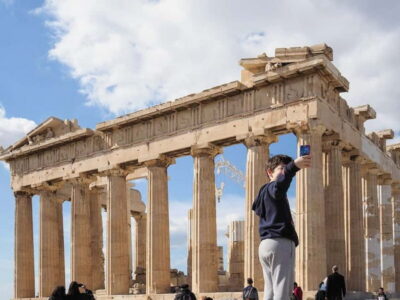
Acropolis & up to 5 Archaeological Sites Combo Pass
Read our review →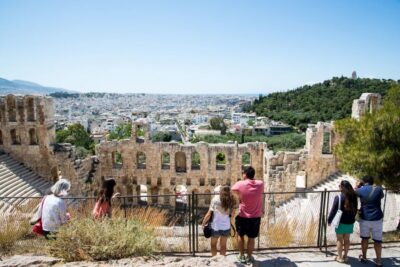
Acropolis, Parthenon & Acropolis Museum Guided Tour
Read our review →
Cape Sounion & Poseidon Temple Sunset Half-Day Trip
Read our review →

All Day Cruise -3 Islands to Agistri,Moni, Aegina with lunch and drinks included
Read our review →
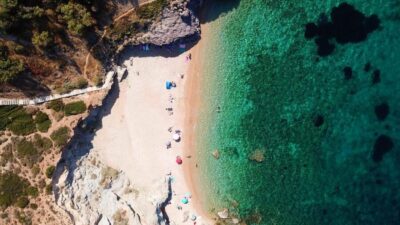
Cape Sounio & Poseidon Temple Trip with Audio Guide
Read our review →
Browse the lists this tour appears in