
Reviewed · ANCIENT CORINTH, MYCENAE & NAFPLIO TOURS
Biblical Corinth: St. Paul and His Letters to the Corinthians
The heart of this day is St. Paul’s Corinth, where you connect the Acts of the Apostles and the letters to the Corinthians with real places: the Bema, the Temple of Apollo, the old harbor at Kechries, and the roadways that shaped ancient trade. The route also begins at Areopagus Hill in Athens, where Paul addressed the Athenians.
I like two things right away: the private format, which lets you linger or move on without a busload of strangers, and the broad route, which includes the Corinth Canal, Isthmia, Ancient Corinth, Kechries, and Akrokorinthos. Drivers such as Alex, George, Spiros, Stephanos, and Panos have been praised for clear English, safe driving, patience, and useful historical commentary.
The main point to understand is simple: your driver is not a licensed guide and does not enter the archaeological sites with you. That keeps the price at $218.43 per person, but if you want a guided explanation among the ruins, request a licensed guide in advance and expect an added cost.
Key points for a meaningful Corinth day trip
- Follow Paul from Athens to Corinth: Begin at Areopagus Hill, then travel into the region where Paul spent about 18 months.
- See more than one famous ruin: The route includes Ancient Corinth, Isthmia, the Temple of Apollo, Kechries, the Diolkos, and Akrokorinthos.
- Enjoy private pacing: Your pickup time can be adjusted, and your group controls the rhythm of the day.
- Know what the driver does: Expect commentary in fluent English, but not a guided walk inside the archaeological sites unless you add a licensed guide.
- Allow extra money for entry: Ancient Corinth and the Archaeological Museum of Isthmia cost €15 per person, purchased on site.
- Make lunch part of the experience: The Greek traditional food option includes lunch, while some visitors choose to pack food to keep the day moving.
Why Paul’s Corinth makes such a strong day trip from Athens

Corinth was not a quiet provincial town in Paul’s time. Its position on the narrow isthmus between mainland Greece and the Peloponnese made it a meeting point for merchants, sailors, athletes, officials, and religious pilgrims.
That setting helps explain the tone of Paul’s letters. The Corinthian church faced arguments, moral questions, social divisions, and competing ideas. When you visit the old city, you are not simply looking at broken stones. You are seeing the commercial and religious world in which those problems took shape.
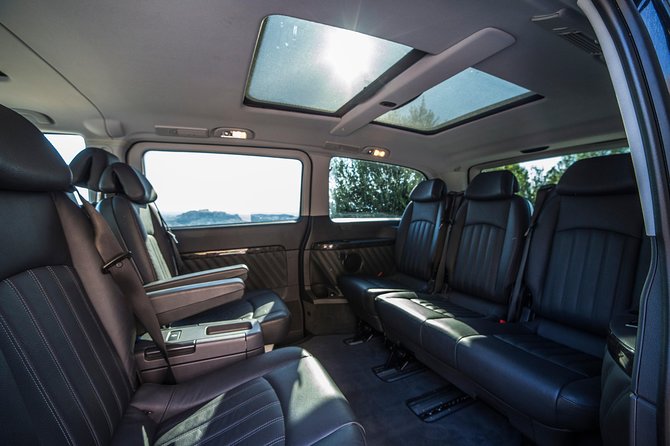
The drive from Athens takes you through a change in scenery and history. Onboard Wi-Fi, bottled water, and an air-conditioned vehicle make the long day easier, especially in warm weather. The private vehicle also gives you room to talk, rest, or ask for a pause when needed.
The tour is usually booked about 73 days ahead, so I would not leave it until the last minute if your Athens dates are fixed. Pickup is available from a hotel, apartment entrance, or port gate, and the return point can be arranged to suit your plans.
More Peloponnese days from Athens:
- From Athens: Mycenae, Epidaurus & Nafplio Full Day Trip
★ 4.8 · 2,438 reviews - From Athens: Mycenae, Epidaurus & Nafplio Full-Day Tour
★ 4.5 · 1,580 reviews - From Athens: Ancient Corinth Day Trip with Canal & VR Guide
★ 4.6 · 1,073 reviews
Areopagus Hill puts Paul’s Athenian speech first
The day begins with a short stop at Areopagus Hill, also called Mars Hill. This rocky rise near the Acropolis is tied to Paul’s speech to the council of Athens, where he spoke about the Unknown God and presented Christianity to an audience shaped by philosophy and traditional Greek religion.
You get about 20 minutes here, with no admission charge. That is enough for a meaningful look and some reflection, but not a long Acropolis visit. Do not confuse this stop with a full guided tour of the Acropolis complex. The focus is Paul’s connection to Athens, not the Parthenon.
I like this opening because it gives the day a clear arc. You begin with Paul speaking in Athens, then follow the route toward Corinth, where his work became longer and more organized.
The Corinth Canal and the Diolkos explain the route
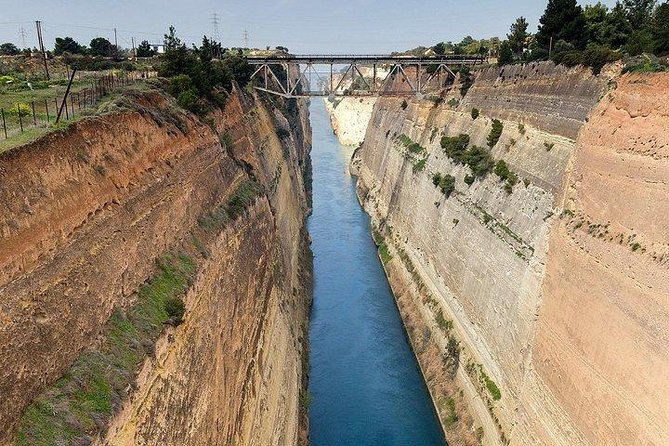
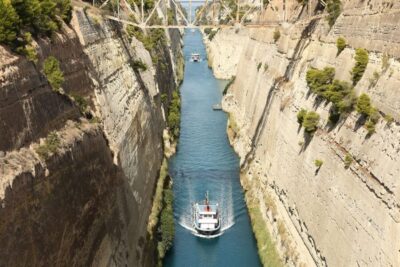
The Corinth Canal is one of the quickest visual rewards of the day. From above, you can look down at the narrow waterway cut through steep limestone walls. It links the Gulf of Corinth with the Saronic Gulf and separates the Peloponnese from mainland Greece.
The canal is about 6.4 kilometers long and only 21.4 meters wide at its base. It has no locks because it was cut at sea level. Many modern ships are too large for it, but smaller vessels still make the passage.
Allow about 30 minutes here. It is a photo stop, but it also gives you an immediate sense of why Corinth mattered. Control of this crossing meant influence over movement between two seas.
Nearby, the Diolkos provides an older answer to the same problem. Before the canal, ships and cargo could be moved overland across part of the isthmus. The surviving remains of this ancient roadway connect Paul’s era with a much older system of trade and transport.
This is one of the more unusual stops. It may not have the visual impact of the canal, but it helps you picture the merchants, sailors, and supplies that passed through Corinth long before modern roads and railways.
Isthmia links Paul with sport, religion, and public life
Isthmia was home to the Isthmian Games, a major athletic festival held in honor of Poseidon. The games ranked just below the Olympics in importance and drew people from across the Greek world.
The connection with Paul is especially interesting. He worked as a tentmaker, and the crowds of athletes and visitors may have offered both business and conversation. Paul’s letters also use athletic images to explain discipline, endurance, and spiritual effort. At Isthmia, those metaphors feel less abstract.
The sanctuary, stadium, theater, and nearby remains show that this was not only a sports venue. It was also a religious and political meeting point. Public performances, worship, commerce, and decisions among city-states all took place in this wider area.
You will spend roughly an hour exploring the area, with another 40 minutes at the archaeological site. The itinerary also includes the ancient theater, which was first used for musical contests. Roman mosaics with sea creatures and Dionysian scenes add a glimpse of the pagan culture surrounding early Christianity.
This portion requires some imagination. The remains are spread out, and you may not find a constant stream of signs explaining every connection to Paul. Your driver can prepare you before you enter, but the explanation inside is self-guided unless you arrange a licensed guide.
Same base, a completely different day:
- Athens: Acropolis & up to 5 Archaeological Sites Combo Pass
★ 4.4 · 12,619 reviews - Athens: Acropolis Ticket with Optional Audio or Live Guide
★ 4.2 · 11,055 reviews - Athens: Acropolis, Parthenon & Acropolis Museum Guided Tour
★ 4.8 · 9,316 reviews - Athens: Cape Sounion & Poseidon Temple Sunset Half-Day Trip
★ 4.8 · 8,241 reviews
The Archaeological Museum of Isthmia fills in the missing details

The small museum at Isthmia helps turn scattered ruins into a more complete picture. Its collection includes objects from the Sanctuary of Poseidon, along with statues, offerings, and burial pieces.
One especially useful display includes glass panels from ancient Kenchreai, the port from which Paul sailed toward Syria. These objects connect the inland sanctuary with the wider Mediterranean world and with Paul’s movements beyond Corinth.
Plan on about 30 minutes here. Admission is not included. The combined entry fee for Ancient Corinth and the Archaeological Museum of Isthmia is listed as €15 per person, paid on site.
I would not skip the museum if you care about the biblical setting. The ruins show structure and scale, while the museum supplies the smaller human details: religious gifts, decorative work, burial customs, and trade connections.
Ancient Corinth brings the letters to life

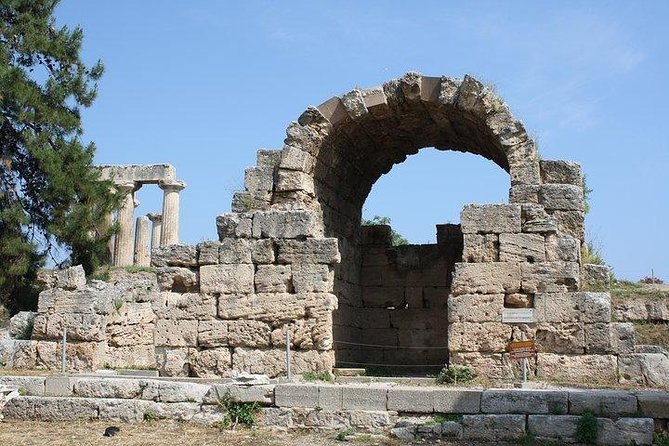
Ancient Corinth is the central stop. Paul spent more than 18 months in Corinth around AD 51 to 52, building a Christian community that later received the letters now known as First and Second Corinthians.
The site includes the Roman Forum, the Bema, and the Temple of Apollo. The Bema is the stone platform associated with Paul’s appearance before Gallio, the Roman proconsul. According to Acts, Gallio treated the dispute as an internal religious matter and declined to judge it.
You can stand near the Bema and picture the public nature of the confrontation. Paul’s work was not happening in isolation. It unfolded in a Roman city where religion, law, trade, and status were closely connected.
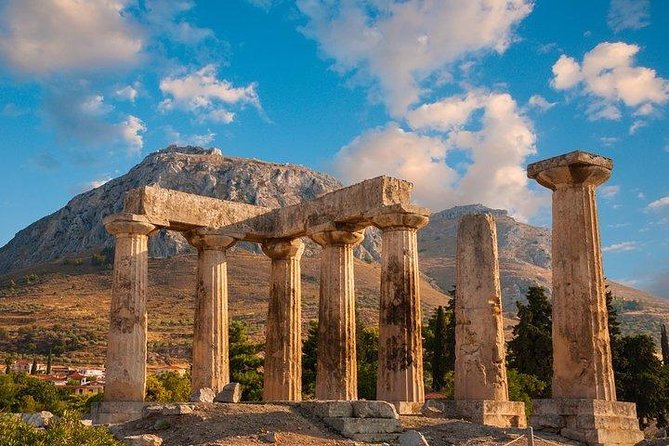
The Temple of Apollo is another strong visual moment. Built around 560 BC, its massive Doric columns are among the oldest surviving temple columns in Greece. When Paul arrived, this pagan sanctuary would have been part of the city’s identity and skyline.
You receive about an hour here, but the site can reward more time if you read slowly and want to study the remains. The important catch is that your driver drops you off and waits outside. You explore independently unless you have booked the optional licensed guide.
That arrangement worked well for people who wanted to move at their own pace. It disappointed at least one visitor who expected a site tour to be included. I consider this the single most important booking detail. If you want a proper explanation beside each ruin, arrange the extra guide before departure.
Kechries offers a quieter port connection
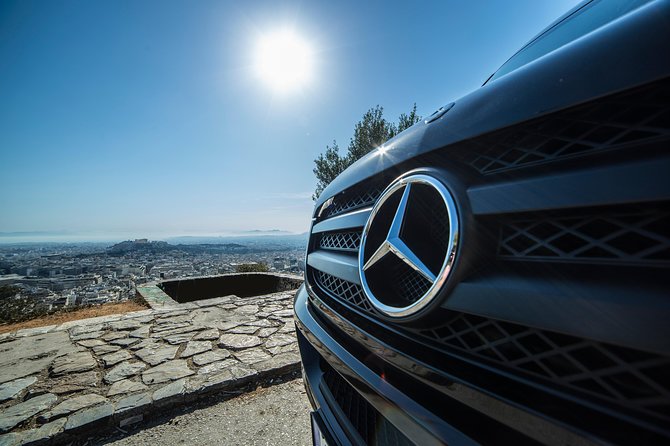
Kechries, ancient Cenchreae, was Corinth’s eastern port. Acts 18:18 connects it with Paul’s departure for Syria, after he cut his hair while fulfilling a vow.
The site today is quieter than Ancient Corinth. That is part of its appeal. You are looking at the place where Paul’s work moved outward by sea, toward other Christian communities and the wider Roman world.
The port also connects with Phoebe, whom Paul commends in his letter to the Romans as a servant of the church at Cenchreae. That reference gives the stop another layer, showing that early Christian communities depended on more than one famous preacher.
You get about 30 minutes here. There is no admission charge listed for the stop, and the seaside setting makes it a pleasant change from the inland ruins. It is not a large archaeological complex, so approach it as a quiet historical pause rather than a major attraction.
Churches and the Bema add a living religious layer
The Apostolou Pavlou church honors Paul’s work in Corinth. It is a short 20-minute visit and offers a modern place of worship connected to the ancient Christian story.
The church does not replace the archaeological site, but it changes the mood. At Ancient Corinth, you see the civic and pagan city around Paul. Here, you encounter the way later Christian communities chose to remember him.
The itinerary also returns to the Bema connection at Ancient Corinth. This repeated focus makes sense for a biblical tour because the platform is one of the clearest physical links between Acts and the ruins.
Lunch is part of the pace, not just a break
The tour includes a leisurely lunch stop in Corinth. If you choose the Greek traditional food option, the meal is included in the price. You can expect a traditional seaside taverna setting, and the food has received especially strong praise, including a meat platter and excellent Greek dishes.
You can also pack a lunch. One group did this to spend more time at the sites, while another enjoyed a long meal with a view. I would choose the included lunch if you want the social and culinary side of Greece. Pack food if your priority is fitting in every stop or spending extra time at Akrokorinthos.
Your driver may help with the menu and timing. That small bit of assistance matters when you are unfamiliar with Greek dishes or need to keep the day on schedule.
Akrokorinthos rewards effort with wide views
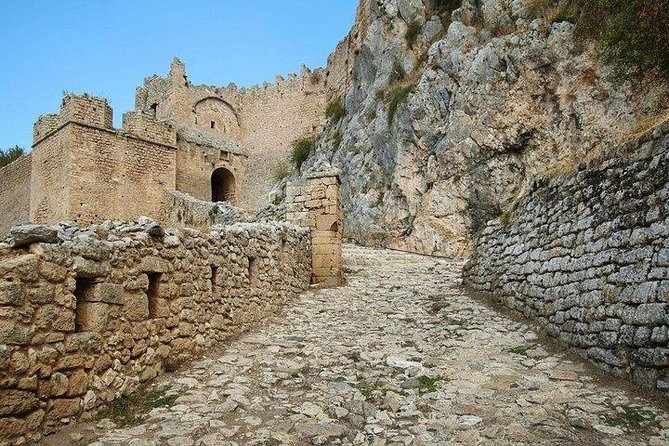
Akrokorinthos is the day’s most demanding stop. The fortress rises above Ancient Corinth, and exploring it involves an uphill walk over old paths and uneven ground.
The reward is a broad view over Corinth and the surrounding area. From the heights, you can understand the defensive value of the site and see how the fortress watched over the routes below.
Allow about an hour, but your actual time depends on how far you climb and how comfortable you are on uneven surfaces. One visitor found the climb harder than expected but felt the view near the top was worth it.
This is not a quick photo stop. Wear practical shoes, carry water, and tell your driver if you need a slower pace. The tour is private, so you have more freedom here than you would on a fixed group excursion.
What the $218.43 price includes
At $218.43 per person, the tour is not the cheapest way to reach Corinth. The value comes from the private vehicle, hotel or port pickup, flexible timing, air conditioning, Wi-Fi, bottled water, and a full route built around Paul rather than a simple transfer to Ancient Corinth.
Lunch is included only with the Greek traditional food option. Entry fees are extra, with €15 per person listed for Ancient Corinth and the Archaeological Museum of Isthmia.
For a couple or small family, the price can make sense because you are paying for a private day and direct transportation. The value is weaker if you mainly want one archaeological site with a formal explanation. In that case, compare the cost of adding a licensed guide or choose a tour where site guiding is included from the start.
The driver quality also matters. Alex, George, Spiros, Stephanos, Panos, Kostas, Vasilis, and others have been noted for safe driving, friendly conversation, clear English, and flexibility. Still, the exact driver is not guaranteed, so book for the structure of the experience rather than a particular name.
Who should book this Corinth experience
I would choose this tour if you want a private biblical day trip from Athens and care about the places behind Paul’s ministry. It suits travelers who enjoy connecting scripture with geography, ancient trade, Roman law, Greek religion, and modern local life.
It is also a good fit for cruise passengers because port pickup and return can be arranged. Confirm your ship departure time carefully and give the company your required return deadline.
I would hesitate if you dislike long days, uphill walking, or self-guided ruins. The itinerary covers many locations, and the driver does not accompany you inside the archaeological areas. Also, the route includes several stops that are meaningful mainly because of their connection to Paul, not because each one is a large, polished attraction.
Free cancellation is available up to 24 hours before the start time. Changes made inside that window are not accepted, so keep your plans firm once the deadline passes.
Should you book it?
Book this tour if you want the full Corinth story, from Mars Hill and the canal to Isthmia, Ancient Corinth, Kechries, and Akrokorinthos. The private format, flexible pacing, strong drivers, and excellent lunch option make it a thoughtful choice for families, couples, church groups, and cruise passengers.
Before paying, decide if you need a licensed guide inside the ruins. If yes, request one in advance. If you are comfortable exploring independently after a detailed briefing from your driver, this tour offers a rewarding and unusually complete way to follow Paul through Corinth.
FAQ
How long does the tour last?
The experience lasts approximately 8 to 9 hours.
What is the price?
The listed price is $218.43 per person.
Is pickup available from Athens hotels?
Yes. Pickup and return are available from hotels, apartments, ports, or another agreed location.
Is this a private tour?
Yes. Only your group participates, and the pickup time can be adjusted upon request.
Does the driver enter the archaeological sites?
No. The drivers provide historical commentary and answer questions, but they are not licensed guides and do not accompany you inside the sites.
Can I book a licensed guide?
Yes. A licensed guide can be requested, subject to availability, for an additional cost.
Are entrance fees included?
No. Ancient Corinth and the Archaeological Museum of Isthmia require an entrance fee listed as €15 per person, payable on site.
Is lunch included?
Lunch is included if you select the Greek traditional food option. Other options may require you to pay for lunch separately or bring your own food.
Just added in Athens
- Ceramic and Pottery Creative Workshop with Two Local Artists★ 4.0 · 57 reviews
- Small-Group Women History in Ancient Greece Walking Tour★ 5.0 · 38 reviews
- Athens Old City Private Photoshoot Tour / 2 hrs★ 5.0 · 109 reviews
- Athens: Wine Workshop Create your Own Wine under the Acropolis★ 5.0 · 77 reviews
- Athens: Greek Wines Tasting with Sommelier and Acropolis Views★ 5.0 · 88 reviews
- Wine Trails Private Tour/ Nemea visit 3 wineries from Athens or Nafplion (10 h)★ 5.0 · 44 reviews
- FLYING DRESS Photoshoot in Athens – Greece★ 5.0 · 47 reviews
- Small-Group Wine Tour in Athens with Tasting★ 5.0 · 33 reviews
Ancient Corinth, Mycenae & Nafplio Tours, compared.
Ancient Corinth Day Trip with Canal & VR Guide
Read our review →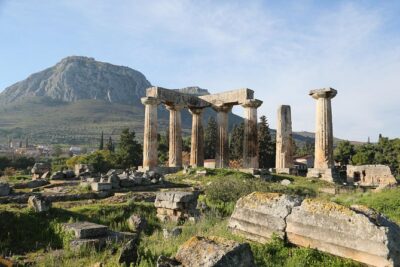
Private Biblical Tour Ancient Corinth & Isthmus Canal from Athens
Read our review →
4-Day Classical Greece Tour: Epidaurus, Mycenae, Olympia, Delphi, Meteora
Read our review →
Ancient Corinth & Nafplio Full Day Trip with Swim
Read our review →
Mycenae and Nafplion Day Trip from Athens with Official guide
Read our review →
Browse the lists this tour appears in