
Reviewed · ACROPOLIS & ATHENS HIGHLIGHTS
Athens: Acropolis FULLY PRIVATE Tour with Licensed Guide
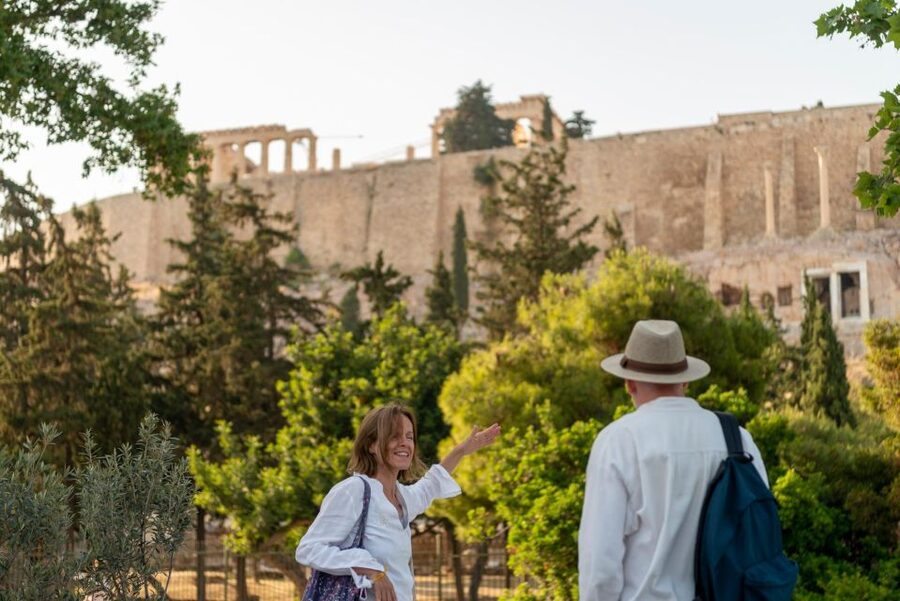
The best part of this Acropolis tour is the private licensed archaeologist at your side. Instead of trying to make sense of broken columns and crowded viewpoints on your own, you get a guide who connects the monuments to Greek myths, ancient theater, warfare, trade, and daily life. I especially like the careful route through the Theater of Dionysus, Propylaea, Temple of Athena Nike, Parthenon, and Erechtheion. I also like that the guide can adjust the storytelling for children or seasoned history fans.
The main catch is price and ticket handling. At $163 per person, this is not a cheap Acropolis visit, and admission is extra. You can ask the operator to arrange skip-the-line tickets after booking, but you need to confirm that before arriving. The site also has steps, uneven ground, and no wheelchair access.
Key points to know before you book
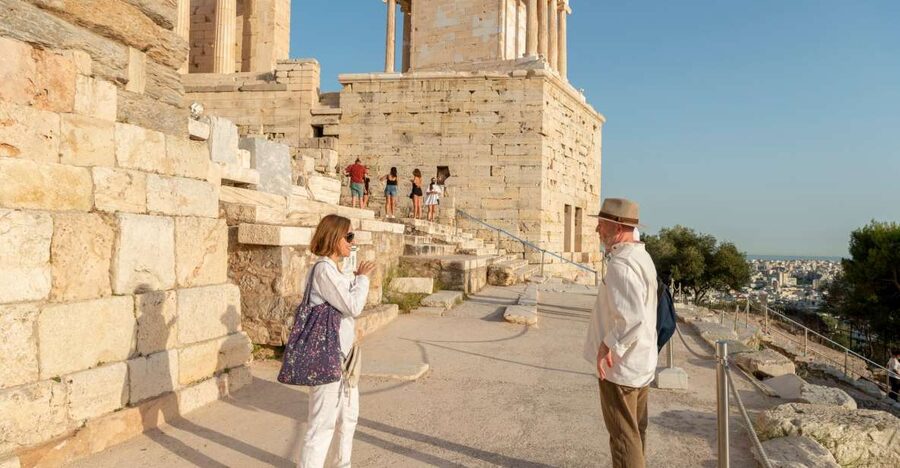
- A private archaeologist leads the way: Your group gets a state-accredited licensed guide rather than a large shared tour.
- The Theater of Dionysus comes first: You see the ancient stage where Greek drama began before climbing toward the Acropolis.
- The guide gives the ruins a human story: Athena, Poseidon, ancient sailors, playwrights, and Athenian builders all enter the explanation.
- The Parthenon is only part of the visit: The Propylaea, Erechtheion, Temple of Athena Nike, and Odeon of Herodes Atticus receive attention too.
- Ticket help is available, but tickets cost extra: Ask for skip-the-line admission after booking and make sure the arrangement is confirmed.
- You can extend the experience: Depending on the option and available time, you may add another site or a Plaka walk with Greek coffee, souvlaki, pies, and sweets.
Why a private Acropolis guide can be worth the money
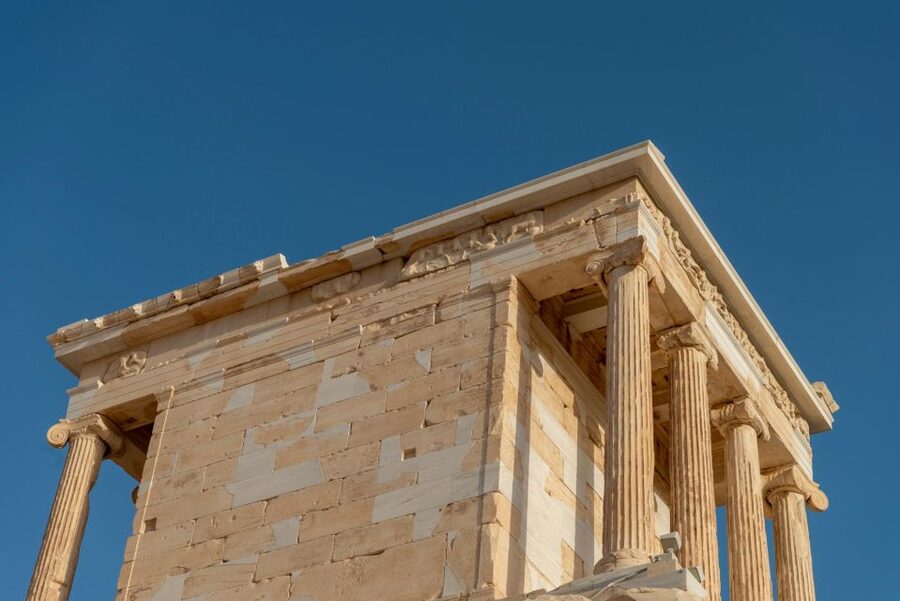
The Acropolis is easy to recognize and surprisingly hard to understand. You see the Parthenon in photographs long before you reach Athens, but the hill contains far more than one famous temple. A good guide helps you read the site in the right order, from theater and fortification to ceremonial entrance, temples, and city views.
That matters even more when you have only a few hours in Athens. A private guide can spend more time on the questions that interest you and less time on material you already know. The tour is designed for groups of your own choosing, so you are not waiting for strangers or listening to a fixed script aimed at the average crowd.
The guide’s role is the strongest reason to choose this experience. Guides who have led the tour include Efie, Betty, Lisa, Ava, Kelly, Vicky, Ria, and Calliopeia. The praise attached to these guides focuses on clear explanations, warmth, passion for Greek culture, good care of the group, and the ability to make old events feel relevant.
You should not assume you will receive a particular guide. Assignments can vary. Still, the repeated emphasis on personal attention is encouraging, especially if you want more than a quick photo at the Parthenon.
More of the old city on foot in Athens:
- Athens: Acropolis & up to 5 Archaeological Sites Combo Pass
★ 4.4 · 12,619 reviews - Athens: Acropolis Ticket with Optional Audio or Live Guide
★ 4.2 · 11,055 reviews - Athens: Acropolis, Parthenon & Acropolis Museum Guided Tour
★ 4.8 · 9,316 reviews
Starting near Makrigianni
The meeting point is near Makrigianni, with the exact location depending on the option you book. The listed starting points include Makrigianni 7 and Makrigianni 11, so check your confirmation carefully rather than walking to the first address you remember.
The total experience can last from 1.5 to 3 hours. The core Acropolis visit is described as about 1.5 hours, while the longer options may include extra guiding or a Plaka walk. Starting times vary with availability, and a time may be changed if access is limited.
I would allow extra time before the meeting point. You do not want to begin a steep archaeological visit while rushing from a hotel or metro stop. Wear firm shoes, carry water, and expect sun exposure and uneven surfaces. Pets are not allowed.
The Theater of Dionysus begins the story
The route includes the Theater of Dionysus, often described as the world’s oldest theater. This is a smart opening stop because it shifts your attention away from the Parthenon and toward the people who used the Acropolis area.
Your guide can explain how plays were performed in the ancient world and how famous Greek dramas first reached audiences on this stage. The theater also makes a useful point about time. Much of what you see on the hill belongs to the classical period, yet theatrical traditions here reach back thousands of years.
This stop is especially useful for families. Children may connect more quickly with a theater than with a damaged temple, and a guide can turn the stone seating and stage into a picture of an ancient performance. Adults who already know Greek drama should still appreciate the setting.
The route involves steps and slopes, so this is not a gentle stroll. The guide can help you pace the walk, but the activity is not suitable for wheelchair users.
Ancient walls before the grand entrance
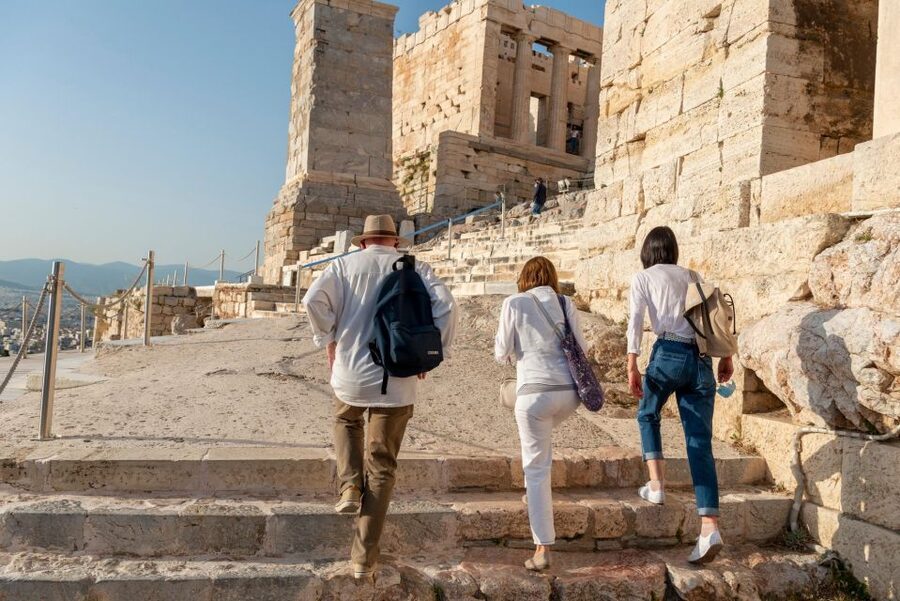
As you continue upward, the guide discusses the defensive walls around the Acropolis. The point is easy to miss without explanation: these fortifications were not built by the classical Athenians alone. They reach back to earlier ancestors, roughly another thousand years before the classical age.
That gives the hill a longer timeline than the familiar story of Pericles and the Parthenon. You are not simply seeing one burst of Greek architecture. You are walking through layers of settlement, defense, religion, politics, and memory.
This is one of the tour’s strongest features. The guide is not limited to naming buildings. The explanation links the structures to the people who built, worshipped, fought, traded, and performed here. Calliopeia, one of the guides who has led this experience, was praised for connecting the archaeological sites with the people who created them.
A few more things to do in Athens worth a look
- Best of Athens Half Day Private Tour
★ 5.0 · 3,714 reviews - Athens Full Day Private Tour
★ 5.0 · 2,903 reviews - Athens Airport Private Arrival Transfer with Meet & Greet
★ 4.5 · 1,495 reviews - Athens Airport to Athens Hotels Private Arrival Transfer
★ 5.0 · 947 reviews
The Propylaea makes a dramatic entrance
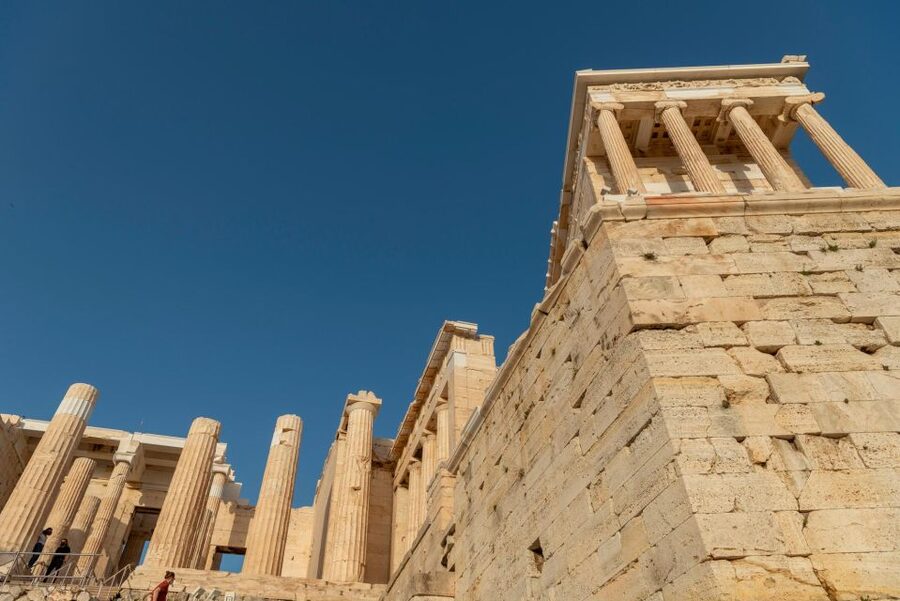
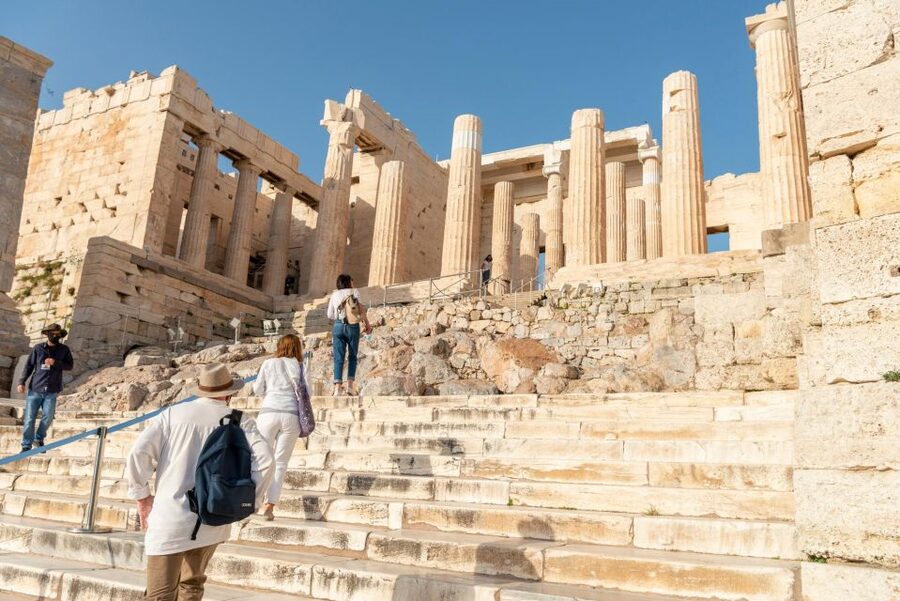
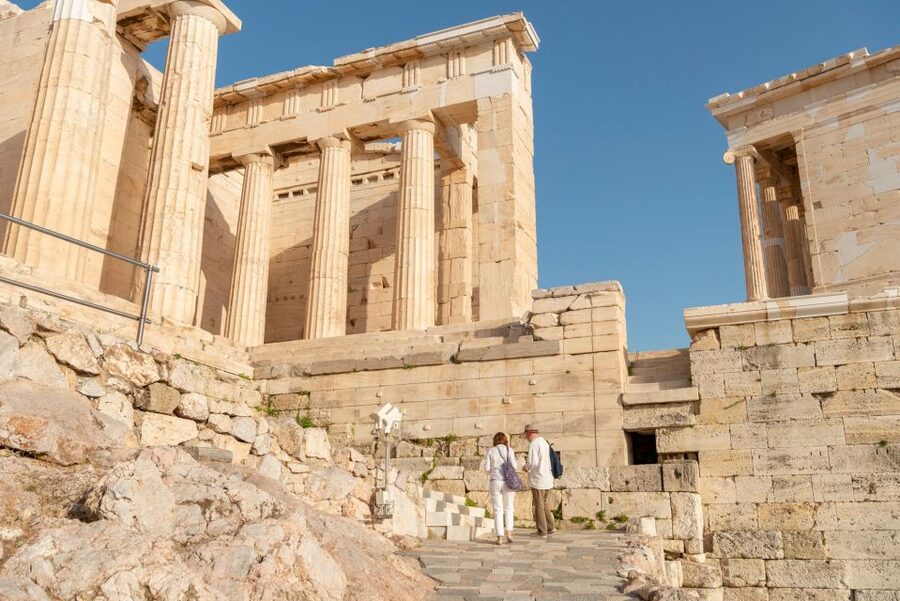
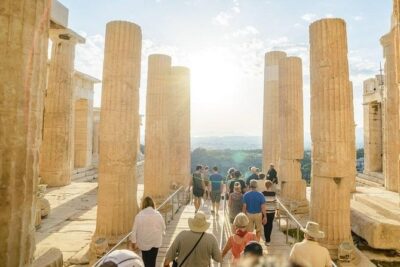
The Propylaea is the monumental gateway to the Acropolis. It is less famous than the Parthenon, but the entrance gives you an important sense of ceremony and power. You do not simply walk onto the hill. You pass through a carefully planned architectural threshold.
Your guide may point out how the site was designed to impress visitors approaching from below. The description of the ancient bronze statue of Athena adds a striking visual detail. Its spear tip was said to catch the sun, and sailors leaving from Cape Sounion, about 70 kilometers away, could see it.
Treat that story as part of the tour’s historical interpretation, not as a feature you can still see today. The statue is gone, but the idea helps you picture the Acropolis as a landmark visible across the ancient Athenian world.
The Propylaea also offers a practical lesson: the Acropolis is more than a collection of isolated temples. Its approach, gates, walls, and elevated position all helped shape the visitor’s experience thousands of years ago.
Athena Nike and the smaller temple with a big message
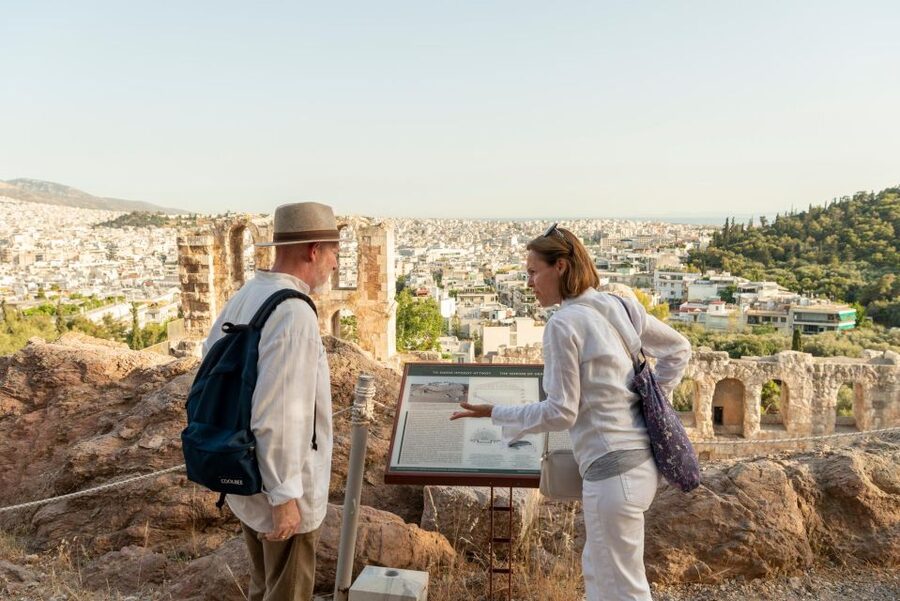
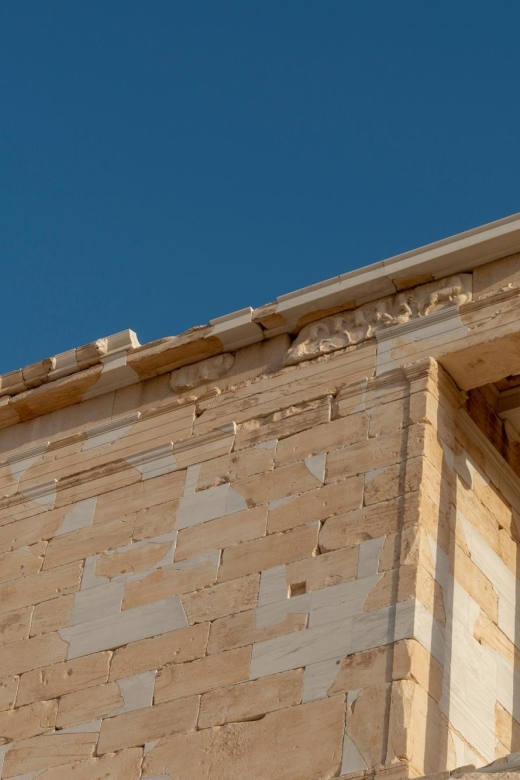
The Temple of Athena Nike receives its own guided explanation. Compared with the Parthenon, it is compact, but its location near the entrance gives it great importance. Athena Nike represents victory, and the temple’s position helped place that idea right at the threshold of the sacred hill.
This is the kind of stop that benefits from a guide. On your own, you might walk past it while heading toward the larger monuments. With an archaeologist, the smaller temple becomes part of the political and religious message of the entire complex.
The tour’s format allows you to ask why this temple was placed here, how it related to Athena, and what the Athenians wanted people to feel as they entered. The guide can also keep the stop brief if your group is more interested in the Parthenon.
The Parthenon, viewed with context
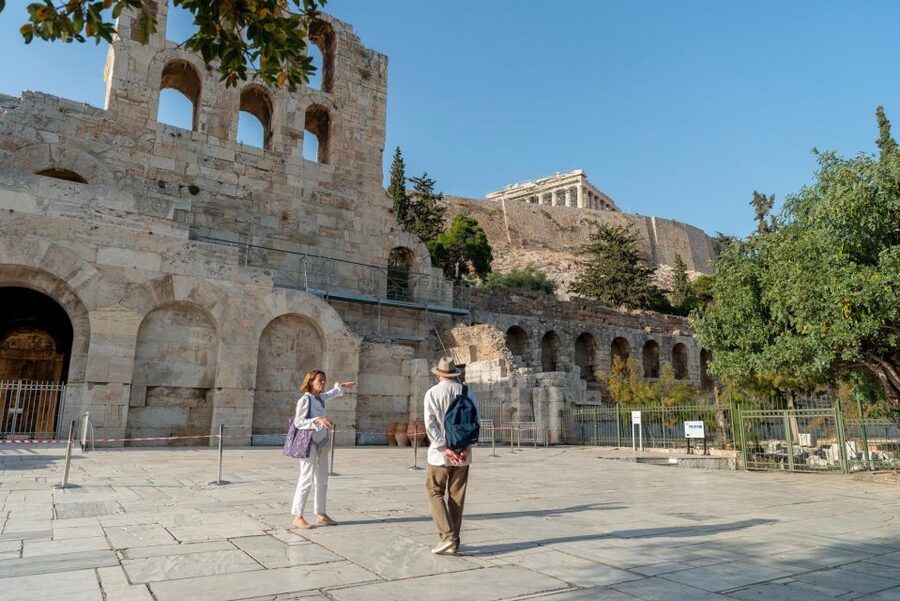
The Parthenon is the visual center of the visit, and the tour gives it about 15 minutes of focused explanation within the larger route. That may sound short, but it works better than treating the building as the only attraction.
You will see the temple’s scale, columns, sculptural decoration, and elevated position over Athens. Your guide explains why it is considered a masterpiece of classical Greek architecture and places it within the religious world dedicated to Athena.
I like the fact that the Parthenon comes after the Theater of Dionysus, walls, Propylaea, and Temple of Athena Nike. By then, you have a better sense of the hill as a planned sacred and defensive site. The temple is still the star, but it no longer has to carry the whole story by itself.
The main limitation is crowding. The Acropolis can be busy, and no guide can remove every person from your photographs. One guide, Vicki, was praised for knowing where to find strong photo positions and how to reduce unnecessary uphill effort. That kind of local route judgment can make a real difference, especially in warm weather.
The views are another major reward. From the top, Athens spreads below you, and your guide helps connect the modern city with the ancient site. I would linger after the formal explanation if conditions and your ticket allow it. The tour ends with time to remain on the hill or receive help with onward directions.
The Erechtheion and the contest between Athena and Poseidon
The Erechtheion gives the tour a different mood. Its unusual design and sacred associations invite stories rather than a simple lesson in symmetry. Your guide explains the mythic struggle between Athena and Poseidon and the role of the temple in that story.
This is also where mythology and archaeology sit side by side. The guide can distinguish the surviving stonework from the beliefs and traditions attached to the place, giving you a better sense of how the ancient Athenians understood their city.
The Erechtheion is often one of the most memorable stops because it does not look like a simplified version of the Parthenon. It has a more complex shape and a different character. If your guide is Efie, Betty, Ava, Lisa, or another member of the team, expect the exact emphasis to vary, but the itinerary includes time here.
Descending past the Odeon of Herodes Atticus
The tour finishes by descending through the olive trees toward the Odeon of Herodes Atticus. This theater is still used for performances each summer, which gives the ruins an unusual link to modern Athens.
I like this ending because it avoids closing the experience at the most obvious monument. You leave with a reminder that the Acropolis is not only an archaeological site. It remains part of the city’s cultural life.
The descent can be easier than the climb, but uneven ground remains part of the route. Your guide can return you to the meeting point and help with onward directions, or you can stay longer to enjoy the views if the access rules and your schedule permit.
The listed drop-off choices include Makrigianni 7, Makrigianni 11, and Plaka. Confirm the exact option before booking, particularly if you have a restaurant reservation or another timed visit.
Optional Plaka food and a longer private visit
Some options allow you to extend the tour with another site or a walk through Plaka. The food stops are built around classic tastes such as Greek coffee or mountain tea, souvlaki, savory pies, and sweets or cake.
This add-on changes the feel of the experience. The Acropolis portion is focused and archaeological. Plaka offers a more casual way to continue the day, with local food and neighborhood streets. The available duration can reach three hours, so check which option you are selecting rather than assuming every booking includes the extension.
An added site may also suit you if the Acropolis is only one part of your ancient Athens plans. The tour has previously included the Ancient Agora in a longer private experience, but the information provided here does not promise that site for every booking. Ask exactly what the extra option contains.
Is $163 per person good value?
At $163 per person, this is a premium guided visit. Admission fees are not included, so your total cost will be higher once tickets are added. The operator can purchase skip-the-line tickets on request after booking, but that arrangement needs to be made clear in advance.
The price makes the most sense for a small private group that values time, questions, and a licensed archaeological guide. If you are two people splitting a private experience, it may feel expensive. If you are a family or a group of friends, the cost may compare more favorably with several separate admissions and a private guide arranged elsewhere.
You are paying for more than entry. You are paying for a structured route, explanations at every major monument, flexible pacing, and help making sense of a complicated site. The value is strongest if you would otherwise walk around without understanding why the buildings matter.
It is less compelling if you only want a quick look at the Parthenon and a few photographs. In that case, a self-guided visit may suit your budget better, provided you are comfortable arranging admission and planning your own route.
Who should book this Acropolis experience?
I would choose this tour for first-time visitors who want the Acropolis explained in a clear, human way. It also fits families because the guide can adjust the level of detail and use stories about gods, theaters, sailors, and ancient performances to keep younger minds involved.
History fans should appreciate the licensed archaeological background and the attention given to lesser-known parts of the hill. The tour is also a good match for anyone with limited time in Athens who wants to cover the main monuments without guessing where to go next.
You should think twice if stairs and uneven paths are difficult for you. Wheelchair users cannot take this tour. I would also avoid booking it without a ticket plan, since admission is separate and the start time may change when availability is limited.
The tour is available in English, German, and Italian. Cancellation is free up to 24 hours before the start, and you can reserve now and pay later, which helps if your Athens schedule is still shifting.
Should you book it?
Book this Acropolis tour if you want the Parthenon placed in a larger story, from the Theater of Dionysus and ancient walls to the Propylaea, Athena Nike, Erechtheion, and Odeon of Herodes Atticus. The private format and strong guide-led focus are the real advantages.
Before paying, confirm three things: the exact meeting point, whether the operator will purchase your skip-the-line ticket, and what the longer three-hour option includes. If the price fits your budget and you want careful explanations rather than a fast photo stop, this is a very solid way to see Athens’ most important ancient site.
FAQ
How long does the Acropolis tour last?
The tour lasts between 1.5 and 3 hours, depending on the option selected and availability. The main Acropolis guiding is listed as about 1.5 hours, with longer options available.
Is the tour private?
Yes. The tour is exclusive to your group and is led by a licensed expert archaeological guide.
Are Acropolis admission tickets included?
No. Ticket costs and admission fees are extra. You can ask the operator to purchase skip-the-line tickets after booking.
Does the tour skip the ticket line?
Skip-the-line tickets are available on request, but they are not included in the base price. Contact the operator after booking to arrange them.
Which monuments are included?
The route includes the Acropolis, Theater of Dionysus, Propylaea, Temple of Athena Nike, Parthenon, Erechtheion, and Odeon of Herodes Atticus.
What languages are available?
Guiding is available in English, German, and Italian.
Where does the tour meet?
The meeting point varies by the option booked. Listed starting locations include Makrigianni 7 and Makrigianni 11.
Is the tour suitable for wheelchair users?
No. The Acropolis has steps and uneven surfaces, and the activity is not suitable for wheelchair users.
Can I cancel the booking?
Yes. You can cancel up to 24 hours before the tour for a full refund. Reserve now and pay later is also available.
Just added in Athens
- Ceramic and Pottery Creative Workshop with Two Local Artists★ 4.0 · 57 reviews
- Small-Group Women History in Ancient Greece Walking Tour★ 5.0 · 38 reviews
- Athens Old City Private Photoshoot Tour / 2 hrs★ 5.0 · 109 reviews
- Athens: Wine Workshop Create your Own Wine under the Acropolis★ 5.0 · 77 reviews
- Athens: Greek Wines Tasting with Sommelier and Acropolis Views★ 5.0 · 88 reviews
- Wine Trails Private Tour/ Nemea visit 3 wineries from Athens or Nafplion (10 h)★ 5.0 · 44 reviews
- FLYING DRESS Photoshoot in Athens – Greece★ 5.0 · 47 reviews
- Small-Group Wine Tour in Athens with Tasting★ 5.0 · 33 reviews
Acropolis & Athens Highlights, compared.
Acropolis & up to 5 Archaeological Sites Combo Pass
Read our review →
Acropolis, Parthenon & Acropolis Museum Guided Tour
Read our review →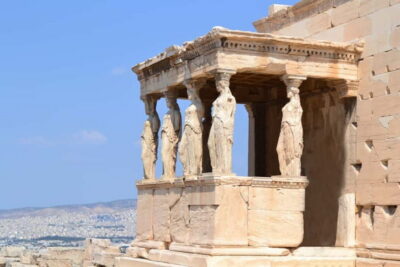

Acropolis monuments & Parthenon Walking Tour with Optional Acropolis Museum
Read our review →
Athens All Included: Acropolis and Museum Guided Tour with Ticket
Read our review →
Acropolis Museum Ticket with optional Audio Guide
Read our review →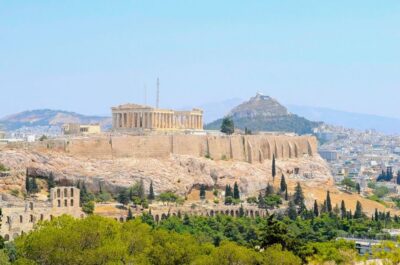
Acropolis Ticket & Optional Self-Guided Audio Tours
Read our review →Browse the lists this tour appears in