
Reviewed · ACROPOLIS & ATHENS HIGHLIGHTS
Athens & Acropolis Highlights: Greek Mythology Small-Group Tour
The clever idea here is to use Greek mythology as a key to Athens. Instead of treating the Acropolis as a pile of famous stones, your guide connects Athena, Nike, Dionysus, Hephaestus, and Zeus to the temples, theaters, and civic spaces in front of you. That makes the ruins easier to remember and much more human.
I like the small-group format, capped at 15 people, and the route from the Temple of Olympian Zeus through the Acropolis to the Ancient Agora. I also like the guides’ use of stories and visual aids. Guides such as Irene, Michael, Dani, Athena, Maria, and Christina have been praised for clear explanations, good pacing, and the ability to answer detailed questions.
The main catch is cost and effort. The $54.42 tour price does not include admission, and the four-hour route includes steep climbs, stairs, uneven ground, and plenty of walking. You must also keep track of your guide in busy areas, since one poor experience involved a larger-than-advertised group and a guide who lost sight of people.
Key points to know before booking
- Mythology gives the Acropolis a memorable thread: Stories about Athena, Nike, Dionysus, and Hephaestus help explain why each monument mattered.
- The route covers two major archaeological areas: You visit the Acropolis and Ancient Agora, ending at the Temple of Hephaestus.
- Groups are limited to 15 people: That is small enough for questions, though group size and guide style can still affect the experience.
- Tickets are extra: The Acropolis admission is listed at €30 and Ancient Agora admission at €20 for the four-hour option.
- Expect a real uphill walk: Wear sturdy shoes, carry water, and bring a hat, especially in warm weather.
- Morning timing can be wise: One morning group found the Acropolis far more crowded by the time it was leaving.
Why mythology makes the Acropolis easier to understand
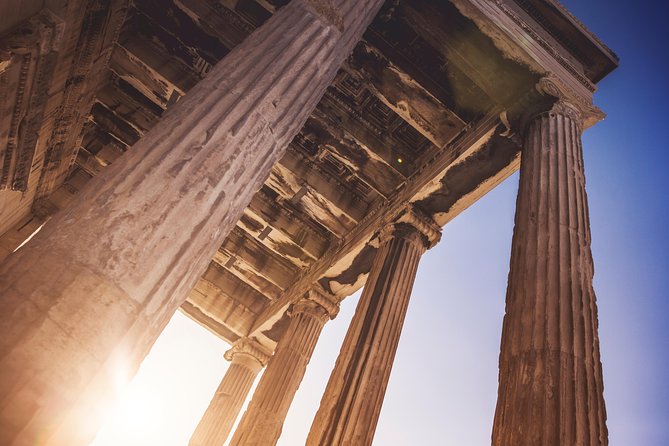
The Acropolis is famous, but fame alone does not explain what you are looking at. From a distance, the Parthenon, Erechtheion, and smaller temples can blur into one grand archaeological scene. A guide who links the buildings to ancient beliefs gives you a practical way to sort them out.
This tour puts mythology at the center without leaving history and architecture behind. You hear why Athena mattered to Athens, how Nike represented victory, and why the gods were tied to everyday trades and civic life. The stories are not just entertaining extras. They help explain the purpose of the buildings.
That approach works especially well if you know the broad outlines of Greek mythology but have trouble connecting names to places. It also suits you if you are starting from scratch. Guides have been praised for explaining the myths in plain language, asking questions, and adding small facts beyond the standard textbook account.
The strongest guide experiences seem to come from people who enjoy teaching. Irene has been praised for breaking complex subjects into understandable pieces. Dani has been noted for adding extra details to familiar stories and keeping the group moving. Other guides, including Michael, Christina, Maria, and Chrysanthi, have been singled out for making the material lively while watching the group’s comfort.
Guides change, so you cannot book a particular personality unless the operator confirms one. Still, the repeated praise for clear storytelling is a good reason to choose this tour instead of simply walking through the monuments with an audio guide.
More of the old city on foot in Athens:
- Athens: Acropolis & up to 5 Archaeological Sites Combo Pass
★ 4.4 · 12,619 reviews - Athens: Acropolis Ticket with Optional Audio or Live Guide
★ 4.2 · 11,055 reviews - Athens: Acropolis, Parthenon & Acropolis Museum Guided Tour
★ 4.8 · 9,316 reviews
Starting at the Temple of Olympian Zeus and Arch of Hadrian
The meeting point is at the Arch of Hadrian, on Leoforos Vasilisis Amalias 50, beside the Temple of Olympian Zeus. This is a sensible place to begin because it puts you near two visible reminders of Athens as both a Greek and Roman city.
The tour discusses the Temple of Olympian Zeus from the outside, with about 15 minutes devoted to the site. The temple was once one of the ancient world’s great marble buildings, but you should understand that this is an exterior visit, not a full entry and exploration.
That short stop works as an opening chapter. Zeus represents the grand scale of ancient religious building, while the temple’s long construction story helps set up the political ambition behind the monuments you see later. You get an early connection between myth, power, and architecture before climbing toward the Acropolis.
The Arch of Hadrian is also an easy landmark for finding the group. Confirmation arrives at booking unless you reserve within an hour of departure, when it is sent as soon as possible subject to availability.
The Acropolis climb, with eight major sights in view
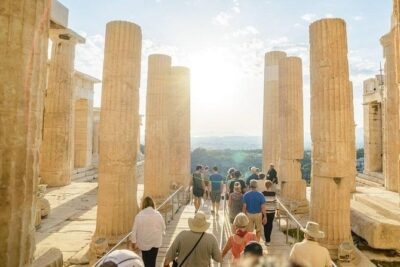
The Acropolis section lasts about 90 minutes, though the full experience of moving between the main monuments depends on crowd levels and the group’s pace. This is the tour’s main event, and it demands attention from both your mind and your legs.
You will walk over uneven surfaces and climb uphill. Several people have found the ascent easier than expected, but others describe it as steep. The practical answer is simple: wear good walking shoes, carry water, use a hat in strong sun, and expect to stop along the way.
A thoughtful guide can make the climb far more manageable. Guides have been praised for pausing in shaded areas, breaking the uphill route into smaller sections, and allowing water or rest breaks without losing the group’s rhythm. On a hot day, that care matters as much as the facts.
Theater of Dionysus
The Theater of Dionysus receives about 15 minutes. This is where the tour’s mythology theme connects directly with the birth of Western drama. Dionysus was linked to wine and the grape harvest, and the theater was dedicated to him.
You learn that works by Aeschylus, Sophocles, Euripides, and Aristophanes were first performed here. That detail changes the site from a set of stone seats into a place where tragedy, comedy, politics, and religion met in public.
The stop is brief, but it gives useful context before you reach the Acropolis summit. Ancient Athens was not only a city of temples. It was also a place where citizens gathered to watch stories about gods, heroes, war, family, and civic duty.
Same base, a completely different day:
- Athens: Cape Sounion & Poseidon Temple Sunset Half-Day Trip
★ 4.8 · 8,241 reviews - Athens: Acropolis and Parthenon Guided Walking Tour
★ 4.6 · 5,882 reviews - All Day Cruise -3 Islands to Agistri,Moni, Aegina with lunch and drinks included
★ 5.0 · 4,958 reviews - Athens, Piraeus, and Coastline: Blue Hop-On Hop-Off Bus
★ 3.9 · 4,849 reviews
Temple of Athena Nike
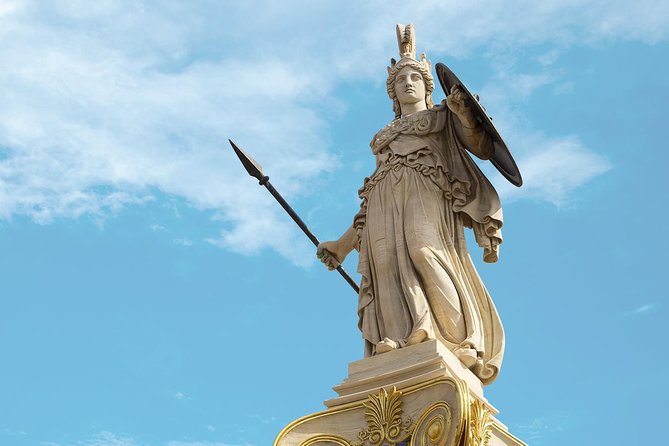
The Temple of Athena Nike is small compared with the Parthenon, but its location and meaning make it easy to remember. It honored Athena in her victory aspect, joined with Nike, the goddess of victory.
Your guide may explain the tradition that the cult statue had no wings so victory would not leave Athens. That is exactly the kind of compact myth this tour handles well. The story is short, tied to the building, and linked to the city’s hopes in war.
The stop lasts about 10 minutes. Crowds may make close viewing difficult, so listen carefully and use the guide’s position as your reference point.
Erechtheion and its unusual identity
The Erechtheion gets another 10 minutes. It was built to house the ancient wooden cult statue of Athena and to honor the city at the height of its power.
This building is often more confusing than the Parthenon because it has an irregular shape and several sacred associations. A guide helps you understand why it does not follow the same visual order as the larger temple nearby.
The mythology is especially useful here because the Erechtheion is not simply a backup monument. It reflects the layered religious traditions of Athens and the importance of Athena as the city’s patron goddess.
The Parthenon
The Parthenon receives about 20 minutes, the longest single stop on the upper Acropolis. Built in the mid-fifth century BCE, it was dedicated to Athena Parthenos, or Athena the Virgin.
Most people arrive already knowing its name. The value of a guide is in helping you look more closely at its role, design, and place within the wider sanctuary. You learn why it is associated with the Doric order and why its design became such a powerful model for later architecture.
Do not expect a quiet, private encounter. The Parthenon is the busiest part of the route, and the group must share the summit with many other people. A guide who uses printed images or visual aids can help you picture missing details and understand the building beyond the surviving columns.
One practical issue deserves attention: no microphone is guaranteed. One person found it difficult to hear everything without one. Stay close, especially when the guide is explaining a monument in a crowded area.
The Ancient Agora and the civic life of Athens
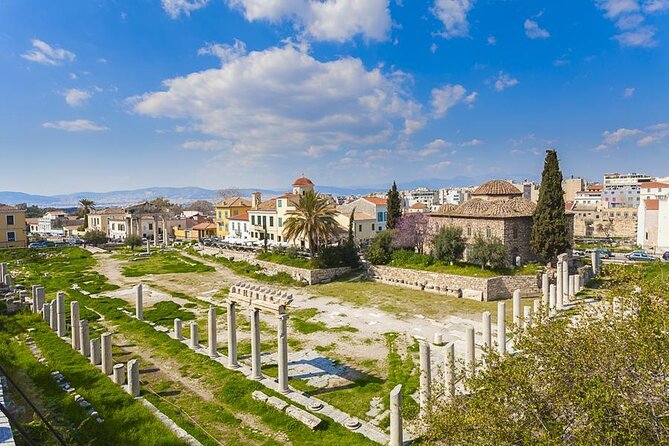
After the Acropolis, the tour continues to the Ancient Agora for about an hour. This is where the route broadens from temples and sacred myths to the daily machinery of the city.
The Agora was the center of political, commercial, administrative, social, religious, and cultural life. It was also connected to the legal system. That range makes it an important counterpoint to the Acropolis, which can feel focused on divine patrons and public ideals.
Here, your guide can show how ancient Athens functioned as a community. The Agora was not just a market. It was a place where people met, conducted business, took part in civic life, and dealt with questions of law and public order.
The mythology remains useful, but the emphasis shifts. You are no longer looking only at gods and sacred buildings. You are considering how religious beliefs sat alongside trade, politics, and ordinary work.
The tour ends in the Agora, rather than returning you to the starting point. That matters for planning. The end point is the Ancient Agora of Athens, and you should arrange your next activity from there rather than assuming you will finish near the Temple of Olympian Zeus.
Finishing at the Temple of Hephaestus
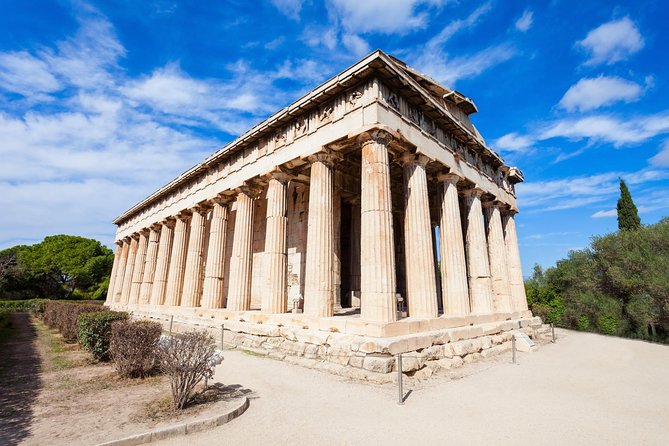
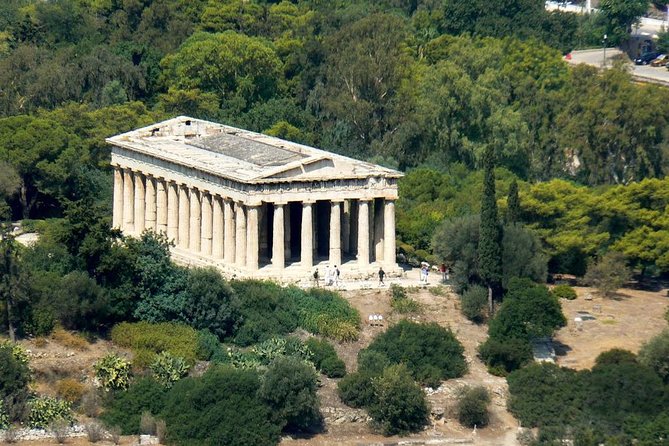
The final stop is listed as the Temple of Aries, but the description identifies the monument as the Temple of Hephaestus. This is the temple you will actually be seeing at the end of the Ancient Agora visit.
It is dedicated to Hephaestus, protector of metalworkers, and Athena Ergani, associated with potters and cottage industries. That connection gives the building a welcome link to working life. Ancient religion was not only about kings, wars, and grand civic ceremonies. It also reflected the trades that kept the city running.
The temple is one of the best-preserved ancient temples in the world. Its condition makes it a strong final stop because you can read its form more easily than at many ruined sites. Your guide can point out how its design and function fit into the Agora’s commercial and social setting.
Ending here also gives the tour a satisfying arc. You begin with Zeus and the grand scale of divine power, move through Athena’s sanctuary and the theater of Dionysus, then finish with Hephaestus and the practical world of skilled work.
What the $54.42 price really covers
At $54.42 per person, the tour is reasonably priced for four hours with a certified guide and a group limited to 15. The value depends on how much context you want. If you only need directions and photographs, you can spend less by visiting independently. If you want the myths, architectural explanations, and links between the sites, the guide adds real value.
The headline price does not include site admission. For the four-hour option, the listed entry costs are €30 for the Acropolis and €20 for the Ancient Agora, adding €50 per person before any other expenses. That makes the overall outing notably more expensive than the tour price alone.
The operator can pre-purchase tickets, which may simplify the process. You should still understand exactly what you are paying for before departure, since entry fees are non-refundable and non-exchangeable.
The tour includes a certified guide, small-group service, and a fun ancient Athens map. It does not include food, drinks, or transport to and from the meeting point. The central starting location is easy to reach by public transportation, but you need to make your own way there.
Who will enjoy this four-hour route most
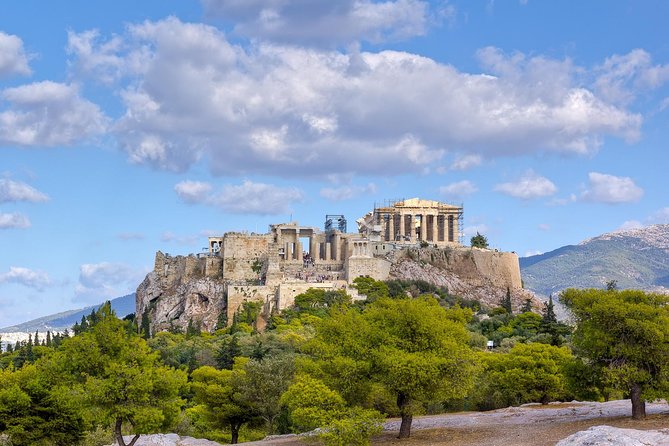
I would choose this for you if you want the Acropolis explained rather than simply photographed. It is especially good for anyone interested in mythology, ancient religion, classical architecture, or the way public life worked in Athens.
Families and mixed-age groups may also appreciate the storytelling format. The material is serious, but the myths give younger visitors something concrete to follow. The route is not described as inaccessible to most people, yet the climb and uneven ground mean you should judge your own fitness carefully.
This is also a strong choice for a first full day in Athens. A morning start can help you see the Acropolis before crowds grow thicker, and the route gives you an overview of the city’s most important ancient spaces.
I would hesitate if you dislike guided pacing, need a slow and quiet visit, or want to linger at each monument for photography. Four hours covers a lot, and the group must keep moving. The experience also depends on hearing the guide clearly and staying together in crowded spaces.
The maximum group size is stated as 15, but one past group was reported as 18, with some difficulty keeping everyone together. That appears to be an exception, not the stated standard, but it is worth knowing. Look for the guide’s identifying sign or visual marker and stay near the group at busy points.
Practical details that can make the day easier
Meet at the Arch of Hadrian and confirm the exact departure time on your booking. The tour is offered in English, although one account describes a French-language experience, so confirm the language available for your date if that matters.
Do not bring a large backpack, stroller, or big bag to the Acropolis. These are not allowed there. Carry only what you need, including water, a hat, and any required identification.
People under 25 should carry an ID card or passport in case they qualify for an admission discount. Since entry fees may be purchased separately, having proof of age can matter at the ticket stage.
The experience requires good weather and a minimum number of participants. If weather or minimum attendance causes cancellation, you are offered another date or experience, or a full refund. For your own cancellation, you receive a full refund if you cancel at least 24 hours before the start time. Inside that window, no refund is provided and changes are not accepted.
Should you book the Athens mythology tour?
Book it if you want the Acropolis and Agora to make sense as places shaped by gods, citizens, artists, workers, and political life. The best part is the connection between story and stone, especially when a guide such as Irene, Michael, Dani, or Christina turns a familiar monument into a clear human story.
Before paying, add the €30 Acropolis and €20 Agora admission costs to the tour price. Then decide if four hours of expert explanation, a small group, and a carefully linked route fit your budget.
My advice is to choose a morning departure, wear proper shoes, stay close to the guide, and treat the mythology as a way into the history rather than a substitute for it. For a first visit to Athens, this is a useful and engaging introduction. For a repeat visit, it works best if you want fresh context for monuments you have already seen.
FAQ
How long does the tour last?
The experience lasts approximately four hours. The listed route includes the Temple of Olympian Zeus, the Acropolis, the Theater of Dionysus, the Temple of Athena Nike, the Erechtheion, the Parthenon, the Ancient Agora, and the Temple of Hephaestus.
Are admission tickets included?
No. Acropolis admission is listed at €30 per person, and Ancient Agora admission is listed at €20 per person for the four-hour option. The operator can pre-purchase tickets if you request this.
Where does the tour start and finish?
The tour starts at the Arch of Hadrian, at Leoforos Vasilisis Amalias 50 in Athens. It ends at the Ancient Agora of Athens.
How large is the group?
The tour has a maximum of 15 travelers according to the stated details. One past account described a group of 18, so group size may occasionally vary.
What should I bring?
Wear good walking shoes and bring water and a hat. Strollers, backpacks, and large bags are not allowed at the Acropolis. People under 25 should bring an ID card or passport for possible discounts.
Can I cancel for a refund?
You can cancel at least 24 hours before the start time for a full refund. Cancellations or changes made less than 24 hours before departure are not accepted for a refund. If poor weather or insufficient attendance cancels the experience, you are offered another date or a full refund.
Just added in Athens
- Athens: Half-Day Morning Catamaran Cruise with Meal & Drinks★ 4.9 · 221 reviews
- Athens hotels to Athens airport Private departure transfer★ 5.0 · 285 reviews
- Argolis: Full-Day Tour in Mycenae & Nafplio★ 4.2 · 350 reviews
- Athens: Riviera Catamaran Cruise with Meal and Drinks★ 5.0 · 345 reviews
- Athens: Delphi, Corycian Cave, and 300 Battlefield Day Trip★ 4.8 · 344 reviews
- 3-Day Classical Greece Tour: Epidaurus, Mycenae, Nafplion, Olympia, Delphi★ 4.5 · 342 reviews
- Best of Athens Half Day Private Tour★ 5.0 · 353 reviews
- Electric Bike Tour of Athens by Night★ 5.0 · 355 reviews
Acropolis & Athens Highlights, compared.
Acropolis & up to 5 Archaeological Sites Combo Pass
Read our review →
Acropolis, Parthenon & Acropolis Museum Guided Tour
Read our review →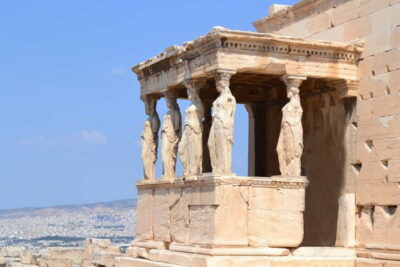

Acropolis monuments & Parthenon Walking Tour with Optional Acropolis Museum
Read our review →
Athens All Included: Acropolis and Museum Guided Tour with Ticket
Read our review →
Acropolis Museum Ticket with optional Audio Guide
Read our review →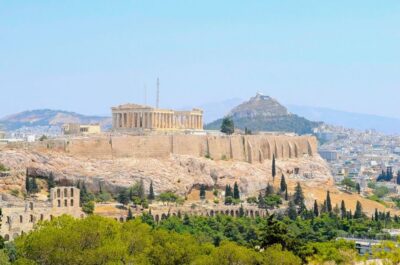
Acropolis Ticket & Optional Self-Guided Audio Tours
Read our review →Browse the lists this tour appears in