
Reviewed · WALKING TOURS
Santorini: Akrotiri Prehistoric City Guided Walking Tour
Akrotiri is Santorini’s most haunting sight: a whole Bronze Age city buried under volcanic pumice for nearly 3,500 years. You’ll walk past ancient streets, workshops, pottery, and multi-story homes while a licensed archaeologist explains how this once-busy town met its sudden end. The myth of Atlantis still clings to the site, though the real story is fascinating enough without legend.
I like the chance to ask questions during a guided visit, then continue exploring at your own pace. I also like the easy pairing with a nearby beach for a swim. The main concern is reliability: despite the advertised private-group format, some bookings were folded into large groups, and several people had trouble finding or meeting their guide.
Key points to know before booking
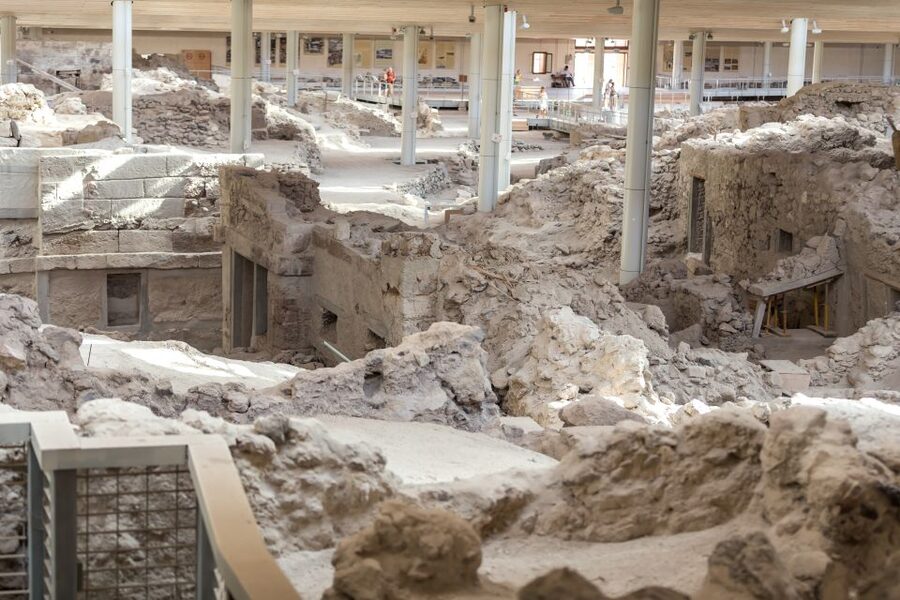
- A city buried in the 16th century BC: See streets, squares, workshops, pottery, and houses preserved beneath volcanic pumice.
- A licensed archaeologist leads the visit: The guide adds context that is hard to get from signs alone.
- The 90-minute schedule is compact: You get a focused explanation, followed by free time inside the site.
- The $424 price covers up to two people: Entry tickets are extra, so the value depends on having two people who want expert interpretation.
- Private group is not guaranteed in practice: Some visitors were attached to much larger groups or had difficulty locating the guide.
- Wheelchair access is listed: Confirm the exact route and meeting details if mobility access is important to you.
Why Akrotiri is Santorini’s essential ancient site
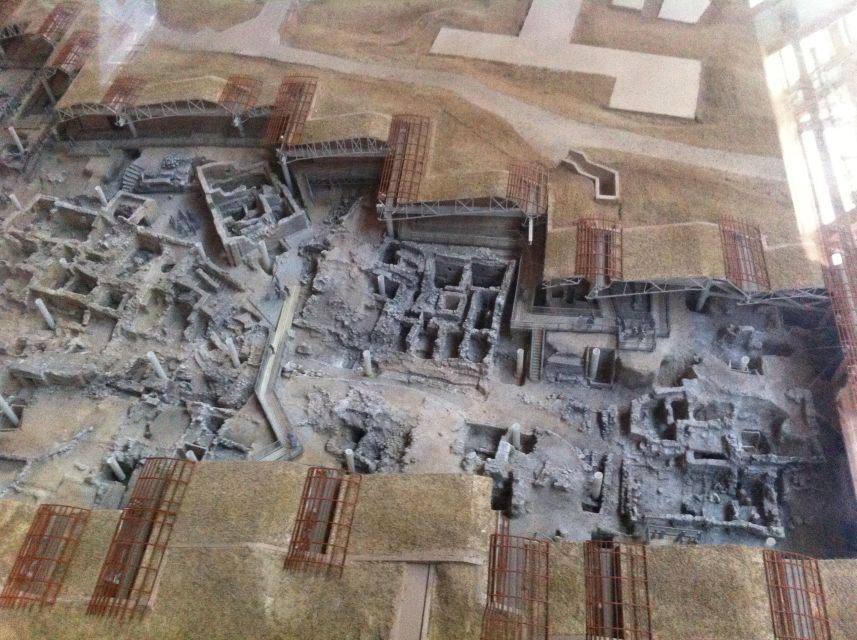
Santorini is famous for white villages and sunset views, but Akrotiri tells you what existed here long before the postcard scenery. This was a planned settlement from the Bronze Age, with streets, public spaces, workshops, and substantial houses. The town was not simply a scatter of huts. It had urban order and an advanced level of construction.
A volcanic eruption in the 16th century BC buried the settlement under a thick layer of pumice. Much of the island collapsed beneath the sea, and Akrotiri remained hidden until excavations began in 1967 under Professor Spyros Marintos. That long burial is the reason the site is so special. The eruption destroyed daily life, but it also covered buildings and objects before time, weather, and later construction could erase them.
I find the comparison with Pompeii useful, though Akrotiri is older by many centuries and was preserved in a different way. Here you are looking at a Bronze Age town whose streets and homes survived under volcanic material. The connection with Atlantis is intriguing, but you should treat it as a legend tied to the eruption rather than a proven identification.
A few more things to do in Santorini worth a look
- Fira: Guided Foodie Walking Tour with Tastings
★ 4.9 · 474 reviews - Athens: Acropolis and Parthenon Guided Walking Tour
★ 4.6 · 5,882 reviews - Greek Food Walking Tour in Athens
★ 5.0 · 4,740 reviews
Meeting your archaeologist at the excavation entrance
Your meeting point is the entrance to Akrotiri Prehistoric City, after the ticket office. This detail matters. You need to buy your admission ticket first, since the ticket is not included, then look for the guide beyond the ticket office.
The guide is a licensed archaeologist, and the planned visit lasts about 1.5 hours. That is enough time for a useful introduction and a walk through the main excavated area, but it is not a full-day archaeological seminar. You will want to stay alert at the start, confirm the guide’s identity, and make sure the guide knows you have arrived.
This is especially important because the meeting process has caused problems. Some people arrived early but could not tell which guide or group to join. Others were placed with a large bus tour. One booking reported that the guide left without realizing the group was still waiting, while another said no guide had been sent and a different guide allowed them to tag along.
Those incidents are not a reason to dismiss Akrotiri itself. They are a reason to be organized. Arrive early, remain near the designated entrance, and keep your phone available for any contact from the operator. If the group begins moving, make sure you are visibly included before setting off.
Streets, squares, and workshops beneath the pumice
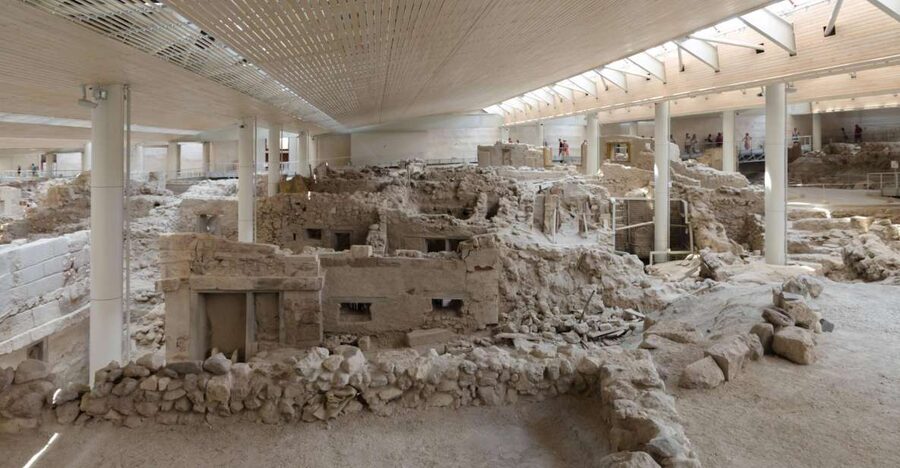
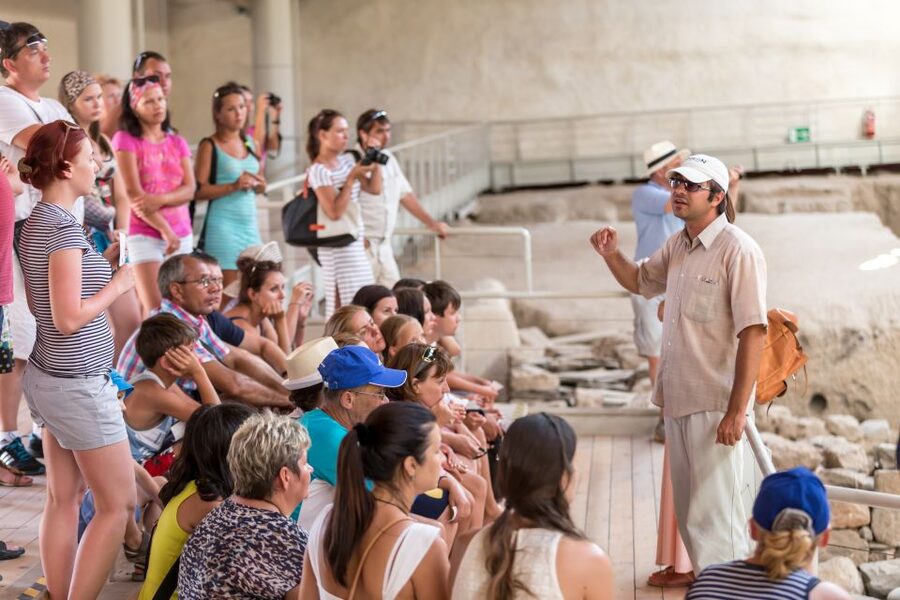
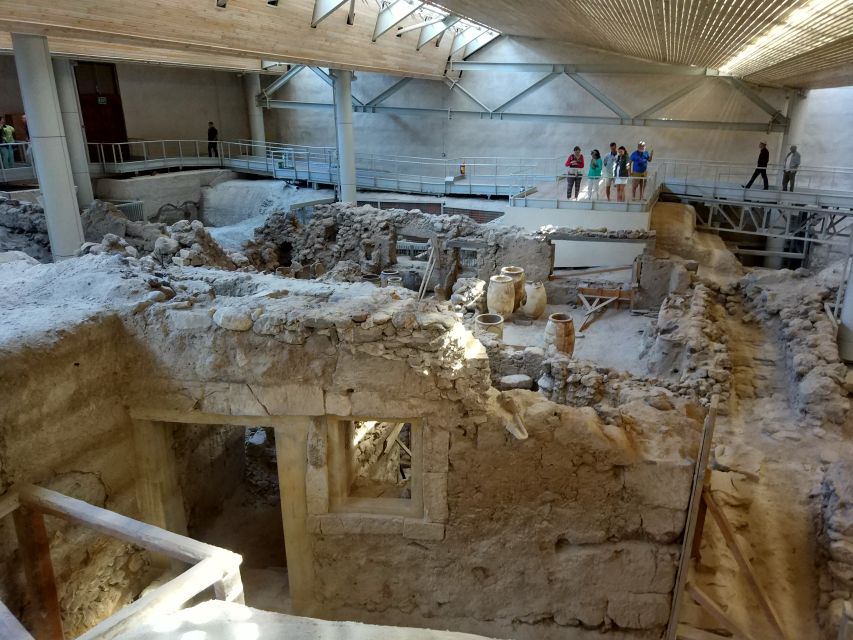
Once inside, the guide takes you through the excavated part of the prehistoric city. The pleasure here is not one dramatic object. It is the sense of a complete neighborhood revealed in pieces.
You can see ancient roads and squares, then follow the layout of buildings around them. Pottery and workshop areas help show that Akrotiri was a place of work as well as residence. The guide’s job is to turn these remains into a picture of daily life: where people moved, where goods were made, and how homes related to the wider town.
The site’s preservation gives you a rare look at architecture from roughly 3,500 years ago. You can view two- and three-story houses, an impressive scale for the period. Their walls once carried painted decoration, and even when the original frescoes are not visible in their former setting, the buildings still suggest a town with wealth, planning, and artistic skill.
I would pay close attention to the spaces between buildings. Roads and squares are easy to overlook when you are focused on walls and pottery, but they show how the settlement functioned as a community. A good guide can help you read those gaps and understand the town as an organized place rather than a collection of ruins.
What the licensed guide adds
Akrotiri rewards a guide because the remains do not explain themselves. You may recognize a street or a wall, but you will not automatically know whether a room was domestic, commercial, or connected to a workshop. A licensed archaeologist can provide the historical frame and point out details you might otherwise walk past.
The advertised languages are English, French, Spanish, and German. You should select the language you need when booking and confirm the meeting instructions carefully. No individual guide names are provided, so the quality of the visit depends on the assigned archaeologist and on how well the group is managed that day.
The strongest reason to pay for this experience is not speed. It is interpretation. You are paying for someone to connect pottery, walls, roads, and eruption deposits into a readable story. One person described the site as offering a great deal to learn, and that is the tour’s real promise when it works properly.
The weakness is that the guided portion may feel generic if the group is too large. One booking expected 90 minutes but received about 50 minutes of explanation before being told to continue alone. The guide was reportedly available at a cafe outside the site for questions, which is not much help if you want to ask about a particular room while you are still inside it.
Same base, a completely different day:
- Santorini Classic Catamaran Cruise with BBQ, Drinks and Transfers
★ 5.0 · 3,933 reviews - Half-Day Exclusive Catamaran Cruise in Santorini with Meal and Open Bar
★ 5.0 · 2,975 reviews - Santorini Gold Catamaran Cruise with Snorkel, BBQ & Open Bar
★ 4.8 · 2,822 reviews - Private Santorini Tailor Made – Choice of the Guest!
★ 5.0 · 1,972 reviews
Free time after the 90-minute tour
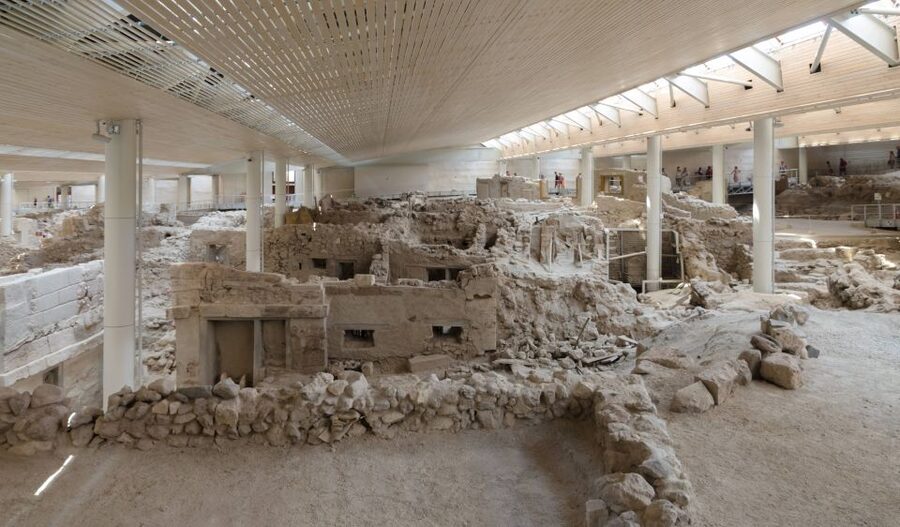
After the guided portion, you are free to continue walking through Akrotiri by yourself. This is a useful part of the arrangement because you can return to details that caught your attention or move at a slower pace than the group.
I would use this time to revisit the streets, pottery, and house remains that the guide introduced. If the tour felt rushed, the free period gives you a chance to look more carefully. If the explanations were broad, you can focus on the parts that interest you most.
The wording of the experience promises free time, but it does not specify how long that period lasts. Your total time at the site may therefore depend on the day’s schedule and the guide’s handling of the group. Ask before the tour ends if you need to know exactly when the visit is considered finished.
The nearby beach is another practical bonus. After the archaeological site, you can pair the visit with a swim rather than treating Akrotiri as your only stop. The information provided does not state beach facilities, water conditions, or transport details, so plan that part separately and do not assume anything beyond the chance to visit the coast nearby.
Private group promise and actual group size
The experience is described as a private group for up to two people. On paper, that makes the price easier to understand. You are not paying per person, and a couple can receive a tailored visit from a licensed archaeologist.
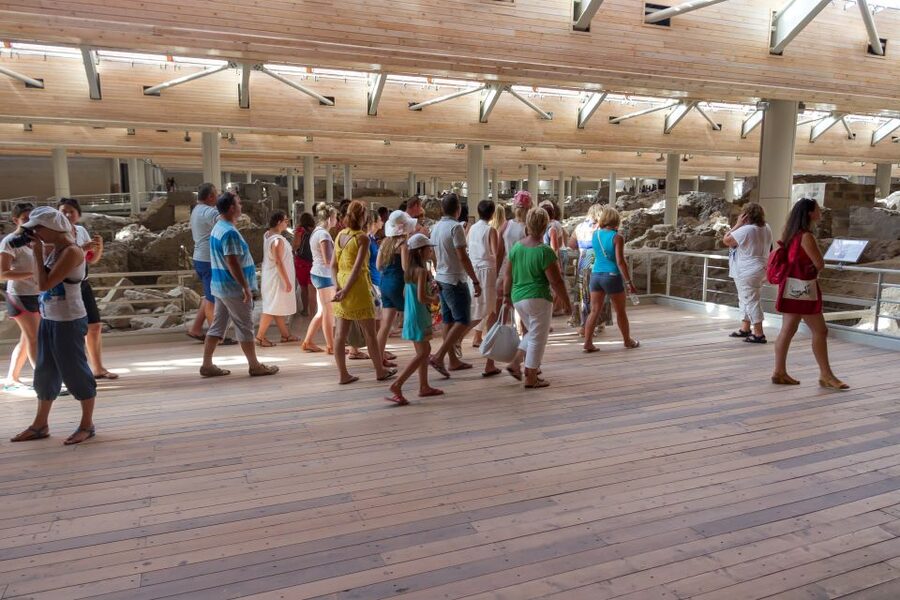
In practice, the group arrangement deserves careful thought. Several bookings described being added to larger groups, including one with roughly 30 people. Another couple was attached to a bus tour at the last minute. A large group changes the experience in two ways: it becomes harder to hear, and the guide has less time for individual questions.
That is a serious issue at an archaeological site. Akrotiri is not a place where you want to spend the full tour trying to stay close enough to hear. If you are paying for a private format, you have every reason to expect the guide to know your names, locate you at the entrance, and keep the group together.
The rating of 3.1 out of 5 reflects this uneven operation. The attraction itself receives praise for its archaeological interest, while the weak points involve communication, guide arrival, group size, and tour length. I would treat the private-group label as something to verify, not something to accept without question.
Is $424 for two people a fair price?
At $424 per group of up to two, this is a costly short tour. The entry ticket is not included, so your final expense is higher. For a couple with a strong interest in archaeology, the price may be acceptable if the private format is delivered as promised.
The value is less convincing if you are mainly looking for a quick introduction. The site can be visited without this tour, and some people who had guide problems ended up joining another group or exploring on their own. In that case, you have paid a premium without receiving the private attention that justified it.
I would compare the cost with your priorities. If personal interpretation, questions, and a compact schedule matter most, a private archaeologist can be worth paying for. If you are comfortable reading signs and taking your time, saving the fee and using the money for another Santorini experience may make more sense.
The price is easier to defend when two people share it. For one person, $424 before admission is a much harder calculation. For a couple celebrating a special occasion or for visitors with a serious interest in ancient sites, the convenience may carry more weight than it would for casual sightseers.
Practical tips for a smoother visit
Arrive early, but do not simply wait anywhere around the entrance. Go beyond the ticket office as instructed and actively identify the guide before the scheduled start. If the guide is not obvious, contact the operator rather than assuming the group has left.
Keep your booking information ready and check your email, including the spam folder, if you selected hotel transfer. Pickup details for that option are sent separately after booking. The meeting instructions for visitors making their own way are different: meet at the excavation entrance after the ticket office.
Wear something suitable for walking through an archaeological site and allow enough time to hear the guide before rushing away. The tour is only 1.5 hours, and a late start or confusion at the entrance can consume a large part of it.
If wheelchair access matters to you, the activity is listed as wheelchair accessible. Still, ask about the precise route when confirming the booking. The provided information does not describe the surface, the covered excavation area, or any limits within the site.
The experience offers free cancellation up to 24 hours before the start and a reserve-now, pay-later option. Those terms give you some flexibility, especially if your Santorini schedule depends on weather or transport, but they do not solve the basic question of guide availability.
Who will get the most from this tour?
I would recommend Akrotiri itself to almost anyone interested in Santorini’s past. The buried streets and houses offer a side of the island that you will not get from the caldera villages or beach resorts.
The guided version suits you best if you want an archaeologist to explain what you are seeing, prefer a fixed 90-minute introduction, and plan to use the free time afterward. It is also a sensible choice for a couple who can share the group fee and who value questions over simply walking through the ruins.
I would be more cautious if you dislike uncertainty, need a guaranteed small group, or have only a narrow window before another activity. The reported problems with missing guides and oversized groups are too specific to ignore.
Language choice is another advantage. English, French, Spanish, and German are offered, so you can arrange the explanation in the language that works best for you. Just remember that no guide name is provided in advance, and the quality of communication at the meeting point is part of the risk.
Should you book the Akrotiri walking tour?
Book it if Akrotiri is high on your list and you want archaeological context rather than a quick self-guided walk. The chance to see an ancient town preserved beneath volcanic pumice, then continue alone and visit a nearby beach, makes a good half-day plan.
Before paying $424, I would confirm that your booking will receive the promised private treatment and ask exactly where the guide will meet you. If the operator cannot give a clear answer, visit Akrotiri independently or choose a more dependable arrangement.
The site is the star here. The licensed archaeologist can make it far more readable, but the uneven organization can weaken an otherwise excellent cultural stop. For an archaeology-minded couple willing to accept that risk, it may be worthwhile. For everyone else, the admission ticket and a self-guided visit offer the safer value.
FAQ
Where does the Akrotiri tour meet?
Meet your assigned guide at the entrance to the Excavation Site, after the ticket office.
Is the entry ticket included?
No. The archaeological site entry ticket is not included in the tour price.
How long does the guided tour last?
The stated duration is 1.5 hours, or 90 minutes. Free time afterward is included, but the exact length of that additional time is not specified.
What languages are available?
The live guide is offered in English, French, Spanish, and German.
Is the tour private?
The activity is described as a private group for up to two people. However, group handling has not always matched that description, so confirm the arrangement before booking.
Can I cancel for a full refund?
Yes. You can cancel up to 24 hours in advance for a full refund. You can also reserve now and pay later.
Just added in Santorini
- Small-Group Tour: Best of Santorini★ 4.7 · 42 reviews
- Santorini: Wine Tour with Sunset in Oia★ 4.6 · 199 reviews
- Santorini Wine Roads: Tour of 3 Wineries with a Sommelier★ 4.8 · 79 reviews
- Santorini Volcano, Hot Springs Adventure★ 3.6 · 54 reviews
- Santorini Unfiltered: Luxury Photoshoot with a Photographer★ 4.9 · 43 reviews
- From Santorini: Volcano Cruise With Oia Sunset★ 4.3 · 97 reviews
- Santorini: Scuba Diving Experience for Beginners★ 4.7 · 112 reviews
- Santorini: Small-Group Highlights Tour of Venetian Castles★ 4.9 · 83 reviews
Walking Tours, compared.

Acropolis monuments & Parthenon Walking Tour with Optional Acropolis Museum
Read our review →
Knossos: Knossos Palace Skip-the-Line Guided Walking Tour
Read our review →

Athens Authentic Greek Food Walking Tour (Small Group)
Read our review →
Early Morning Acropolis & Old Athens Guided Walking Tour
Read our review →
Browse the lists this tour appears in