
Reviewed · ACROPOLIS & ATHENS HIGHLIGHTS
Athens All Included: Acropolis and Museum Guided Tour with Ticket
The best thing about this Athens tour is the way it links the Acropolis hill with the Acropolis Museum. You see the monuments first, then view original sculptures and architectural pieces that explain what you have just seen. That order gives the visit a clear shape instead of leaving you to puzzle over a field of marble and broken columns.
I like the pre-booked tickets and the small-group format. I also like the headsets, which matter when you are standing in a busy archaeological site and want to hear the guide without crowding around her. Guides named Eva, Lisa, and Antigone have been singled out for warmth, clear explanations, good pacing, and help with photos.
The main drawback is the limited free time at the Acropolis. This is a guided lesson with a set schedule, not a loose wander. At $165.67 per person, it costs far more than visiting independently, so you are paying for context, timing, and convenience rather than admission alone.
Key points to know before booking
- Two major sights in about three hours: You visit the Acropolis for roughly two hours, then spend about 45 minutes with a guide in the museum.
- Timed tickets reduce the entry hassle: Pre-reserved admission gets you into both sites, though high-season queues for ticket holders can still form.
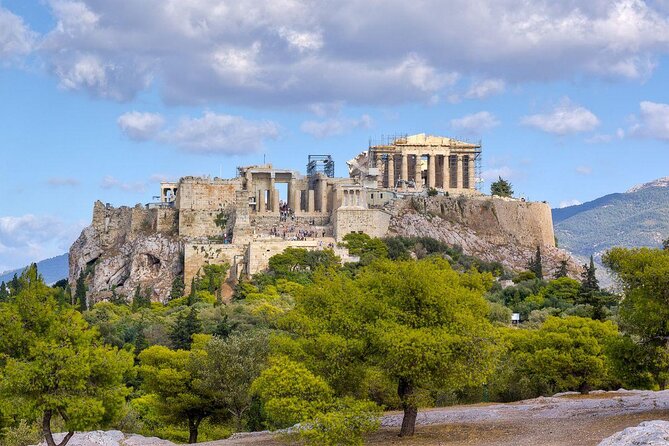
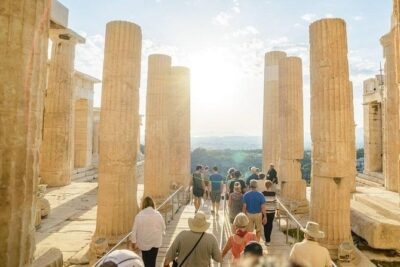
- The Parthenon is only part of the story: The route also includes the Erechtheion, Propylaea, Temple of Athena Nike, Theatre of Dionysus, and other areas.
- Headsets make the explanations easier to follow: You can hear the guide while walking through an open, crowded site.
- Expect a real uphill walk: Uneven ground, stairs, and several hours on your feet call for proper walking shoes.
- Small group, but not necessarily tiny: The maximum group size is 20 people, with the aim of keeping the visit more personal.
Why the Acropolis and museum work well together
You can visit the Acropolis on your own. You can also visit the museum on your own. What this tour does well is put the two experiences in the right order and give you a guide to connect them.
On the Acropolis, you see temples in their original setting, high above Athens. At the museum, you see sculptures and architectural fragments in a calm indoor setting. The museum’s glass floors even reveal archaeological remains below the building, giving you another look at the layers of Athens beneath the modern city.
That connection matters. At the Parthenon, you are looking at a famous building with missing pieces, repairs, and a long, complicated past. In the museum, your guide can show you related sculpture and explain where architectural elements belonged. The result is more useful than a string of isolated facts.
This is also a good choice if ancient history does not come naturally to you. The guides use stories, mythology, architecture, and political background to explain the site. You are not expected to arrive with a working knowledge of Greek gods or fifth-century BC Athens.
More of the old city on foot in Athens:
- Athens: Acropolis & up to 5 Archaeological Sites Combo Pass
★ 4.4 · 12,619 reviews - Athens: Acropolis Ticket with Optional Audio or Live Guide
★ 4.2 · 11,055 reviews - Athens: Acropolis, Parthenon & Acropolis Museum Guided Tour
★ 4.8 · 9,316 reviews
Meeting at the Acropolis metro station
The meeting point is at Makrigianni 7, close to the Acropolis metro station. You meet your licensed Greek guide and group there before walking to the entrance. The guide outlines the route and gets everyone moving toward the timed entry point.
Arrive at least 10 minutes early. This advice is not casual. The Acropolis tickets are tied to a specific entry time and can expire within five to 10 minutes. The tour departs sharply, and late arrivals may not be able to join or receive a refund.
If you are coming from the port, allow extra time. The metro may be the practical choice, but you still need to account for the trip from the ship and the walk to the meeting point. Transportation to and from the sights is not part of the price.
The group can include up to 20 people. That is smaller and easier to manage than a large coach excursion, but it is not a private family tour. Your experience will depend partly on the guide assigned that day and on the walking pace of the group.
Walking up through the Acropolis entrance
The Acropolis visit takes about two hours, with roughly 90 minutes devoted to the wider site and another 30 minutes focused on the Parthenon. You walk uphill over uneven surfaces and climb steps. The route is manageable for people with moderate fitness, but it is not suitable for everyone with mobility restrictions.
Wear proper walking shoes. Flip-flops, slippers, and loose sandals are a poor match for polished stone, uneven ground, and an extended walk. Bring water and prepare for exposure to the weather, since much of the visit is outside.
The pre-reserved tickets help, but do not assume you will walk straight through an empty entrance. In high season, even people with advance tickets may wait in a queue for ticket holders. The advantage is that you avoid buying tickets on the spot and have a guide coordinating the entry time.
The headsets are a useful touch. You can move with the group, look at the monuments, and still hear the explanation. Without them, you would often need to gather tightly around the guide, especially when other groups are nearby.
The Propylaea and the first view of ancient Athens
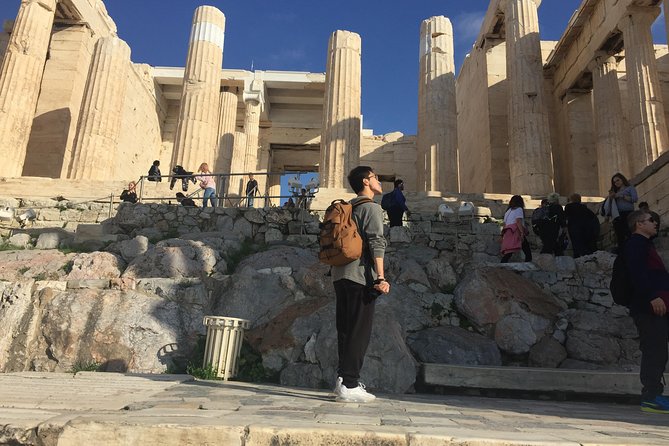
The Propylaea is the monumental gateway to the Acropolis. It was designed to make an impression before visitors reached the sacred buildings beyond it. Your guide explains its role in processions and religious ceremonies, along with the way its marble architecture expressed Athenian power and order.
This is a good early stop because it gives you a sense of arrival. You are not simply walking up a hill to a famous ruin. You are passing through a grand entrance that once prepared worshippers and festival crowds for the temples above.
From the upper levels, you also get broad views across Athens and toward the Aegean Sea. The view is one of the strongest reasons to take your time on the climb. Your guide may point out good photo positions, and several guide accounts describe stopping to take pictures for people in the group.
The schedule does not leave unlimited time for photography. If you want a large collection of posed shots, tell the guide early and use the planned pauses well. The tour aims to keep everyone together and on time.
A few more things to do in Athens worth a look
- Athens: Mythology of Delphi, Museum and Arachova Guided Tour
★ 4.6 · 4,008 reviews - Athens: Acropolis, Parthenon & Acropolis Museum Guided Tour
★ 4.8 · 3,579 reviews - Acropolis monuments & Parthenon Walking Tour with Optional Acropolis Museum
★ 5.0 · 2,678 reviews - Athens: Acropolis Museum Ticket with optional Audio Guide
★ 4.4 · 2,652 reviews
The Parthenon, explained beyond the postcard
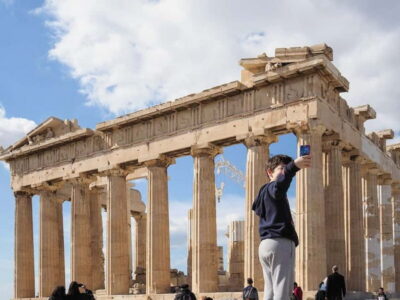
The Parthenon is the centerpiece of the Acropolis visit. Dedicated to Athena, the city’s patron goddess, it was built during the fifth century BC, when Athens was at the height of its political, artistic, and economic influence.
Your guide explains how the temple was designed, built, and used. You also hear why it came to represent Athenian civic pride, democracy, power, and artistic achievement. That background helps you see the building as more than a damaged temple that looks good in photographs.
The Parthenon has suffered from war, explosions, weather, reuse, and the removal of sculptures. A guided explanation helps you understand why the building looks the way it does today without reducing the visit to a list of dates.
Some people will enjoy the detailed discussion of architecture and ancient Athens. Others may feel the guide talks too much and leaves too little space for quiet looking. One particularly important point to understand before booking is that free time at the Acropolis may be as short as 10 minutes. If you prefer to explore independently, this format may feel restrictive.
The Erechtheion and the northern side
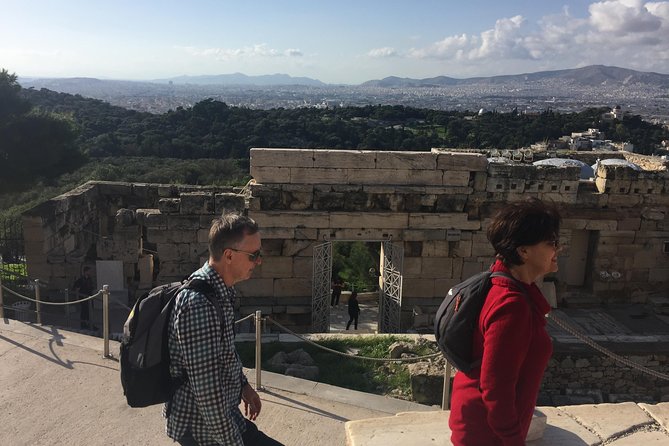
The Erechtheion gives the tour a different feel from the Parthenon. It is associated with earlier Athenian cults and the Olympian gods, and its unusual design reflects the layered religious traditions of the Acropolis.
The route also includes the Temple of Athena Nike, a smaller temple with an important position near the entrance, and areas on the north side that many people miss when they focus only on the Parthenon. These stops help broaden the visit beyond Athens’ most famous monument.
Your guide places the buildings within the larger fifth-century BC program connected with Pericles. You get a picture of an Acropolis filled with color, ceremony, worship, and political meaning, rather than the pale marble ruins you see today.
This is where the value of a guide is easiest to judge. If you want to know what each building was for and why its position mattered, the commentary adds a great deal. If you mainly want time to take pictures, read plaques, and wander at your own pace, you may prefer a self-guided visit.
The Theatre of Dionysus and the southern exit
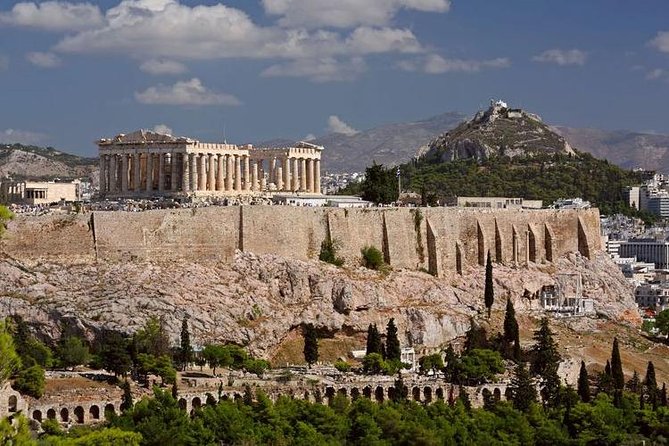
The route heads toward the south exit, passing the Altar of Asclepius and the Theatre of Dionysus. The theatre is especially important because it is tied to the birth of theater and drama.
This stop gives you a break from temples and religious monuments. You begin to see ancient Athens as a city of performances, public gatherings, healing, festivals, and civic life. The guide can make that shift clear in a way a quick walk past the stones may not.
The route is also carefully paced to include more than the central summit. That is a benefit for first-time visitors who might otherwise see the Parthenon, take a few pictures, and leave without noticing the surrounding sanctuaries.
The tradeoff is physical. By the time you reach the southern side, you have already walked uphill and crossed uneven ground. The full Acropolis segment can feel tiring, especially in hot weather or after a long day of sightseeing. One cool-weather note is worth remembering too: the top can feel cold even when the streets below are comfortable.
The short break before the museum
After the Acropolis, you take a short break before entering the museum. The break is useful, but do not expect a long meal stop or a fully open afternoon. The museum entry is also pre-booked, so the tour needs to keep moving.
The Acropolis Museum is nearby, and the tour ends there. You do not need transportation between the two attractions. Once inside, you spend about 45 minutes with the guide, then you may remain longer on your own.
That arrangement works well. The guided portion gives you a framework, while the remaining time lets you return to objects that caught your attention. You can also relax at the museum café or enjoy city views outside after the formal tour ends.
Inside the Acropolis Museum
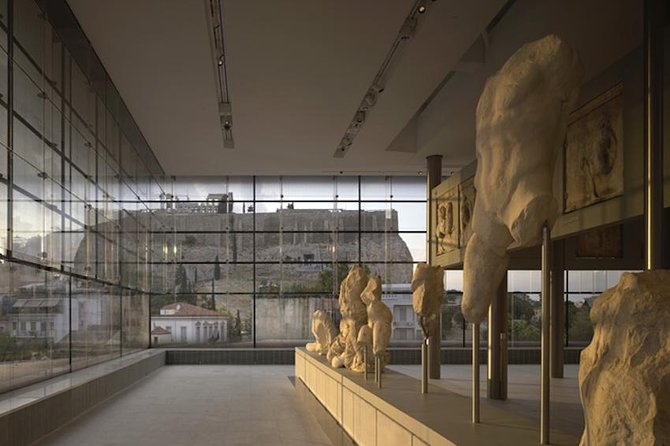
The museum provides the indoor half of the experience. Its glass floors look down onto archaeological excavations, a striking reminder that ancient Athens is still present beneath the modern city.
Your guide introduces original sculptures and architectural elements from the Acropolis temples. Instead of seeing isolated stones on the hill, you can examine pieces in a controlled setting and learn how they once fitted into the buildings and their decoration.
The Parthenon Gallery is a major focus. Here, the guide explains the story and significance of the Elgin Marbles. The subject can be politically and culturally sensitive, but it is essential to understanding the museum and the continuing debate over the sculptures.
The guided museum visit finishes in the Archaic Gallery, which contains statues from before the Acropolis monuments. This gives you a useful time sequence, moving from earlier Greek art toward the period associated with the major fifth-century BC buildings.
Forty-five minutes is enough for an overview, not a full museum visit. I would treat the guided section as an introduction, then stay on your own if you want to read every label or spend time with individual sculptures.
How much value do you get for $165.67?
At $165.67, this is not a bargain admission package. The basic attraction tickets cost less when purchased independently, and you can explore both sites without a guide if you are willing to plan the timing yourself.
The price makes more sense if you value three things: expert explanation, timed coordination, and a small-group experience. You do not have to research the monuments before arriving, figure out the best order, or manage two separate admissions. The headsets also improve the experience in a crowded outdoor setting.
The price is harder to justify if you already know the Acropolis well, want long periods of quiet exploration, or are comfortable arranging your own tickets. One direct assessment is that you can visit independently for much less if the history lesson does not matter to you.
The experience has a 4.7 rating from 2,673 ratings, and 94 percent of participants recommend it. That points to a dependable format, though no tour can guarantee the same guide or the same group dynamic each day. The especially strong feedback centers on guides who explain clearly, answer questions, include younger visitors, help with photos, and adjust the pace for mixed walking ability.
Who will enjoy this guided format?
I would choose this tour for a first visit to Athens, especially if the Acropolis feels intimidating or you want the major facts without reading several guidebooks first. It also suits people who want to combine the outdoor site and museum in one well-planned morning or afternoon.
Families with older children can do well here. One guide made a 12-year-old feel included, and the format gives children stories and visual details to follow. Children under six are not permitted, and strollers of any kind are not allowed.
The tour can work for mixed walking ability, but you should be realistic. You need moderate fitness, comfortable shoes, and the ability to manage stairs and uneven ground. People using a cane may manage the route, but the tour is not designed for significant mobility restrictions.
It is less suitable for photographers who need long, unstructured pauses, museum fans who want several hours indoors, or anyone who dislikes fixed entry times. The guide keeps the group moving, and the Acropolis portion may offer only brief independent time.
Booking, timing, and cancellation details
The experience is offered in English and lasts approximately three hours. It is often booked well ahead, with an average booking lead time of 51 days, so popular dates and time slots may fill early.
Free cancellation is available up to 24 hours before the local start time for a full refund. Cancellations or changes made less than 24 hours before the start are not refunded or accepted.
Gratuities are not included, and tips for the guide are appreciated. The experience provider is Walks In Europe. Admission to both the Acropolis and the Acropolis Museum, the guide, small-group setup, and headsets are included. Transportation, food, and personal expenses are not.
Should you book the Acropolis and Museum tour?
Book it if you want the Acropolis explained in plain terms and prefer a guide to handle the timing. The combination of the Propylaea, Parthenon, Erechtheion, Theatre of Dionysus, and museum gives you a strong first look at Athens, and the museum makes the outdoor ruins easier to understand.
Skip it if your top priority is freedom. You can save money independently, spend as long as you like at each monument, and return to the museum at your own pace.
For most first-time visitors who can manage the walking, I think the tour earns its price through structure and context. Arrive early, wear serious shoes, save your photo requests for the natural pauses, and expect a focused visit rather than a leisurely wander.
FAQ
How long does the experience last?
The tour lasts approximately three hours. About two hours are spent at the Acropolis, followed by roughly 45 minutes of guided touring in the Acropolis Museum, with a short break between them.
Where do I meet the guide?
You meet the guide and group at Makrigianni 7, near the Acropolis metro station in Athens.
Where does the tour finish?
The tour ends at the Acropolis Museum on Dionysiou Areopagitou 15.
Are admission tickets included?
Yes. Pre-reserved tickets for both the Acropolis and the Acropolis Museum are included.
Does the tour include transportation?
No. Transportation to and from the attractions is not included. The meeting point is near public transportation.
How large is the group?
The maximum group size is 20 people.
Is the tour offered in English?
Yes. The experience is offered in English.
Are children under six allowed?
No. Children under six are not permitted on this tour. Strollers of any kind are also not allowed.
What should I wear?
Wear proper walking shoes. Flip-flops, slippers, and sandals are not recommended because the route includes stairs and uneven ground.
What happens if I arrive late?
You should arrive 10 minutes before the start time. The tickets are timed and may expire within five to 10 minutes, so it is not possible to join after the tour has started, and late arrivals are not eligible for a refund.
Can I stay in the museum after the guided visit?
Yes. After the guided overview, you may remain in the museum to explore independently or relax at the museum café.
What is the cancellation policy?
You can cancel up to 24 hours before the experience start time for a full refund. Cancellations or changes made less than 24 hours before the start are not accepted or refunded.
Just added in Athens
- Athens: Half-Day Morning Catamaran Cruise with Meal & Drinks★ 4.9 · 221 reviews
- Athens hotels to Athens airport Private departure transfer★ 5.0 · 285 reviews
- Best of Athens Half Day Private Tour★ 5.0 · 353 reviews
- Electric Bike Tour of Athens by Night★ 5.0 · 355 reviews
- Argolis: Full-Day Tour in Mycenae & Nafplio★ 4.2 · 350 reviews
- Athens: Riviera Catamaran Cruise with Meal and Drinks★ 5.0 · 345 reviews
- Athens: Delphi, Corycian Cave, and 300 Battlefield Day Trip★ 4.8 · 344 reviews
- 3-Day Classical Greece Tour: Epidaurus, Mycenae, Nafplion, Olympia, Delphi★ 4.5 · 342 reviews
Acropolis & Athens Highlights, compared.
Acropolis & up to 5 Archaeological Sites Combo Pass
Read our review →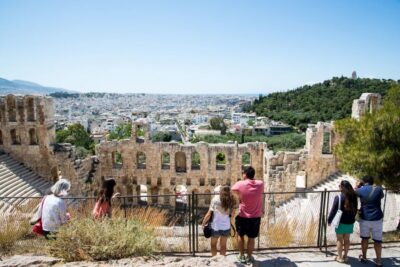
Acropolis, Parthenon & Acropolis Museum Guided Tour
Read our review →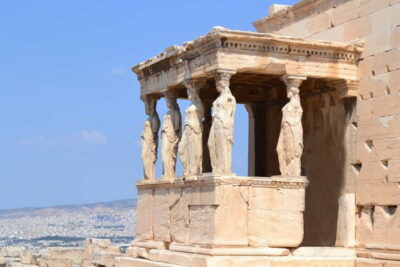

Acropolis monuments & Parthenon Walking Tour with Optional Acropolis Museum
Read our review →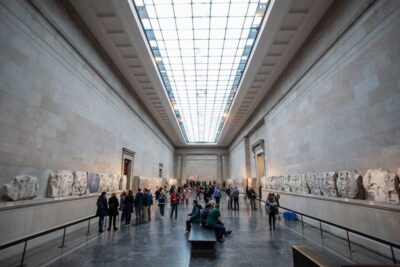
Acropolis Museum Ticket with optional Audio Guide
Read our review →
Acropolis Ticket & Optional Self-Guided Audio Tours
Read our review →
Parthenon & Acropolis Museum with Audio or Live Tour Option
Read our review →Browse the lists this tour appears in