
Reviewed · HISTORICAL TOURS
Small-Group Women History in Ancient Greece Walking Tour
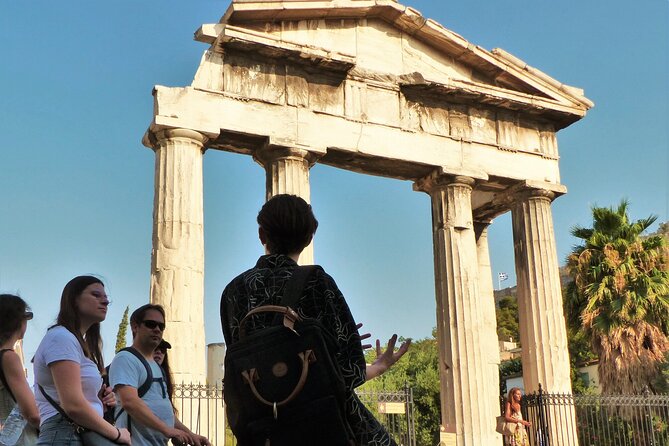
Ancient Athens is often told through male philosophers, generals, and voters. This walk shifts the focus to women’s daily lives, using streets, ruins, myths, and overlooked figures to show what women could and could not do. You’ll hear about Athena, Penelope, Pandora, Sappho, Aspasia, and Agnodice, with guide Maelle adding the human details that a standard monument tour often skips.
I especially like the route’s two-part appeal: it gives you a fresh way to see familiar Athens, and it connects women’s private lives with public places such as the Agora and Pnyx. The small maximum of 12 people should also make it easier to ask questions and keep the discussion personal.
The main consideration is physical. This is a walking tour ending on Philopappos Hill, and it is not recommended for people with mobility issues. You do not enter the Ancient Agora, and the experience depends on good weather, so it works best when you want an outdoor city walk rather than a museum visit.
Key points to know before you book

- Women take the lead in the story: Learn about education, marriage, slavery, courtesans, politics, medicine, poetry, and mythology.
- Maelle guides the walk: Her presentation is praised for being warm, funny, inclusive, and well prepared.
- Nine stops link stories to place: The route runs from Monastiraki through the Agora and Pnyx to Philopappos Hill.
- The group is capped at 12 people: That keeps the walk smaller than a standard city tour.
- The finish has an Acropolis view: Philopappos Hill provides a fine closing viewpoint, but reaching it requires walking uphill.
- The price is $44.71 per person: For about two hours with a specialist theme and a small group, that is fair value if women’s history is a priority.
Why this women’s history walk changes the way you see Athens
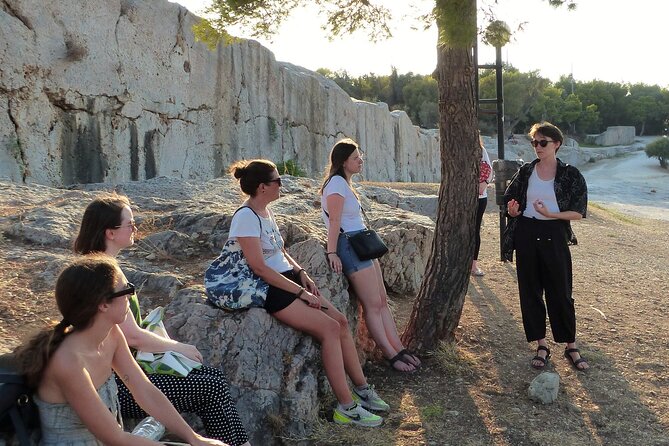
I like this tour because it asks a simple question that many Athens visits avoid: what did life look like for the women who lived among these famous temples, markets, courts, and meeting places?
The answer is not a cheerful one. Women in ancient Athens faced strict limits on education, movement, political rights, and public life. Yet the walk does not reduce women to victims. It also brings forward women who wrote poetry, shaped political discussion, practiced medicine, inspired myths, or challenged the rules around them.
That balance matters. You will hear about the restrictions placed on ordinary wives and enslaved women, but also about Sappho, Aspasia, and Agnodice. Mythological figures such as Athena, Penelope, and Pandora add another layer, showing how ancient societies imagined women even when real women had little formal power.
The result is not a separate side note to Athenian history. It is a different frame for understanding the whole city. The marketplace, the law court, and the birthplace of democracy look different when you ask who was allowed inside, who had a voice, and who was expected to remain at home.
A few more things to do in Athens worth a look
- Historical Delphi One Day Tour with Arachova Stop & Expert Guide
★ 4.5 · 1,247 reviews - Historic Athens: Small Group Electric Bike Tour
★ 4.9 · 740 reviews - The History of Athens: Greek Mythology Private Tour
★ 5.0 · 138 reviews
Monastiraki starts the story in the middle of modern Athens
You meet at Monastiraki Square, at Pl. Monastirakiou 2. This is a practical starting point near public transportation, and the square gives the tour an immediate sense of place. You begin in one of central Athens’s best-known gathering areas before moving toward ancient sites on foot.
The first stop is brief, about 10 minutes, so do not expect a long lecture here. Instead, it serves as the opening page of the story. From the start, Maelle introduces the contrast between the modern city around you and the social world of ancient Athens.
The tour is conducted outdoors, so the square can be busy. Arrive with enough time to identify your guide and group without rushing. The small-group limit helps, but Monastiraki remains a lively public meeting place.
Hadrian’s Library reveals the limits of women’s education
At Hadrian’s Library, the focus turns to the education of girls and women in ancient Athens. This is one of the most useful early stops because it addresses a basic issue behind almost every later story: who was allowed to learn, read, speak, and develop a public reputation?
The name of the site might suggest a conventional stop about books or Roman architecture. Instead, the tour uses it to explore access to education. That shift is the point. You begin to see that the absence of women from many written records was not simply an accident. Social rules shaped who received training and who had the chance to leave a record behind.
The stop lasts about 10 minutes and does not include admission to the site. You view the location as part of the city walk, with Maelle supplying the context.
Marriage, Eros, and the rules of adult life
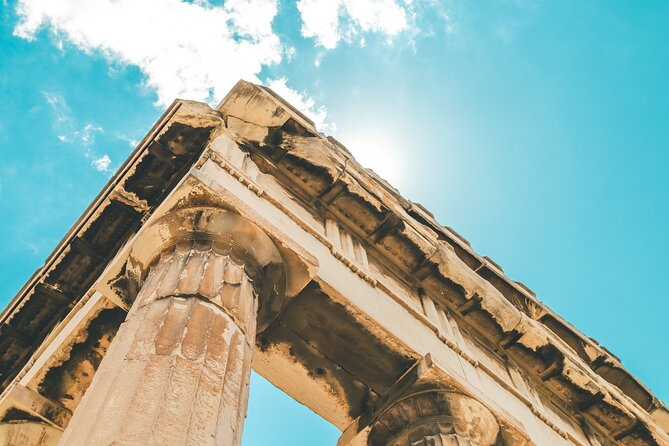
The Holy Church of the All-Great Taxiarchs and the Virgin Mary Gregorousa provides the setting for a discussion of marriage in ancient Athens and ancient Sparta. The location is especially useful because the tour moves beyond the familiar idea of marriage as a private romance.
You will hear about the social role of marriage and the different expectations placed on women in Athens and Sparta. The discussion also introduces Eros, the passionate form of love. That gives the walk room to consider the gap between romantic desire and the practical arrangements that shaped family life.
This is a 15-minute stop, long enough to draw comparisons without turning the walk into a formal lecture. I like this part because it reminds you that ancient societies did not treat marriage, love, inheritance, and family in the same way we do today.
Same base, a completely different day:
- Athens: Acropolis & up to 5 Archaeological Sites Combo Pass
★ 4.4 · 12,619 reviews - Athens: Acropolis Ticket with Optional Audio or Live Guide
★ 4.2 · 11,055 reviews - Athens: Acropolis, Parthenon & Acropolis Museum Guided Tour
★ 4.8 · 9,316 reviews - Athens: Cape Sounion & Poseidon Temple Sunset Half-Day Trip
★ 4.8 · 8,241 reviews
Athena and married life at the Gate of Athena Archegetis
At the Gate of Athena Archegetis, the discussion continues with married life in ancient Athens and Sparta, then turns to myths connected with Athena. This is a strong pairing of social history and mythology.
Athena is a particularly useful figure for the tour’s wider purpose. She is one of the most powerful and famous figures in Greek mythology, yet mythological power did not translate into equal rights for real women. That contrast lets you examine the space between how women were imagined and how women were treated.
The stop lasts about 15 minutes. You should expect interpretation rather than a formal entrance or monument tour. The gate gives the story a visible anchor, while the surrounding streets help connect ancient ideas to the modern city.
Dioskouron and a festival reserved for women
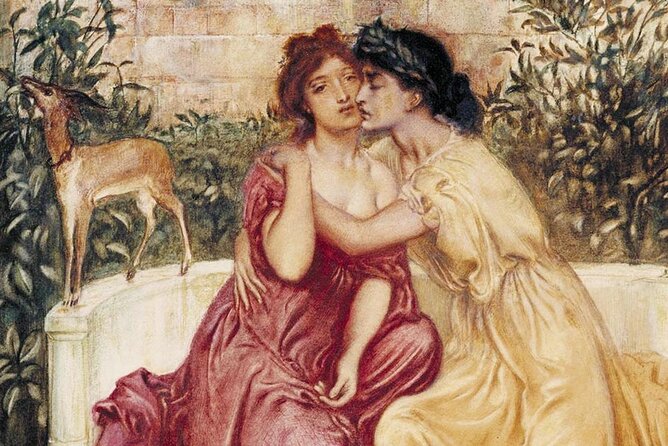
Dioskouron introduces one of the tour’s more unusual subjects: an ancient festival dedicated exclusively to women. This is the sort of detail that can disappear on a standard Athens sightseeing route, where the focus usually rests on temples, battles, and famous men.
The festival offers a chance to consider moments when women gathered in their own spaces and took part in traditions that were not simply extensions of male civic life. It also adds welcome variety after the discussions of education and marriage.
This stop lasts about 10 minutes. The story is likely to appeal most to you if you enjoy lesser-known social customs and want the tour to move beyond a list of famous names.
The Ancient Agora shows who belonged in public life
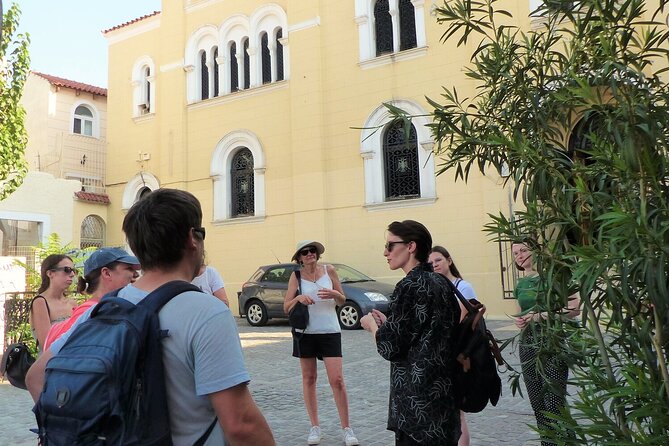
The Ancient Agora is the clearest place on the route for examining public life. It was the marketplace and civic center of Athens, but you will view the archaeological site from outside rather than enter it.
That limitation is worth noting. If you want to explore the Agora’s ruins, museum displays, and walking paths, you will need a separate admission and visit. This tour is using the site as a setting for interpretation, not replacing a full archaeological visit.
The subject here is important: women in public space, including female slaves and courtesans. The discussion makes clear that the category of woman was not one single experience. A citizen wife, an enslaved woman, and a courtesan could face very different rules, duties, and forms of freedom.
At about 15 minutes, this is one of the route’s more substantial stops. I find it especially valuable because it connects gender with class and legal status. It also helps you avoid a common mistake: speaking about women in ancient Greece as if every woman lived under the same conditions.
The Areopagus brings law and risk into the story
At the Areopagus, you hear about the place where serious offenders were tried in ancient times. The stop then turns to the story of a woman who risked a death sentence in an effort to change women’s rights.
That combination gives the walk a sharper edge. Ancient law was not an abstract system sitting far away from daily life. It shaped what women could do, and challenging it could carry a severe price.
The stop takes about 10 minutes. The Areopagus is also a rocky outdoor site, so watch your footing and wear shoes suited to uneven ground. The route is not recommended for people with mobility issues, and this stop helps explain why.
The Pnyx exposes the limits of Athenian democracy
The Pnyx is one of the most meaningful stops because it is tied directly to the development of Athenian democracy. Here, the group considers the uncomfortable fact that only male citizens could vote.
It is easy to praise ancient Athens as the birthplace of democracy and stop there. This tour asks you to look at the boundaries of that democracy. Women were excluded from voting, yet the discussion introduces a woman who influenced Athenian politics during the Golden Age.
That contrast is the heart of the stop. Political power could operate through formal citizenship, but influence could also come through relationships, conversation, family connections, ideas, and social position. Aspasia is central to this part of the story, and her life offers a vivid example of how a woman could matter politically without holding the rights of a male citizen.
The Pnyx stop lasts about 15 minutes. It is a good place to pause and consider how a society can invent democratic institutions while denying participation to much of its population.
Philopappos Hill ends with myths, shade, and the Acropolis
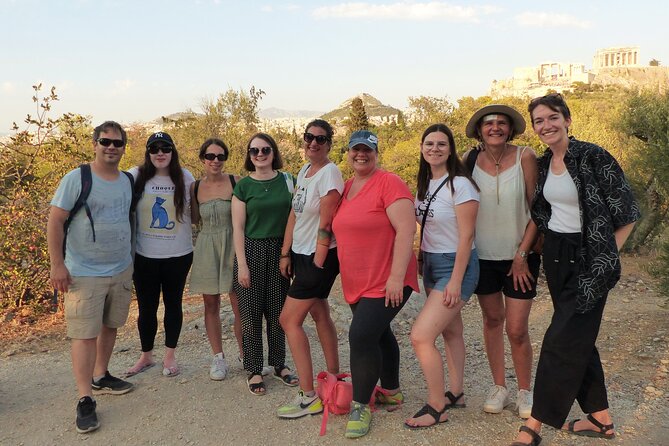
The final stop is Philopappos Hill, also described as the Hill of the Muses. The route ends here after about 10 minutes of discussion about the muses and their continuing inspiration for Athens.
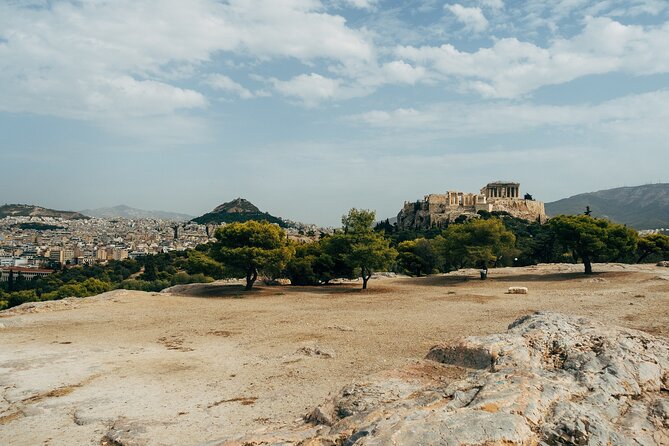
The setting gives the tour a pleasant change of pace. After the close attention required at the city streets and ancient sites, you finish in a greener hilltop setting with a view toward the Acropolis. The view is a genuine reward, especially if this is your first walking tour in Athens and you want to get your bearings.
The endpoint is listed at Philopappos Hill, with access back toward central Athens on foot and to the metro if needed. Still, the hill makes the final stretch less suitable for anyone who finds inclines or uneven paths difficult.
What Maelle brings to the experience
Maelle is repeatedly praised for her warmth, humor, preparation, and ability to answer questions. The most useful quality here is not simply knowing names and dates. It is the ability to connect them.
A successful women’s history tour has to move between myth and evidence, famous figures and ordinary lives, politics and domestic rules. Maelle’s presentation is described as clear and engaging, with links between ancient themes and questions that still matter today.
The tour also appears suitable for a mixed group. A parent traveling with a 15-year-old daughter found the subject especially appealing, while history-focused adults valued the research behind the women’s stories. You do not need to arrive as a specialist. Curiosity is enough.
How the $44.71 price measures up
At $44.71 per person, the cost works out to roughly $22 per hour for a two-hour guided walk. You are paying for a focused subject, a guide’s preparation, and a group capped at 12 people rather than for entry to an archaeological site.
That last point matters. There are no admission tickets included at the listed stops, and the Ancient Agora is viewed from outside. If you want paid entry to the Agora, that will be a separate visit and cost.
I consider the price fair if you have already seen the major monuments or want a more focused way to understand Athens. It is less compelling if your main goal is to enter as many archaeological sites as possible. The value lies in the interpretation, not in the number of tickets bundled into the booking.
The experience is often booked about 37 days ahead, so plan early if your Athens dates are fixed. Group discounts are available, and you receive a mobile ticket.
Who should book this Athens walking tour
I would choose this tour for you if:
- You want women’s history to be a central part of your Athens visit.
- You have already planned, or are planning, the Acropolis and major archaeological sites.
- You prefer stories and discussion over a checklist of monuments.
- You enjoy mythology but also want social and political context.
- You are comfortable walking outdoors and finishing uphill.
- You are traveling with a teenager interested in history, equality, or ancient culture.
I would think twice if you have limited mobility, dislike hills, or want a fully indoor experience. I would also avoid treating this as a substitute for visiting the Agora or other archaeological sites. It is best used alongside those visits.
The route is near public transportation, and service animals are allowed. Most people can take part, but the mobility warning should be taken seriously. Good weather is required, and poor weather can lead to a different date or a full refund.
Should you book the Women’s History in Ancient Greece Walking Tour?
Yes, if you want Athens to be more than temples and famous male thinkers. The tour fills a real gap by showing how education, marriage, work, law, mythology, and democracy affected women in different ways.
I would book it early in an Athens stay if you want its questions to shape the rest of your sightseeing. I would also leave room afterward to think, eat, or visit another site rather than rushing straight into a packed schedule. The walk is only about two hours, but its best stories may stay with you much longer.
Book it for the focused subject, the small group, Maelle’s thoughtful presentation, and the final Acropolis view. Skip it only if you need an accessible route or want archaeological-site admission included.
FAQ
How long is the Women’s History in Ancient Greece Walking Tour?
The tour lasts approximately two hours.
How much does the tour cost?
The listed price is $44.71 per person.
Where does the tour begin?
It begins at Pl. Monastirakiou 2 in Athens, at Monastiraki Square.
Where does the tour end?
The tour ends at Philopappos Hill. The endpoint is close to central Athens by foot and offers access to the metro if needed.
How many people can join the tour?
The group has a maximum of 12 travelers.
Does the tour enter the Ancient Agora?
No. The Ancient Agora is viewed from outside, and the tour discusses its role in Athenian public life without entering the archaeological site.
Is the tour suitable for people with mobility issues?
It is not recommended for people with mobility issues. The route is a walking tour and ends on Philopappos Hill.
Does the tour operate in poor weather?
The experience requires good weather. If it is canceled because of poor weather, you can receive a different date or a full refund.
Is cancellation free?
Yes. You can cancel at least 24 hours before the start time for a full refund. Cancellations or changes made less than 24 hours before the start time are not accepted for a refund.
Are service animals allowed?
Yes. Service animals are allowed, and the tour is near public transportation.
More Walking Tours in Athens
- Athens: Acropolis and Parthenon Guided Walking Tour
★ 4.6 · 5,882 reviews - Greek Food Walking Tour in Athens
★ 5.0 · 4,740 reviews - Acropolis: Acropolis and Parthenon Guided Walking Tour
★ 4.7 · 3,442 reviews - Acropolis monuments & Parthenon Walking Tour with Optional Acropolis Museum
★ 5.0 · 2,678 reviews
Just added in Athens
- Ceramic and Pottery Creative Workshop with Two Local Artists★ 4.0 · 57 reviews
- Athens Old City Private Photoshoot Tour / 2 hrs★ 5.0 · 109 reviews
- Athens: Wine Workshop Create your Own Wine under the Acropolis★ 5.0 · 77 reviews
- Athens: Greek Wines Tasting with Sommelier and Acropolis Views★ 5.0 · 88 reviews
- Wine Trails Private Tour/ Nemea visit 3 wineries from Athens or Nafplion (10 h)★ 5.0 · 44 reviews
- FLYING DRESS Photoshoot in Athens – Greece★ 5.0 · 47 reviews
- Small-Group Wine Tour in Athens with Tasting★ 5.0 · 33 reviews
- Hydra Private Day Trip by Ferry from Athens with Transfers★ 4.0 · 30 reviews
Historical Tours, compared.
Historical Delphi One Day Tour with Arachova Stop & Expert Guide
Read our review →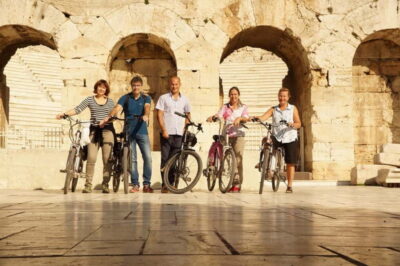
Historic Athens: Small Group Electric Bike Tour
Read our review →


Throne of Helios: The History of Rhodes in 9D Experience
Read our review →
The History of Athens: Greek Mythology Private Tour
Read our review →

Browse the lists this tour appears in