
Reviewed · ACROPOLIS & ATHENS HIGHLIGHTS
Athens: Early Morning Guided Tour to Acropolis and Museum
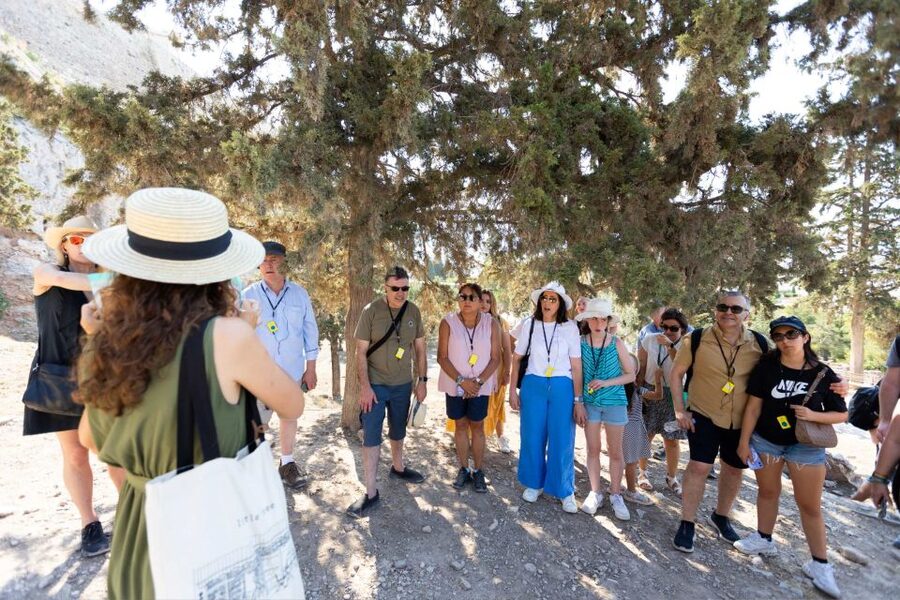
The smart part of this Athens tour is its timing. You reach the Acropolis in the cool of early morning, before the hill fills and the sun begins to punish every uphill step. The route links the Parthenon with the Acropolis Museum, so you see both the weathered monuments and the original works that explain them.
I like the licensed local guides, who turn a pile of marble into a story about gods, politics, theater, and engineering. I also like the steady route: the guide breaks up the climb with stops at the Dionysus Theater, Odeon of Herodes Atticus, and other landmarks rather than marching you straight uphill.
The catch is physical. Slippery marble, uneven ground, stairs, and a demanding ascent make this a poor match for wheelchair users or anyone with serious mobility limits. Also check your booking carefully, since entrance tickets may or may not be included, and museum excavation access can depend on the ticket issued.
Key points at a glance
- Early start: Reach the Acropolis before the strongest heat and the heaviest crowds.
- Two major sights: Combine the Acropolis hill with about 90 minutes inside the Acropolis Museum.
- Story-led guiding: Hear myths, ancient drama, architecture, and everyday context from an English or Spanish guide.
- Important landmarks: See the Propylaea, Temple of Athena Nike, Parthenon, Erechtheion, and sweeping views over Athens.
- Physical demand: Expect a long period on your feet, an uphill climb, slippery marble, and uneven terrain.
- Check the ticket option: Some bookings include admission and skip-the-ticket-office access, while others require you to buy entry separately.
Why early morning makes such a difference
The Acropolis is not a quiet little ruin tucked away from town. It is Athens’ main attraction, and the exposed hill can feel hot and crowded surprisingly early. Starting at first light gives you a better chance of seeing the main monuments before large streams of people reach the summit.
That timing also helps with the climb. You still need to work uphill, but cooler air and more frequent pauses make the effort easier. Several guides, including Margarita, Panayiota, and Harula, were especially careful about shade, water, pace, and slippery steps. That matters here. The ancient stones are beautiful, but they are not forgiving under thin soles or hurried feet.
You meet at one of the stated KeyTours Greece locations, with the exact point depending on the option you book. There is no hotel pickup, so plan your own way to the meeting point and allow enough time to arrive before departure. The tour is offered in English or Spanish.
The advertised duration ranges from 210 minutes to four hours. The longer timing makes sense if the group moves carefully, pauses for photographs, and spends the full museum visit. If you have a flight or another fixed appointment, tell the guide at the start. One guide was praised for keeping good time for a group with a flight to catch, but you should still leave a generous buffer.
More of the old city on foot in Athens:
- Athens: Acropolis & up to 5 Archaeological Sites Combo Pass
★ 4.4 · 12,619 reviews - Athens: Acropolis Ticket with Optional Audio or Live Guide
★ 4.2 · 11,055 reviews - Athens: Acropolis, Parthenon & Acropolis Museum Guided Tour
★ 4.8 · 9,316 reviews
Starting below the Acropolis at the Arch of Hadrian
The route begins near the Arch of Hadrian, a useful first landmark because it helps place the Acropolis within the wider Roman and Greek city. The stop is brief, about 10 minutes, so do not expect a full lecture on the arch. Instead, it acts as a quick orientation before you head toward the southern slope.
This early portion is valuable because the Acropolis is easier to understand when you see it as part of a living city rather than an isolated hill. Your guide can set up the difference between classical Athens and the later periods that changed the area.
Ancient drama at the Dionysus Theater
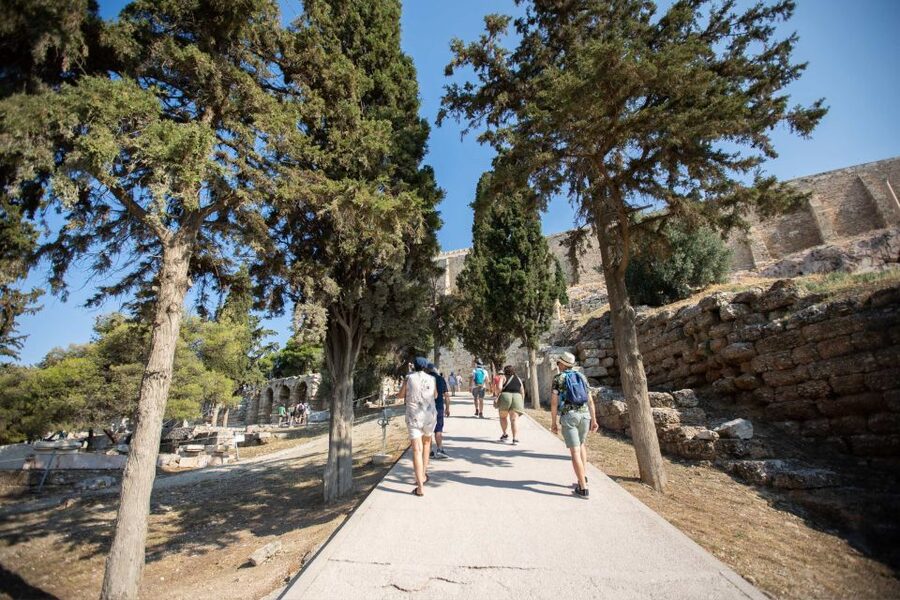
The climb toward the Acropolis includes the Sanctuary of Dionysus and the Theater of Dionysus, with about 15 minutes of guiding. This is one of the strongest parts of the route for anyone interested in Greek theater.
Here, the guide connects the physical seating and stage area with the festivals held for Dionysus, the god associated with theater. The stop adds human scale to the tour. You are not only looking at temples for gods and leaders. You are also standing where ancient audiences watched drama, comedy, and public performances.
The route is uphill, but the frequent stops keep it from becoming one long push. You will still be on your feet for most of the morning, so take the walking advice seriously.
The Odeon of Herodes Atticus and the southern approach
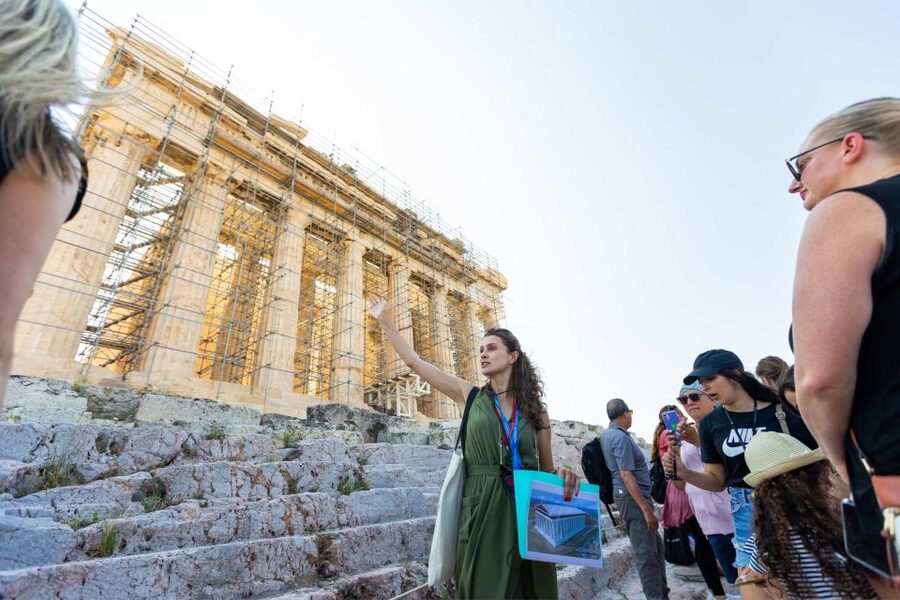
The Odeon of Herodes Atticus appears along the way, with roughly 10 minutes of explanation. Its curved structure and steep setting make it one of the most striking sights on the southern slope.
The tour does not treat every stop as a long separate visit. That is a good thing for a half-day outing. You get enough context to understand why the building matters, then continue toward the summit before your legs tire too early.
At this point, look down as well as up. The southern approach gives you changing views of the city and lets you see how the Acropolis rises above modern Athens. Your guide may also point out how the hill has changed across different eras, a theme that helps explain why the site is a mix of surviving buildings, foundations, repairs, and scattered remains.
A few more things to do in Athens worth a look
- Athens: Mythology of Delphi, Museum and Arachova Guided Tour
★ 4.6 · 4,008 reviews - Athens: Acropolis, Parthenon & Acropolis Museum Guided Tour
★ 4.8 · 3,579 reviews - Acropolis monuments & Parthenon Walking Tour with Optional Acropolis Museum
★ 5.0 · 2,678 reviews - Athens All Included: Acropolis and Museum Guided Tour with Ticket
★ 4.5 · 2,673 reviews
Entering through the Propylaea
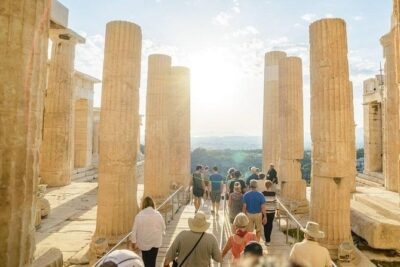
The Propylaea, the monumental gateway to the Acropolis, receives about 15 minutes. It is more than a grand doorway. Its marble columns frame the entrance and prepare you for the important buildings beyond.
This is also where the scale of the ancient project becomes clear. The gateway feels formal and powerful even in its ruined state. Your guide can explain its place in the design of the hill and help you notice details you might otherwise pass without a second look.
The stone can be slick, especially where countless feet have polished it. Wear shoes with good grip, and do not rush for the perfect photograph. Several guides were praised for keeping groups together and watching the steps, but you remain responsible for your footing.
The Temple of Athena Nike
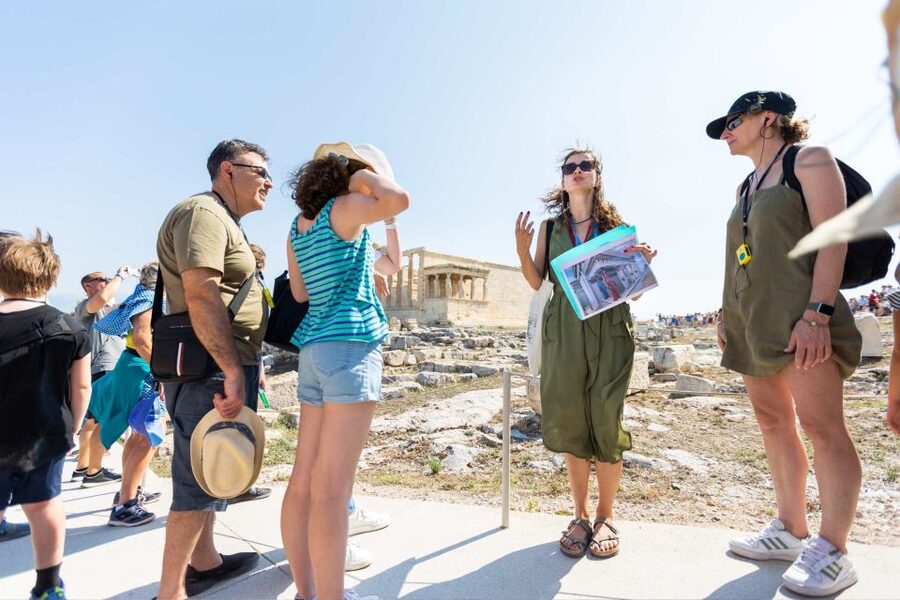
The small Temple of Athena Nike gets a short, focused stop of about five minutes. Because it is much smaller than the Parthenon, you might overlook it if you visit without a guide.
The temple was dedicated to Athena in her role connected with wisdom and war. Its position near the entrance gives it an important visual and symbolic role. This is a quick stop, but it helps you read the Acropolis as a planned collection of monuments rather than one famous building surrounded by leftovers.
The Parthenon, the main event
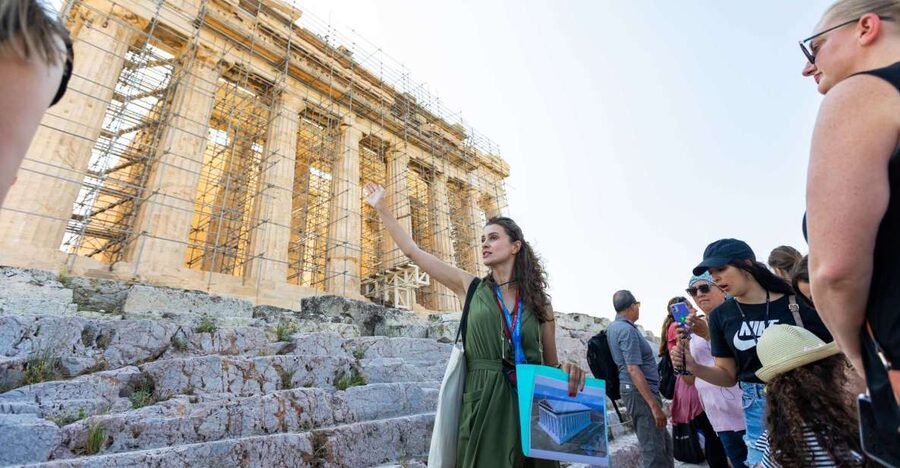
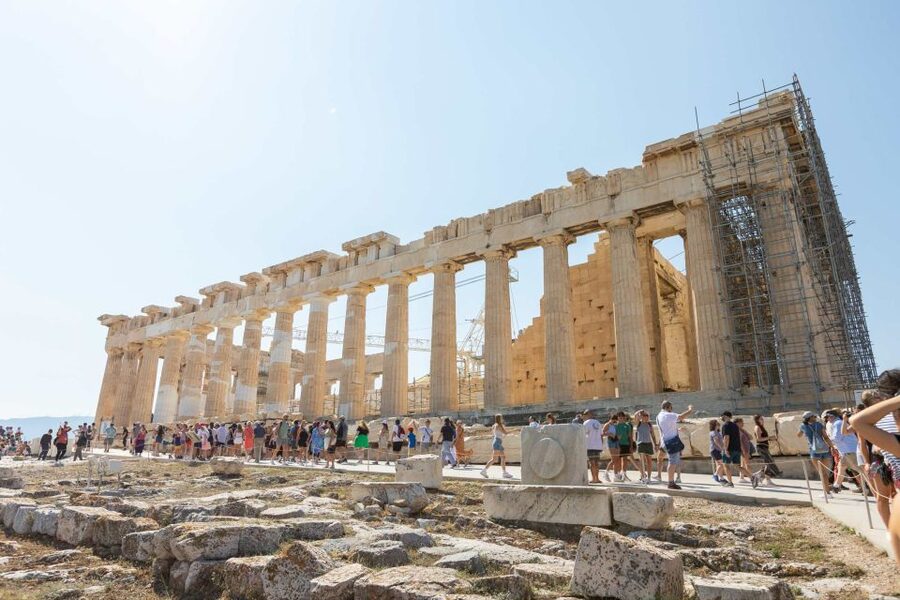
You get about 30 minutes at the Parthenon, the centerpiece of the Acropolis. This is the moment most people picture when they book the tour, and the guide uses it to explain the temple’s dedication to Athena, its design, and its place in classical Athens.
The building is not intact, so the value of the explanation lies in learning how to imagine what is missing. Look closely at the columns, the surviving sculptural details, and the way the temple sits above the city. A good guide helps you understand that the Parthenon was not simply built to look impressive. It carried religious, civic, and political meaning.
The early timing gives you a better chance to study it without being pushed along by a thick crowd. You also have time for photos, though the summit is shared with other groups and independent visitors. Do not expect solitude.
Guides such as Irene, Eirini, Petros, and Vasiliki were praised for mixing facts with questions, humor, and stories instead of reciting a memorized speech. That style works especially well at the Parthenon, where dates and architectural terms can blur together unless someone gives them a clear thread.
The Erechtheion and its famous porch
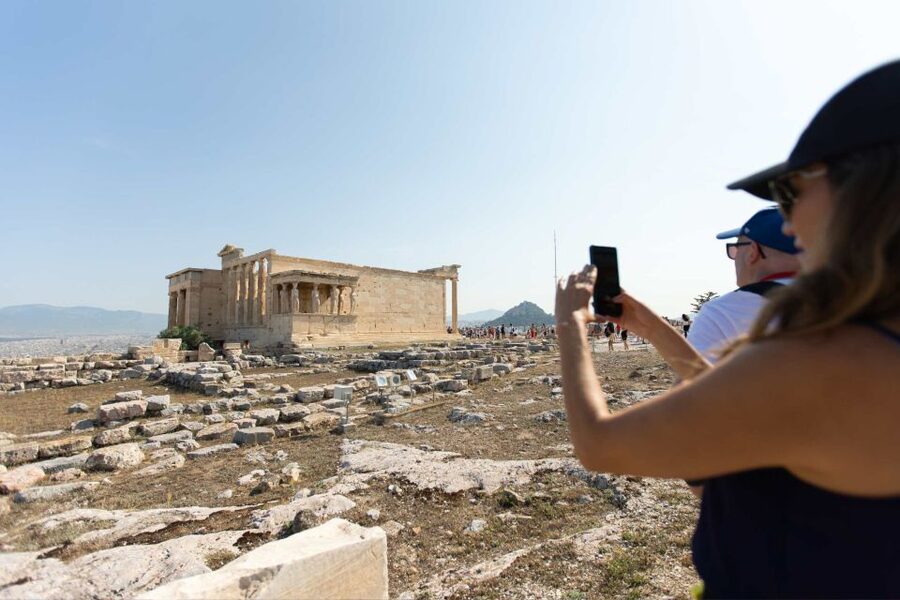
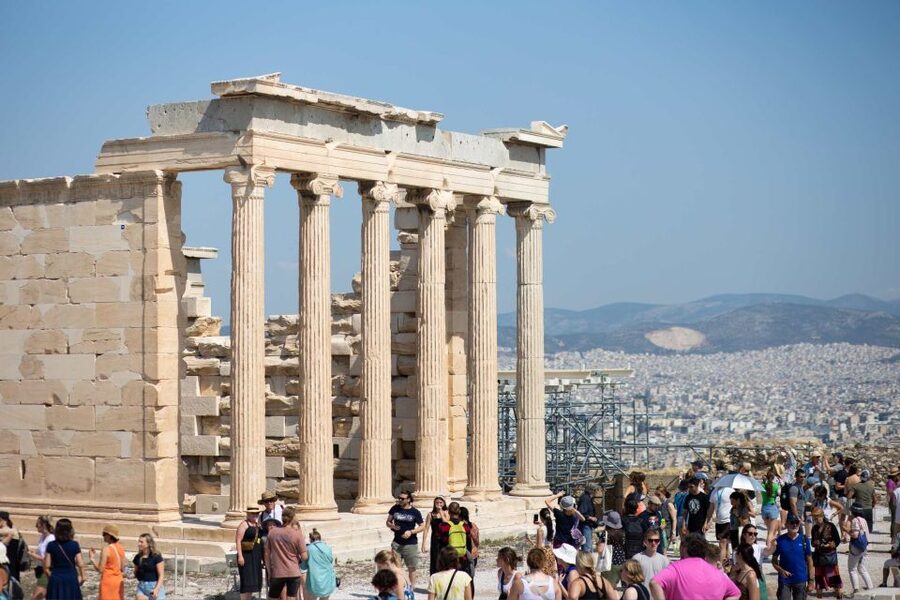
The Erechtheion receives about 10 minutes. This complex is less symmetrical than the Parthenon and has a different character, with several sacred associations tied to Athena and the older myths of Athens.
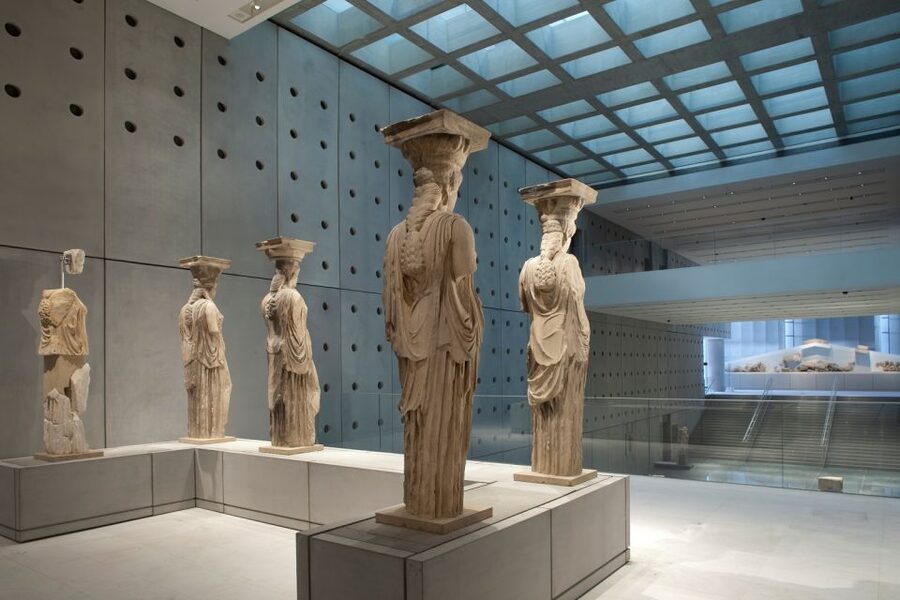
The porch with the sculpted female figures is one of the details you will want to see closely. The original pieces are not all exposed on the building today, which makes the later museum visit important. Your guide can help you connect what you see on the hill with the protected originals and displays below.
This is where the mythic side of the tour comes forward. You hear about the stories linked to Athena and the origins of Athens, while also learning how the site changed through time. The mix of legend and archaeology keeps the tour from becoming a simple list of monuments.
Thirty minutes for views, photos, and recovery
The itinerary allows about 30 minutes at the Acropolis for a break, photographs, and free time. Use it. The view over Athens is one of the best reasons to make the climb, and a pause lets you absorb the place without listening continuously.
Bring water and a sun hat. The top is exposed, and shade may be limited. Summer visitors in particular should treat this break as recovery time, not just a chance to take pictures.
The guide normally keeps the group together while allowing room for photographs. Group sizes can vary, but one report described a group of about 10 people as relatively small compared with the crowds arriving later in the morning. A smaller group makes it easier to hear, ask questions, and keep track of the guide.
Walking down Dionysiou Areopagitou
The route continues along Dionysiou Areopagitou for about 15 minutes. This gives you a change of pace after the summit and connects the Acropolis with the museum area.
The walk is not a transfer by vehicle. It is part of the sightseeing, so comfortable footwear matters from the first step to the last. If you have a bad knee, balance problem, or limited stamina, this is the point where the total amount of walking may begin to feel substantial.
The Acropolis Museum and its original treasures
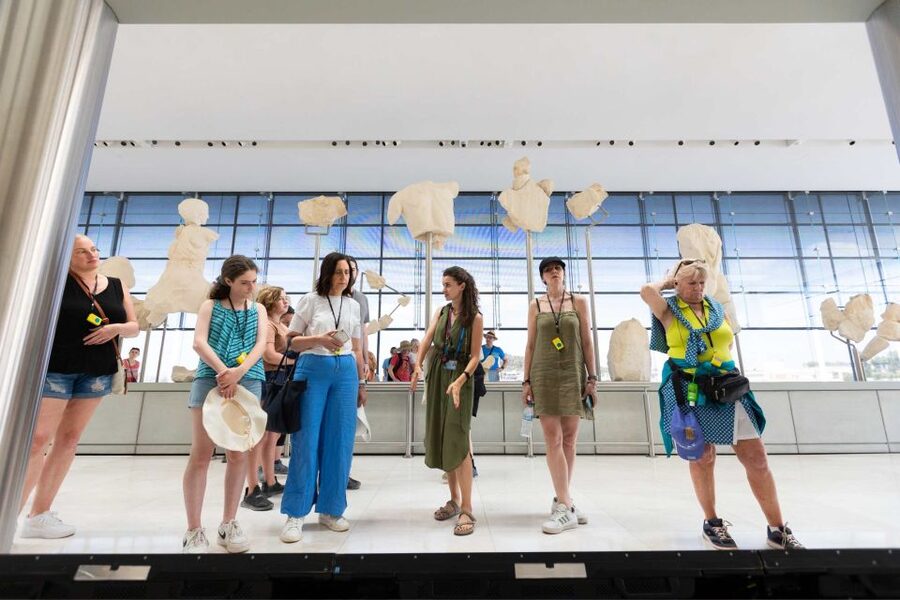
The museum visit lasts about 90 minutes, making it more than a quick add-on. Its galleries display archaeological finds from the Acropolis slopes, including objects dating back to prehistoric periods. Natural light helps you see the sculptures and architectural pieces clearly, while glass floors and walkways reveal excavations below.
This second half improves the hill visit. On the Acropolis, you see buildings in place, exposed to weather and time. In the museum, you can study original surviving works at close range and understand which parts of the temples have been removed, preserved, or reconstructed.
The museum is large enough that 90 minutes cannot cover every display in detail. That is not necessarily a flaw. A focused guide can help you see the most important pieces without exhausting you after the uphill morning. One guide was praised for covering the main highlights without overloading the group, while another visitor wanted more time at individual artifacts. Your experience will depend on the guide’s pace and the group’s questions.
Pay close attention to the ticket details. One booking did not include access to the museum excavations beneath the glass, while another did. If that area matters to you, confirm that your selected option includes it before paying. The phrase Acropolis Museum access does not always tell you exactly which museum areas are covered.
What the guides add to the morning
The guide is the main reason to choose this tour instead of simply buying admission and walking around alone. Names praised for clear, engaging work include Petros, Irene, Eirini, Margarita, Vasiliki, Chryssa, Elena, Michael, and Harula. The specific guide assigned to you will vary.
The strongest pattern is not a single personality. It is the guides’ ability to explain mythology, architecture, engineering, ancient drama, and changing periods in plain English. Several also used questions and humor to keep the group involved.
The audio device is useful when the group spreads out or the site grows noisy. Even so, one person found the microphone difficult to hear at times. Stay reasonably close, and tell the guide promptly if the sound is unclear. A good explanation is worth little if you are standing too far back to catch it.
Price, ticket choices, and practical value
The advertised price is $35 per person, though the final cost depends on the option you select. Some choices include Acropolis admission and skip-the-ticket-office access. Others leave you responsible for purchasing entry before the tour at the correct timed slot.
At $35, the tour can be strong value if admission is included and you want clear explanations at two major sites. You are paying not only for entry when included, but also for a licensed guide, audio equipment, and a carefully arranged route that connects the hill with the museum.
The comparison becomes less simple if you choose the option without tickets. You must arrange admission yourself, and free-entry rules for some younger EU and non-EU citizens require advance planning. EU citizens under 25 and non-EU citizens under 18 may qualify for free admission, but free timed slots are not guaranteed on the day.
Read the option wording before booking. This is the single biggest way to avoid confusion about price and access.
Who should book this Acropolis tour
I would choose this for a first visit to Athens, especially if you want the ancient sites to make sense rather than simply collect photographs. It also suits solo visitors, since the guide-led format gives you company without requiring a private tour.
It is a good fit for people who enjoy history, myths, architecture, and city views, and for anyone who wants to get the main Acropolis sights and museum done in one morning. The early start is especially useful in summer or on a tight sightseeing schedule.
I would think twice if you prefer wandering at your own pace, dislike group tours, or want to spend hours studying every museum case. The route is structured, the museum time is limited, and the group must keep moving.
It is not suitable for wheelchair users or people with mobility impairments. Anyone with difficulty walking uphill should also consider the marble surfaces, uneven paths, steps, heat, and long time standing. Bring water, wear shoes with firm grip, and carry only a small bag. Pets, baby strollers, luggage, and large bags are not allowed.
Should you book it?
Book this tour if you want an early, organized introduction to the Acropolis and museum, with a guide who can connect ruins, myths, and original artifacts. The strongest reasons are the timing, the licensed guiding, and the way the museum completes what you see on the hill.
Skip it if you need a slow, fully independent visit or if the uphill terrain is beyond your comfort level. Before booking, confirm two things: whether your price includes both entrance fees and whether it covers the museum excavation area. Get those details right, arrive ready for a demanding walk, and this is a practical way to make a short Athens visit count.
FAQ
How long does the Acropolis and museum tour last?
The activity lasts between 210 minutes and four hours, depending on the selected option, start time, group pace, and time spent at each location.
What languages are available?
The live tour guide is available in English or Spanish.
Are Acropolis entrance tickets included?
That depends on the option you book. Some options include entrance fees and may include skip-the-ticket-office access. If you choose an option without tickets, you must purchase admission before the tour at the correct timed entry.
Does the tour include the Acropolis Museum?
Yes. The route includes a guided visit to the Acropolis Museum lasting about 1.5 hours.
Is access to the museum excavations included?
It depends on the ticket option. Some bookings include the excavations beneath the museum, while others do not. Check the exact inclusion before booking.
Is this tour suitable for wheelchair users?
No. The activity is not suitable for wheelchair users or people with mobility impairments because it involves an uphill ascent, uneven ground, steps, and slippery marble.
What should I bring?
Bring a passport or ID card, comfortable shoes with good grip, a sun hat, and water.
Can I cancel the booking?
You can cancel up to 24 hours in advance for a full refund. A reserve-now-and-pay-later option is also available.
Just added in Athens
- Athens: Half-Day Morning Catamaran Cruise with Meal & Drinks★ 4.9 · 221 reviews
- Athens hotels to Athens airport Private departure transfer★ 5.0 · 285 reviews
- Argolis: Full-Day Tour in Mycenae & Nafplio★ 4.2 · 350 reviews
- Athens: Riviera Catamaran Cruise with Meal and Drinks★ 5.0 · 345 reviews
- Athens: Delphi, Corycian Cave, and 300 Battlefield Day Trip★ 4.8 · 344 reviews
- 3-Day Classical Greece Tour: Epidaurus, Mycenae, Nafplion, Olympia, Delphi★ 4.5 · 342 reviews
- Best of Athens Half Day Private Tour★ 5.0 · 353 reviews
- Electric Bike Tour of Athens by Night★ 5.0 · 355 reviews
Acropolis & Athens Highlights, compared.
Acropolis & up to 5 Archaeological Sites Combo Pass
Read our review →
Acropolis, Parthenon & Acropolis Museum Guided Tour
Read our review →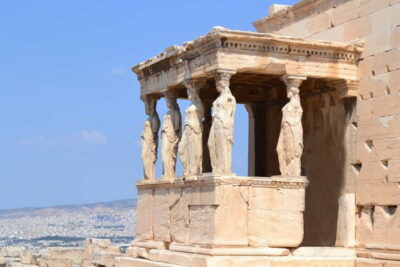

Acropolis monuments & Parthenon Walking Tour with Optional Acropolis Museum
Read our review →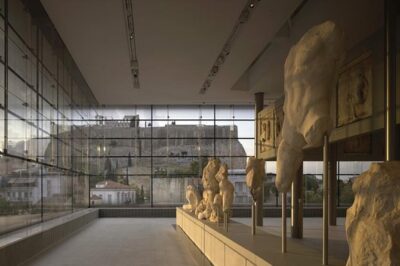
Athens All Included: Acropolis and Museum Guided Tour with Ticket
Read our review →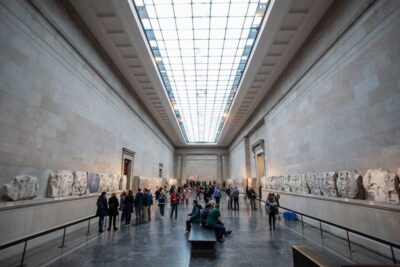
Acropolis Museum Ticket with optional Audio Guide
Read our review →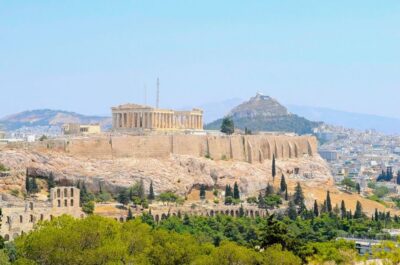
Acropolis Ticket & Optional Self-Guided Audio Tours
Read our review →Browse the lists this tour appears in