
Reviewed · WALKING TOURS
Athens Social and Political Walk
Athens has ancient temples everywhere, but this walk asks a sharper modern question: how did the birthplace of democracy reach the financial crisis of 2008 and its hard aftermath? You follow the answer through government buildings, memorials, streets, and places tied to protest and public life. I like the documentary-style storytelling and the way the tour connects big politics to ordinary Greek life.
I also like that Isaac, a political scientist, explains difficult subjects without turning the walk into a lecture. His humor and comparisons with other countries help make the material easier to follow. The main consideration is pace: two and a half hours covers a lot, so anyone seeking a relaxed stroll or mainly ancient sights may find the discussion more demanding than scenic.
Key points before you book

- Modern Greece from 1821 to today: The walk links independence, the Byzantine and Ottoman periods, World War II, postwar politics, and the financial crisis.
- A political scientist as guide: Isaac leads many English-language tours, using clear explanations, stories, humor, and comparisons with other countries.
- Athens beyond the monuments: Government buildings, the National Garden, Korai 4, Panepistimiou, and the Polytechnic become evidence in a wider story.
- A useful first-day orientation: You get context for religion, language, Europe, immigration, gentrification, and the economy before exploring more of Greece.
- A slideshow adds depth: Photos and extra information help continue the discussion after the walk ends.
- Good value for curious visitors: At $47, the price is reasonable if you want interpretation and historical context, not just a guide to sights.
Why this Athens walk feels different
Many city walks explain what a building is, then move on. This one asks what the building says about Greece. The Presidential Palace, Parliament, university streets, and memorial sites become clues in a story about power, identity, protest, and social change.
The starting question about the cradle of democracy and the financial crisis is deliberately blunt. It gives the walk a clear line of travel, but the guide does not reduce Greece to a simple success-or-failure story. The stated aim is an unbiased look at social and political developments, allowing you to form your own opinion.
That matters because modern Greek history can be hard to follow from a standard sightseeing tour. The country’s story includes independence in 1821, shifting relations with Europe, the role of religion, language disputes, war, military rule, student protest, party politics, migration, and economic upheaval. Here, those subjects are arranged as one connected conversation.
I would choose this experience early in an Athens stay. It can give you a better frame for later encounters with public buildings, political posters, memorials, and conversations about the euro crisis. It is also useful if you have already spent time in Greece and want to move beyond the usual ancient-world focus.
A few more things to do in Athens worth a look
- Athens: Acropolis and Parthenon Guided Walking Tour
★ 4.6 · 5,882 reviews - Greek Food Walking Tour in Athens
★ 5.0 · 4,740 reviews - Acropolis: Acropolis and Parthenon Guided Walking Tour
★ 4.7 · 3,442 reviews
From Maximos Mansion to the Presidential Palace
The walk begins at Planetwonk Experiences and heads toward Maximos Mansion, the official office of the Greek prime minister. This is a fitting first stop because it places present-day government at the center of the story.
You can expect the guide to explain how political authority works in modern Greece and how the country’s institutions developed after independence. The value here is not simply seeing an important building. You begin to understand the difference between ancient Athens as a symbol of democracy and the modern Greek state as a newer, more complicated creation.
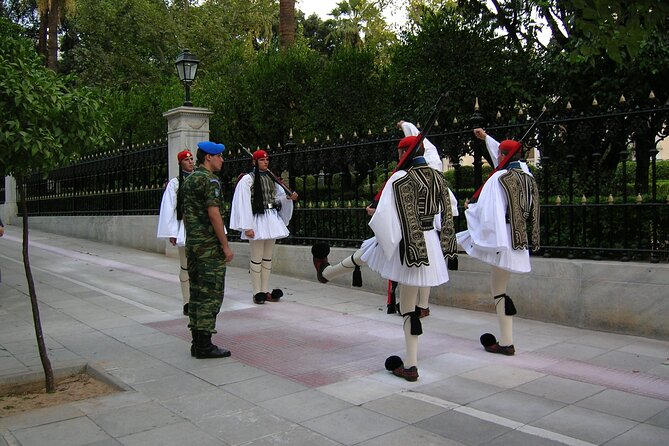
The route continues to the Presidential Palace. Its presence gives the guide a chance to discuss the state, national identity, and the role of public institutions. The walk does not promise entry into either building, so think of these stops as street-level interpretation rather than an interior tour.
That is a useful distinction. You are looking at the places where power is represented, then hearing how those symbols fit into the country’s political development. If you want grand rooms, security details, or formal palace history, this is not the right tour. If you want context, the stop works well.
The National Garden and the Hellenic Parliament

The National Garden offers a change of mood from government buildings and political discussion. The route passes through the garden on foot before reaching the Hellenic Parliament, giving the walk some breathing room.
The garden is not presented as a separate nature tour. Its role is practical: it helps connect the formal center of Athens with the public spaces around it. You get a sense of how political life, daily movement, and civic buildings share the same central area.
At the Hellenic Parliament, the conversation returns directly to government and public power. This is one of the clearest places to discuss modern Greek politics, party conflict, and the pressures that shaped the country before and after the financial crisis.
I like the sequence. You first see the prime minister’s office and Presidential Palace, then move through a public garden, and finally arrive at Parliament. The route gives a simple visual structure to the question of who governs Greece and how that power is experienced by people in the city.
The drawback is that political institutions can feel abstract if you have little interest in government. The guide’s use of stories and humor helps, but you should book this walk because you want to understand Greece, not because you want a list of postcard sights.
National Historical Museum and the birth of the modern state
The National Historical Museum is the natural setting for the discussion of modern Greece’s beginnings. The walk traces the country from the independence war in 1821 through later political and social changes.
The museum itself is treated as part of the street route, not as a long indoor museum visit. That means you should not expect a full collection tour or extended time with exhibits. Instead, the stop helps anchor the story of how a modern state took shape after Ottoman rule and how national identity developed.
The broader historical frame includes the Byzantine and Ottoman periods, followed by independence, World War II, and the postwar years. This is important because Greece’s present-day politics cannot be understood through ancient Athens alone. The modern country has its own state-building struggles, regional pressures, cultural debates, and social divisions.
I particularly value the attention to religion and language. These topics often get reduced to quick facts, yet they affect how a country defines itself and how it relates to Europe. The guide’s job here is to show connections, not hand you a pile of dates.
Same base, a completely different day:
- Athens: Acropolis & up to 5 Archaeological Sites Combo Pass
★ 4.4 · 12,619 reviews - Athens: Acropolis Ticket with Optional Audio or Live Guide
★ 4.2 · 11,055 reviews - Athens: Acropolis, Parthenon & Acropolis Museum Guided Tour
★ 4.8 · 9,316 reviews - Athens: Cape Sounion & Poseidon Temple Sunset Half-Day Trip
★ 4.8 · 8,241 reviews
Korai 4 and the cost of occupation
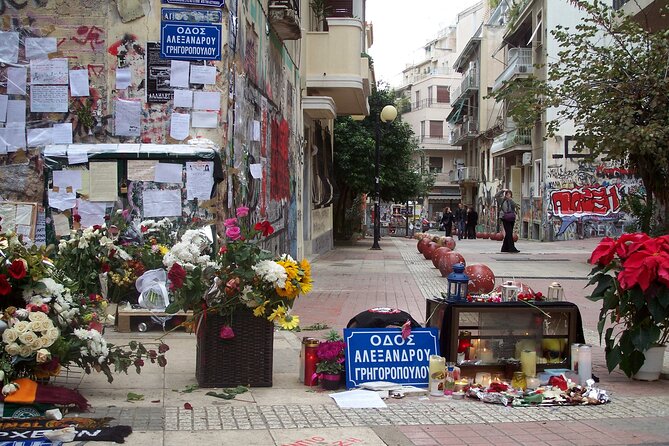
Korai 4, identified as a memorial site for 1941 to 1944, gives the walk one of its most serious stops. The site brings World War II and the occupation into the account of modern Greece.
This is where the tour’s method becomes clear. Instead of discussing war only in a classroom or museum, you encounter a place in the city tied to memory and loss. The stop helps explain why wartime experience continued to shape Greek society and politics long after the fighting ended.
You should expect the tone to change here. The walk includes humor, but it also deals with painful subjects. The guide uses specific places to show how national memory, political conflict, and everyday life can overlap.
Korai 4 is especially valuable if your knowledge of Greece begins and ends with antiquity. It reminds you that the country’s recent past is not a side note. Occupation, resistance, postwar politics, and later tensions all feed into the modern story.
Panepistimiou and the public life of Athens
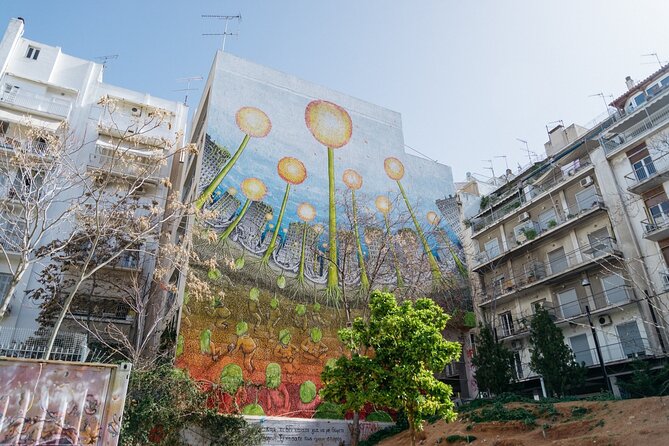
The route continues along Panepistimiou, one of central Athens’s important streets. Here the experience shifts back toward the visible life of the city: movement, institutions, architecture, political expression, and the way central Athens has changed.
The guide uses street exploration to discuss social issues rather than treating the city as a backdrop. Subjects may include the economy, immigration, gentrification, and the everyday lives of Athenians. The walk’s strength is its effort to show how broad policies affect ordinary people.
This part may be most useful to you if you have noticed contrasts in central Athens but have not known how to interpret them. The guide can place those contrasts in a wider discussion of economic change and social pressure. You are not simply told what a street looks like. You are encouraged to ask why it feels the way it does and who benefits from change.
There are several unnamed points of interest along the route. Since the exact stops can vary, you should expect the guide to use lesser-known streets and places as conversation starters rather than treat every location as a formal attraction.
The Polytechnic and student protest
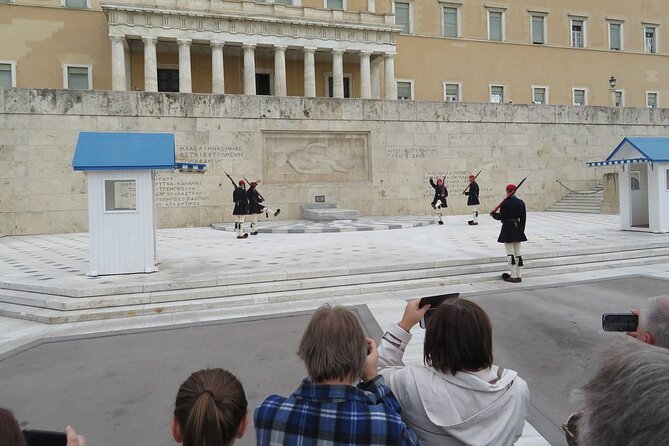
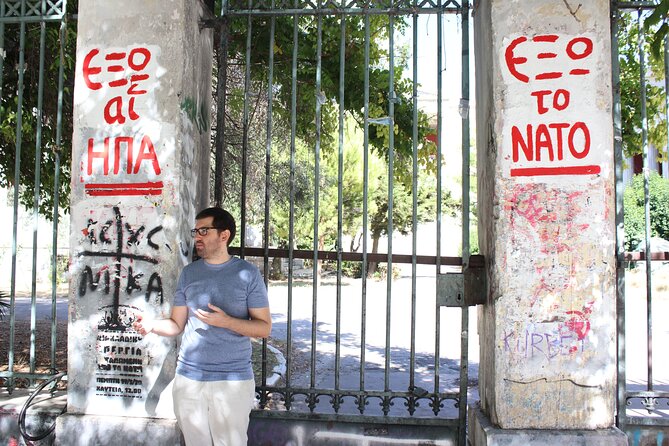
The National Technical University of Athens, often called the Polytechnic, is one of the most politically meaningful stops. It allows the guide to discuss student activism, the student massacre, and the role of protest in recent Greek history.
This is not just a university visit. The site represents a major clash between young people and state power, and it remains part of Greece’s public memory. The stop helps explain why protest, political distrust, and questions about authority have such a strong place in modern Greek life.
For me, this is one of the route’s most valuable locations because it makes political history tangible. A discussion of party politics or military rule can seem distant. A university associated with protest brings the subject back to people, choices, fear, and public action.
The walk finishes at 28is Oktovriou 42, near the Polytechnic area. The ending is practical as well as thematic. After two and a half hours, you finish in a part of Athens linked to education, politics, and public debate rather than at a purely tourist site.
What the guide does well
The guide is the heart of this experience. Isaac is identified as the political scientist leading the English-language walk, and the format depends on his ability to make hard subjects clear. The strongest feedback centers on his explanations, humor, openness to questions, and ability to compare Greece with other countries.
That combination matters. A specialist can easily speak above the group, especially when discussing neoliberalism, party politics, religion, or the economy. Here, the aim is to explain complex issues in simple terms without stripping away the difficult parts.
The guide also links historical periods instead of treating them as isolated chapters. You may move from the Byzantine and Ottoman eras to independence, then to World War II, postwar politics, student protest, immigration, and the financial crisis. The walk gains its value from those links.
The experience is available in English and Spanish. If you prefer to ask detailed questions, an English tour with Isaac may suit you particularly well. One experience also identifies Bianca as a guide, so the exact guide may depend on the date and language you choose.
The slideshow and the $47 price
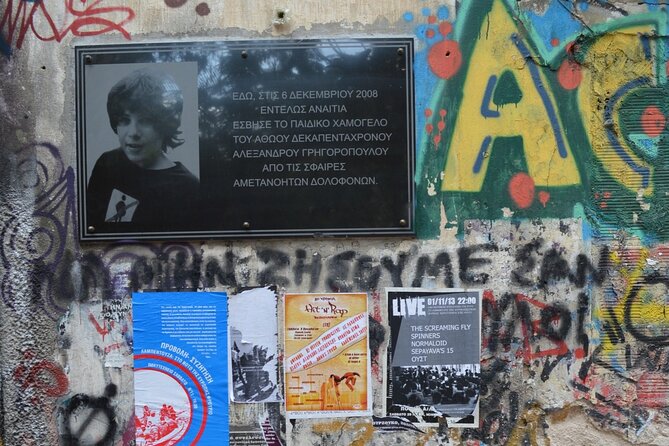
The price is $47 per person for 2.5 hours. That is not the cheapest way to see central Athens, but the comparison should be with an expert-led discussion, not with a basic orientation walk.
You are paying for interpretation, a political-science perspective, and a slideshow with photos and extra information about the subjects covered. No major admission package or meal is included, so the value rests on the quality of the guide and the range of ideas covered.
I find the price fair for the right audience. If you enjoy history, politics, current affairs, or social questions, you get a focused introduction to modern Greece that can shape the rest of your visit. If your priority is ancient monuments, food stops, or interior access, your money may be better spent elsewhere.
The reserve-now-and-pay-later option keeps your plans flexible. You can cancel up to 24 hours before the walk for a full refund. The activity is wheelchair accessible, though you should still confirm the route details when booking if you have specific mobility needs.
Who should take this walk?
I would recommend it to first-time visitors who want Greece explained beyond the Acropolis. It is also a good fit for people who have lived in Greece for a while but still feel unsure about the country’s political and social divisions.
Politics enthusiasts will get the most from the route, but you do not need a specialist background. The guide’s humor and plain explanations make the material approachable. You only need curiosity and a willingness to listen for much of the walk.
It suits adults and older teenagers better than young children, simply because the themes include war, occupation, political violence, economic crisis, migration, and protest. The tour is also a strong choice for anyone who prefers conversation and street observation to formal museum visits.
I would skip it if your ideal Athens experience is slow, scenic, and free of political discussion. The tour covers many decades and serious subjects in a short time. That gives you useful range, but it also means the pace can feel full.
Should you book the Athens Social and Political Walk?
Book it if you want to understand the modern country behind the ancient monuments. At $47, the walk offers solid value for its 2.5-hour route, political-science guidance, slideshow, and unusually broad treatment of Greek society.
The best reason to choose it is the connection between places and ideas. Maximos Mansion, Parliament, Korai 4, Panepistimiou, and the Polytechnic are not random stops. Together they build a story about state power, memory, protest, Europe, economics, and daily life.
Skip it if you want only sightseeing or a light introduction to Athens. For everyone else, especially anyone visiting early in a Greek trip, this is a thoughtful way to get past the familiar ancient image and meet modern Greece on its own terms.
FAQ
How long does the Athens Social and Political Walk last?
The walk lasts 2.5 hours.
How much does the experience cost?
The listed price is $47 per person.
Which languages are available?
The experience is available in English and Spanish.
Who leads the tour?
The walk is led by a political scientist. Isaac is named as the English-language guide in the experience details, and Bianca is also identified as a guide in one account.
Where does the walk finish?
The tour finishes at 28is Oktovriou 42, Athina 106 82, Greece.
Is the walk wheelchair accessible?
Yes, the activity is listed as wheelchair accessible.
What is included in the price?
A slideshow with photos and extra information about the issues discussed during the walk is included.
Just added in Athens
- Ceramic and Pottery Creative Workshop with Two Local Artists★ 4.0 · 57 reviews
- Small-Group Women History in Ancient Greece Walking Tour★ 5.0 · 38 reviews
- Athens Old City Private Photoshoot Tour / 2 hrs★ 5.0 · 109 reviews
- Athens: Wine Workshop Create your Own Wine under the Acropolis★ 5.0 · 77 reviews
- Athens: Greek Wines Tasting with Sommelier and Acropolis Views★ 5.0 · 88 reviews
- Wine Trails Private Tour/ Nemea visit 3 wineries from Athens or Nafplion (10 h)★ 5.0 · 44 reviews
- FLYING DRESS Photoshoot in Athens – Greece★ 5.0 · 47 reviews
- Small-Group Wine Tour in Athens with Tasting★ 5.0 · 33 reviews
Walking Tours, compared.

Acropolis monuments & Parthenon Walking Tour with Optional Acropolis Museum
Read our review →
Knossos: Knossos Palace Skip-the-Line Guided Walking Tour
Read our review →

Athens Authentic Greek Food Walking Tour (Small Group)
Read our review →
Early Morning Acropolis & Old Athens Guided Walking Tour
Read our review →
Browse the lists this tour appears in