

Reviewed · ACROPOLIS & ATHENS HIGHLIGHTS
Athens: The Acropolis Museum Guided Tour
The best reason to visit the Acropolis Museum with a guide is simple: the building is beautiful, but its objects need context. A statue can look like another marble figure until someone explains its purpose, missing color, religious role, and place in ancient Athens. In 75 minutes, a licensed guide leads you through the museum’s main story, from the ruins below your feet to the sculptures linked with the Parthenon.
I like the clear route through the highlights, especially the Archaic Gallery, the Caryatids, and the votive offerings to Athena. I also like the way the museum itself becomes part of the experience, with glass floors showing an ancient neighborhood and the upper atrium aligned with the Parthenon.
The main drawback is timing. Seventy-five minutes goes quickly, and the museum tour can be joined to a longer Acropolis visit already in progress. That has caused late starts for some visitors, so leave space in your schedule rather than planning a tight lunch or afternoon connection.
Key points at a glance

- See ancient Athens beneath your feet: Plexiglass and glass floors reveal excavated remains of an Athenian neighborhood.
- Focus on the museum’s finest objects: The route includes votive offerings, Archaic sculptures, and the famous Caryatids.
- Use the museum before the hilltop Acropolis: The displays provide useful background before you see the ruins in place.
- Look through the Parthenon-aligned atrium: The Modernist building frames views of the Acropolis.
- Expect a brisk, guided visit: You get a strong overview, but not time for every gallery or object.
- Budget for admission separately: The tour costs $41 per person, while adult entry is approximately €20.
Why the Acropolis Museum makes sense before the Acropolis

I recommend seeing this museum before climbing the Acropolis if your schedule allows. On the hilltop, you face columns, foundations, and weathered stones. Inside the museum, you see the sculptures, architectural pieces, religious offerings, and historical setting that help those remains make sense.
The museum covers the period when Athens reached its greatest artistic influence, especially the 5th century BC. Your guide connects religion, art, theatre, science, politics, and daily life instead of treating each statue as an isolated object. That broader explanation is one of the main reasons to choose a live tour instead of simply wandering with labels.
This works particularly well if you are not naturally a museum person. Several guides have been praised for explaining difficult material in plain English, using humor and modern comparisons without turning the subject into a lecture. Guides named Dimitris, Natasha, Niobe, Annie, Margherita, Jordan, and Apollo have all received especially warm praise for their communication, energy, and command of the subject.
The museum also gives you a preview of what you will see outdoors. After learning why particular buildings and sculptures mattered, you can recognize them on the Acropolis rather than simply photographing a famous ruin.
More of the old city on foot in Athens:
- Athens: Acropolis & up to 5 Archaeological Sites Combo Pass
★ 4.4 · 12,619 reviews - Athens: Acropolis Ticket with Optional Audio or Live Guide
★ 4.2 · 11,055 reviews - Athens: Acropolis, Parthenon & Acropolis Museum Guided Tour
★ 4.8 · 9,316 reviews
Meeting at Dionysiou Areopagitou Street
The meeting point is at 3 Dionysiou Areopagitou Street, beside the Lukumades and Pilino stores. This is at the beginning of the pedestrian walkway running from Hadrian’s Arch and Syngrou Avenue toward the Acropolis.
Look for staff holding the orange Athens Walking Tours sign. The location is not directly at the museum entrance, and that matters. Give yourself enough time to find the stores and the representative, especially if you are arriving by metro, walking from another neighborhood, or carrying children along busy central streets.
One practical concern is that the museum tour may be the second part of a longer outing. Some people book only the museum portion and then join a group whose guide has already led an Acropolis visit. When the first part runs late, the museum section can start 30 to 45 minutes behind schedule.
This arrangement can work well because a representative helps connect you with the ongoing group. Still, I would not book this experience immediately before another fixed activity. The 75 minutes refers to the museum visit, not necessarily the full time from meeting point to finish.
The museum building is part of the lesson
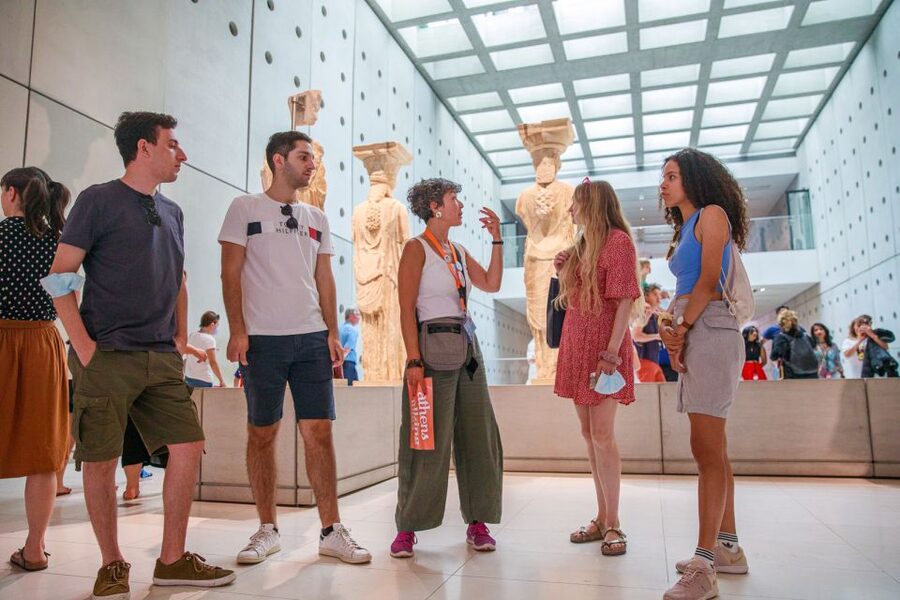
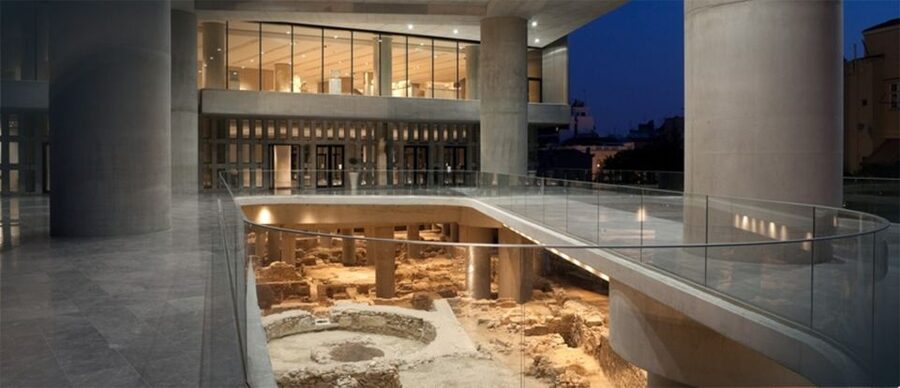
Before you concentrate on the artifacts, notice the building. Designed by Bernard Tschumi and Michael Photiadis, it uses glass, concrete, open space, and strong lines to connect modern Athens with the ancient site above it.
The design is not just decoration. Excavations remain visible through glass and plexiglass floors, allowing you to look down at the remains of an ancient Athenian neighborhood. This gives you a physical sense of the city beneath today’s streets. You are not looking only at objects removed from their setting. You can also see the layers of urban life that developed around the Acropolis.
Natural light is especially effective in the first-floor Archaic Gallery. It gives the sculptures room to breathe and makes details in the marble easier to see. The open, bright space also helps you notice traces of form and surface that can disappear in a dim display room.
Your guide explains how the building’s layout supports the collection. The glass atrium is built in alignment with the Parthenon, so the architecture points your attention toward the monument while you study related material inside. It is a smart way to connect the museum and the hilltop without pretending they are the same experience.
Ancient neighborhood ruins beneath the glass
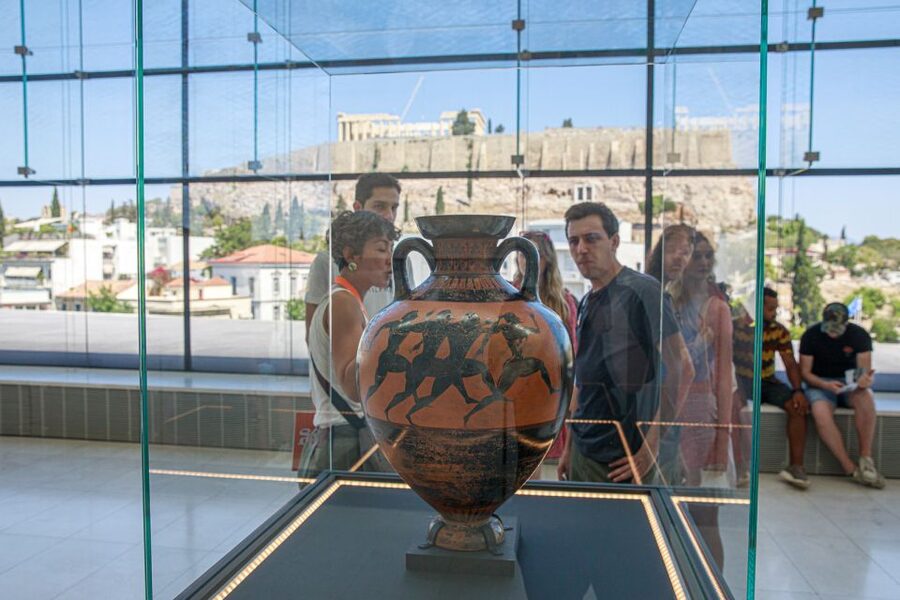
The floor-level archaeology is one of the museum’s most unusual features. Through transparent sections, you can see ruins from an ancient Athenian neighborhood. This is a useful reminder that the Acropolis was not an isolated monument floating above an empty city.
A guide can help you read these remains as part of everyday urban life. The stone foundations and street traces may not immediately explain themselves, particularly if your main interest is sculpture. With a short explanation, the excavation becomes evidence of homes, movement, and city growth around the sacred hill.
Do not expect a full archaeological excavation visit in addition to the museum. You see the remains through the museum’s floors as part of the route. That is enough to add a strong sense of place, but the 75-minute schedule does not allow for a long technical discussion of every visible section.
The floor may also require you to watch where you step and where you stand. Wheelchair access is available, but as with any busy museum tour, it helps to keep the group’s movement in mind.
A few more things to do in Athens worth a look
- Athens: Mythology of Delphi, Museum and Arachova Guided Tour
★ 4.6 · 4,008 reviews - Athens: Acropolis, Parthenon & Acropolis Museum Guided Tour
★ 4.8 · 3,579 reviews - Acropolis monuments & Parthenon Walking Tour with Optional Acropolis Museum
★ 5.0 · 2,678 reviews - Athens All Included: Acropolis and Museum Guided Tour with Ticket
★ 4.5 · 2,673 reviews
The Archaic Gallery and the age of painted sculpture
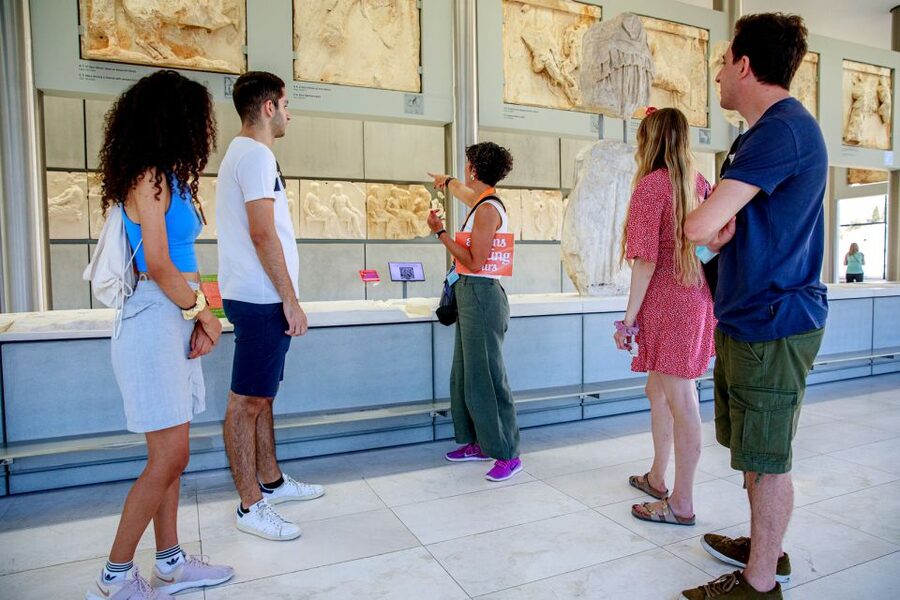
The Archaic Gallery is likely to be one of your main stops. It is filled with early Greek sculpture and receives abundant natural light, a setting that makes the figures feel more immediate than they might in a conventional closed gallery.
This is where a guide can change your understanding of ancient sculpture. Many people arrive expecting white marble, but Greek sculpture was not always intended to look bare and colorless. A guide can point out what the figures represented, how they were offered or displayed, and how Greek artists developed their treatment of the human body.
The tour does not promise a line-by-line account of every object. Instead, you get selected examples that explain the larger change in Greek art. That is the right approach for a short visit. A long list of dates and names would leave you with less sense of why the objects matter.
One visitor felt the guide spent too much time on individual people and wanted more general Acropolis history. That is a fair warning. If you prefer a quick overview, tell your guide early. If you like stories about specific figures, patrons, and religious customs, the detail may be exactly what you want.
Votive offerings to Athena
The museum’s votive offerings show the personal side of ancient religion. These were not simply grand public works. People also dedicated objects to Athena in hope of receiving favor, giving thanks, or marking an important act of worship.
Your guide places these offerings within the life of the Acropolis sanctuary. That context helps you see the site as a working religious center, not just a collection of buildings admired by later generations.
This section can be easy to rush through on your own. Small offerings do not have the instant visual impact of a large statue, but they tell you more about individual relationships with the gods. I like that the tour gives these pieces space within the broader story of monumental architecture.
Because time is limited, your guide will select representative objects rather than discuss the entire collection. The museum holds more than 4,000 artifacts, so no 75-minute route can be exhaustive. Think of this as an introduction that shows you what deserves a slower second look.
The Caryatids and the Parthenon connection
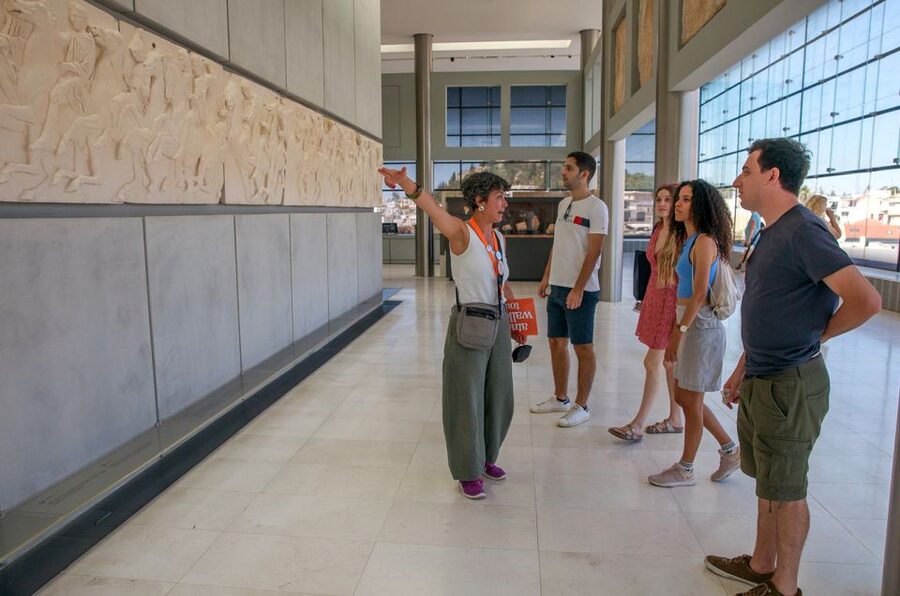
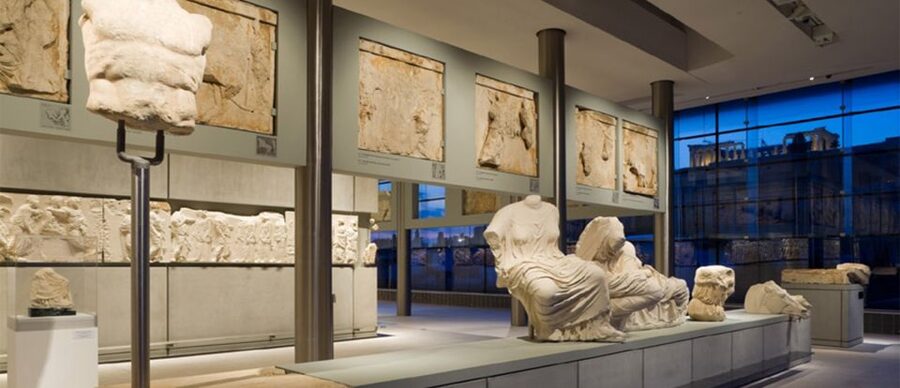
The Caryatids are among the museum’s essential sights. These sculpted female figures are linked with the Erechtheion on the Acropolis, and seeing them close up gives you details that are hard to appreciate from the hilltop.
Your guide can explain their architectural role and why the museum protects the originals. The display also helps you compare the museum pieces with what you see outside, where replicas occupy the monument’s porch.
The upper section’s relationship with the Parthenon is another strong moment. Through the glass atrium, the building frames the Acropolis, while the objects around you connect to the monuments above. You get both a close view of the sculpture and a wider sense of its original setting.
Allow yourself a moment to look beyond the guide’s group here. The views are part of the museum visit, not a spare extra. On a clear day, the alignment makes the connection between the modern building and ancient hilltop especially easy to grasp.
How the guides shape the experience
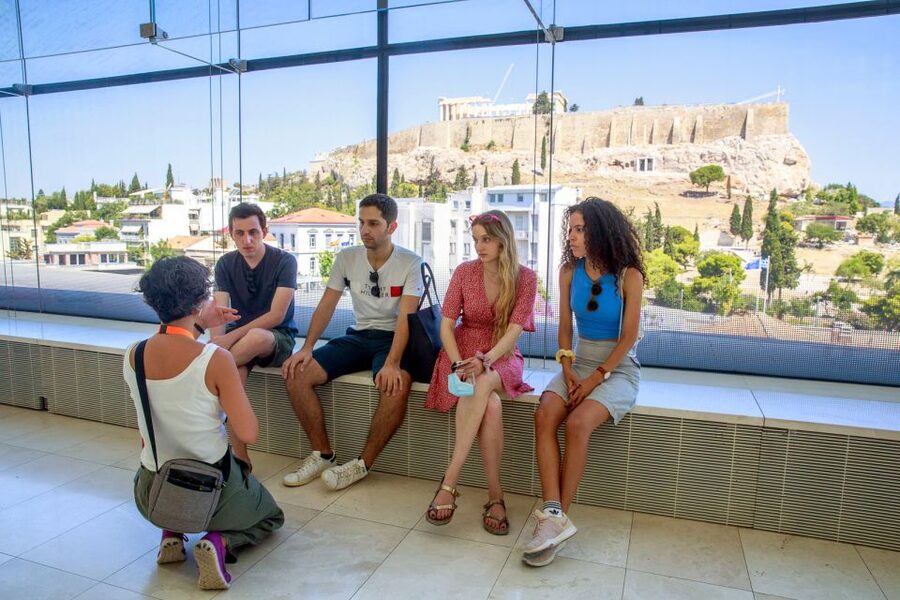
The guide is the main reason to book this rather than enter alone. The museum has plenty to see, but a short visit without a plan can become a walk past famous objects with little understanding of their importance.
The strongest guide style here appears to be organized, lively, and selective. Niobe was praised for having a clear plan and filling roughly an hour with useful information without overwhelming the group. Natasha has been singled out for explaining both the museum’s design and the key exhibits, while also making history approachable.
Families can benefit from the live format. Annie was praised for involving a seven-year-old in the discussion, which is a good sign for parents who worry that an archaeology tour will lose younger children. The tour is conducted in English, and the activity is listed as wheelchair accessible.
Group size can affect the feel. One person found the group quite large, although the guide kept people moving and maintained control. In a crowded gallery, you may need to position yourself near the guide to hear and see the object being discussed.
The guides are not identical in style. Some lean toward mythology and stories, while others focus on chronology, architecture, or individual figures. Apollo, for example, was praised for bringing Greek mythology and history together. If you have a strong preference, the booking information does not guarantee a particular guide.
Is $41 plus admission good value?
The tour price is $41 per person, with adult museum admission costing approximately €20 separately. That makes the total notably higher than a self-guided visit, so the value depends on how much explanation you want.
I think the price is reasonable for first-time visitors who want the main story in a compact format. A licensed guide saves you from sorting through thousands of objects and helps connect the museum with the Acropolis. You are paying for direction, interpretation, and the chance to ask questions.
The value is less clear if you already have strong background knowledge or plan to spend several hours reading every label. In that case, the 75-minute route may feel too brisk, and you may prefer to enter independently and set your own pace.
Admission is not included, so budget for it before you arrive. The included skip-the-ticket-line service is useful, but it does not remove the cost of entry. Food, drinks, and hotel transport are also not included.
Timing, clothing, and practical planning
Wear comfortable shoes. You will meet outside, walk to the museum area, and remain on your feet through much of the visit. Tours run in rain or shine, so bring weather protection if the forecast is poor.
Do not bring luggage or large bags. You should carry your passport or ID card, as these are listed among the required items. The activity is wheelchair accessible, but a large group and crowded galleries can still make movement slower.
Early morning is a smart choice in the summer. One visitor specifically recommended an early tour because of the heat, and an early start can also leave you more time for the Acropolis, lunch, or another central Athens sight.
Cancellation is flexible if your plans are uncertain: you can cancel up to 24 hours before the activity for a full refund. You can also reserve now and pay later, which helps if you are still arranging several days in Athens.
Who should book this museum tour?
I would choose this tour for a first visit to Athens, especially if you plan to see the Acropolis on the same day or the following day. It is also a good fit for families, curious adults who do not usually enjoy museums, and anyone who wants clear English explanations rather than a long academic lecture.
It suits you less if you want a slow, independent museum visit. The guide chooses the route, the group may be sizeable, and 75 minutes leaves little time to linger. It is also not ideal before a tightly scheduled activity because a late start can happen when the museum visit follows an Acropolis tour.
Should you book the Acropolis Museum Guided Tour?
Book it if you want the Acropolis Museum to explain the hilltop ruins rather than simply decorate your Athens itinerary. The combination of ancient neighborhood remains, natural light in the Archaic Gallery, votive offerings, Caryatids, and Parthenon views gives the visit plenty of substance.
The best plan is to visit the museum before the Acropolis and leave extra time around the booking. At $41 plus approximately €20 admission, it is not the cheapest museum entry, but the guide can make a major difference during a short stay.
Skip it if you prefer to move slowly, read every label, or already know the story well. For most first-time visitors, though, the focused route and strong guide-led context make the museum more useful, more memorable, and easier to understand.
FAQ
How long is the Acropolis Museum guided tour?
The guided museum visit lasts 75 minutes. The full time from the meeting point to completion may be longer if the tour starts late or follows an earlier Acropolis visit.
What language is the tour conducted in?
The live guided tour is conducted in English.
Is the museum admission fee included?
No. Entrance costs approximately €20 per adult and is paid separately from the $41 tour price.
Where is the meeting point?
Meet at 3 Dionysiou Areopagitou Street, beside the Lukumades and Pilino stores. Staff will be holding an orange Athens Walking Tours sign.
What will I see during the tour?
The route includes the Archaic Gallery, votive offerings to Athena, the Caryatids, excavated remains of an ancient Athenian neighborhood, and views toward the Acropolis through the museum’s aligned atrium.
Can I bring luggage or a large bag?
No. Luggage and large bags are not allowed.
Is the tour wheelchair accessible?
Yes, the activity is listed as wheelchair accessible.
What happens if it rains?
Tours operate in all weather conditions, rain or shine. Bring suitable clothing and comfortable shoes.
Just added in Athens
- Ceramic and Pottery Creative Workshop with Two Local Artists★ 4.0 · 57 reviews
- Small-Group Women History in Ancient Greece Walking Tour★ 5.0 · 38 reviews
- Athens Old City Private Photoshoot Tour / 2 hrs★ 5.0 · 109 reviews
- Athens: Wine Workshop Create your Own Wine under the Acropolis★ 5.0 · 77 reviews
- Athens: Greek Wines Tasting with Sommelier and Acropolis Views★ 5.0 · 88 reviews
- Wine Trails Private Tour/ Nemea visit 3 wineries from Athens or Nafplion (10 h)★ 5.0 · 44 reviews
- FLYING DRESS Photoshoot in Athens – Greece★ 5.0 · 47 reviews
- Small-Group Wine Tour in Athens with Tasting★ 5.0 · 33 reviews
Acropolis & Athens Highlights, compared.
Acropolis & up to 5 Archaeological Sites Combo Pass
Read our review →
Acropolis, Parthenon & Acropolis Museum Guided Tour
Read our review →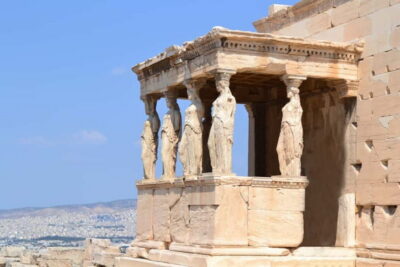

Acropolis monuments & Parthenon Walking Tour with Optional Acropolis Museum
Read our review →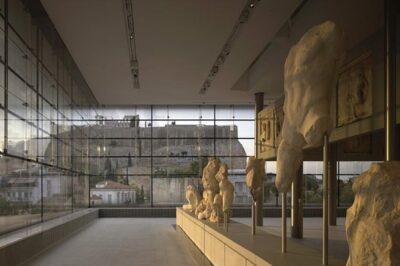
Athens All Included: Acropolis and Museum Guided Tour with Ticket
Read our review →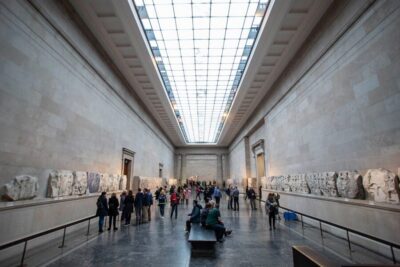
Acropolis Museum Ticket with optional Audio Guide
Read our review →
Acropolis Ticket & Optional Self-Guided Audio Tours
Read our review →Browse the lists this tour appears in