
Reviewed · ACROPOLIS & ATHENS HIGHLIGHTS
Visit of the Acropolis with an official guide in Spanish
The best thing about this Acropolis visit is the Spanish-language storytelling. In about two hours, you move from myth and politics to marble, theater, medicine, and war, with an official guide connecting the scattered ruins into one clear story. Guides named Efi, Ari, Simon, Maria, and Elfi have led particularly engaging visits, though your guide is assigned by availability.
I like the early 8:30 a.m. start, which gives you a better chance of touring before the day becomes punishingly hot. I also like the wireless audio system and the attention to photo spots, since you can hear the explanation without standing shoulder to shoulder with the guide. The main catch is simple: your Acropolis admission ticket is not included, so you must arrange entry separately.
Key points to know before booking
- Spanish is the focus: The tour is designed exclusively for Spanish-speaking visitors, with explanations in Spanish from an official guide.
- The ticket costs extra: The $44.03 tour price covers the guide, audio system, taxes, and the guided visit, but not entry to the Acropolis.
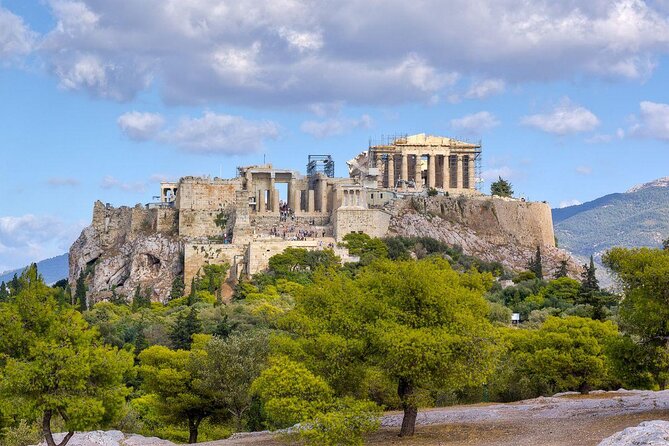
- The route covers more than the Parthenon: You see the Propylaea, Erechtheion, Odeon of Herod Atticus, Temple of Asclepius, and Theatre of Dionysus.
- The start time is 8:30 a.m.: This is useful in Athens, especially since the tour involves exposed stone, stairs, and walking.
- The visit ends on top of the Acropolis: After the guided portion, you can stay to take photographs and look around at your own pace.
- The group can reach 27 people: The audio equipment helps, but this is not a private or tiny-group tour.
Why this Acropolis tour works well in Spanish

The Acropolis is easy to admire and surprisingly hard to understand on your own. You see columns, broken statues, and foundations, but the meaning of each place can blur together without a guide. This visit gives you the political, religious, architectural, and mythological setting before asking you to look closely at the stones.
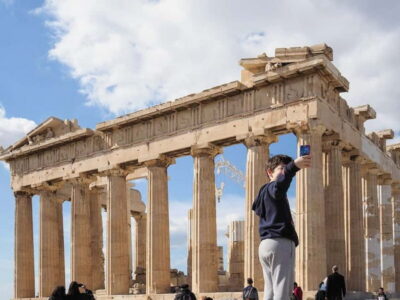
That order matters. The Parthenon was not simply a beautiful temple. It expressed the power of Athens, honored Athena, and reflected the city’s confidence after victories over Persia. The guide also explains how the building later served as a Byzantine church and an Ottoman mosque, then suffered damage, looting, and years of restoration.
The strongest part of this experience is the human delivery. Efi is repeatedly praised for using questions and imagination to draw people into the story. Other guides, including Ari, Simon, Maria, and Elfi, are also singled out for clear, lively explanations and a genuine love of Greek history. You are not promised one particular guide, but the feedback points to a team that treats guiding as interpretation rather than reciting dates.
The tour is conducted in Spanish only. That is a major benefit if you want to think and ask questions in Spanish, but it is not a good fit for a mixed-language group hoping for bilingual commentary.
More of the old city on foot in Athens:
- Athens: Acropolis & up to 5 Archaeological Sites Combo Pass
★ 4.4 · 12,619 reviews - Athens: Acropolis Ticket with Optional Audio or Live Guide
★ 4.2 · 11,055 reviews - Athens: Acropolis, Parthenon & Acropolis Museum Guided Tour
★ 4.8 · 9,316 reviews
Meeting the guide near Dionysiou Areopagitou
The meeting point is the Greek National Tourism Organisation Information Point at Dionysiou Areopagitou 18, near the Acropolis pedestrian zone. The tour begins at 8:30 a.m., and confirmation arrives when you book.
Arrive with enough time to find the meeting point. The experience is entirely on foot, with no hotel pickup or local transport included. The guide then leads the group through the Acropolis site and finishes at Theorias 21, directly on top of the Acropolis.
That final location is useful. You do not have to leave as soon as the formal explanation ends. You can use your remaining time for photographs and a closer look at the monuments, instead of retracing the entire route with the group.
The group size can reach 27 people. That is large enough to keep the price moderate, but not so large that the wireless audio system becomes optional. Keep the receiver close and pay attention when the guide moves between stops.
Starting with the Acropolis and its wider story
The visit begins with the Acropolis as a whole, not just the Parthenon. The guide sets out the religious and civic role of the hill, then brings in the myths and people tied to it.
This opening is valuable because the Acropolis is not one building from one period. It is a sacred center shaped by ancient Greek religion, Athenian politics, later Christian use, Ottoman rule, conflict, damage, and restoration. The guide’s job is to help you see those layers without turning the visit into a classroom lecture.
Expect a lot of looking upward, crossing uneven surfaces, and moving between popular viewpoints. The official guide can point out details you might miss, such as the way a building was positioned, why a particular column type was used, or how a myth explains a feature of the site.
The route is not strenuous in the way a mountain hike is, but it does require a moderate level of fitness. The stone can be uneven, and the site has little protection from the sun. The early start is one of the tour’s practical strengths, particularly during hot weather.
The Parthenon: more than perfect columns
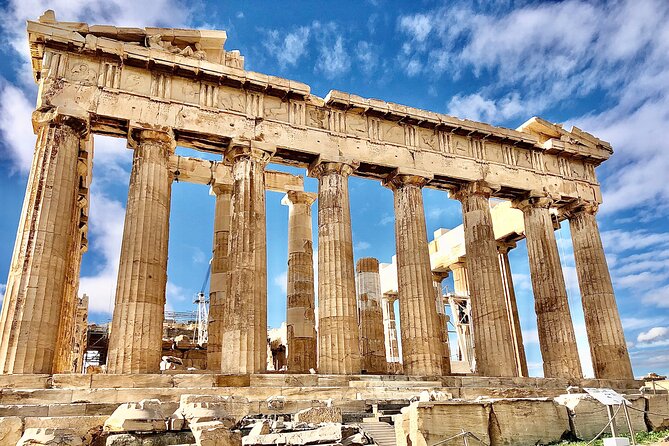
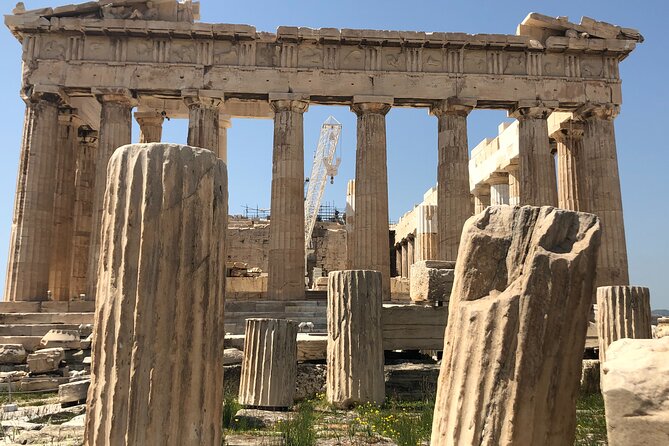
The Parthenon receives the longest and most important explanation. This is the building most people come to see, but it rewards a closer look beyond the familiar front view.
The guide explains its construction around 2,500 years ago, its harmony and proportions, and its optical refinements. These refinements are especially useful to hear about on site, where you can look at the building and understand that its apparently straight lines were carefully adjusted to create a balanced visual effect.
The history after antiquity is just as important. The Parthenon became a church during the Byzantine period and later a mosque under Ottoman rule. Its decoration was damaged, removed, or carried away over time, and restoration remains an active concern.
A good guide helps you hold two thoughts at once: the Parthenon is an extraordinary work of architecture, and it is also a damaged monument shaped by centuries of changing power. That makes the visit more honest than treating it as a frozen object from ancient Greece.
You should not expect to enter the Parthenon itself. The tour takes place among the Acropolis monuments, with explanations from the accessible viewing areas. Since admission is not part of the $44.03 price, arrange your entry separately before arrival.
A few more things to do in Athens worth a look
- Athens: Acropolis and Parthenon Guided Walking Tour
★ 4.6 · 5,882 reviews - Athens: Cape Sounio & Poseidon Temple Trip with Audio Guide
★ 4.4 · 4,521 reviews - Athens: Mythology of Delphi, Museum and Arachova Guided Tour
★ 4.6 · 4,008 reviews - Athens: Acropolis, Parthenon & Acropolis Museum Guided Tour
★ 4.8 · 3,579 reviews
The Propylaea and the Temple of Athena Nike
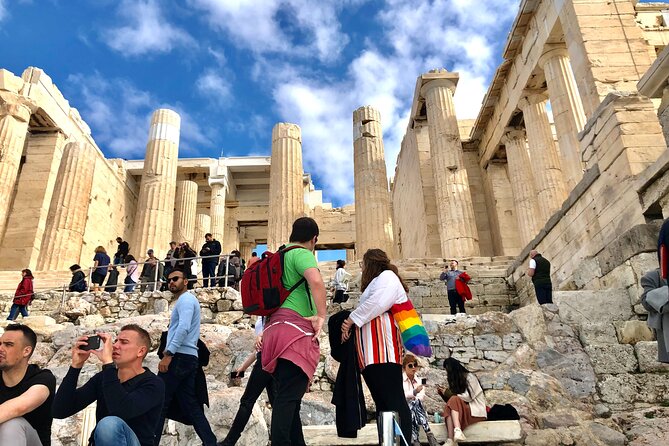
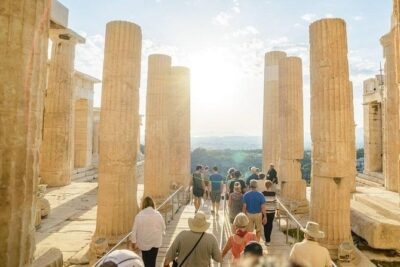
The Propylaea is the monumental gateway into the Acropolis. Made largely of marble, it was meant to impress religious pilgrims in antiquity and still creates a strong first impression today.
Its position also had a practical purpose. The guide explains how the approach worked like a funnel during periods of conflict, using the hill’s topography to control movement. This is the kind of detail that changes the way you see the entrance. It was not just a grand doorway. It shaped how people arrived, gathered, and passed into the sacred area.
Nearby is the small Temple of Athena Nike, described in the route as a tribute to Athena Victorious. It commemorated Athenian victories over the Persians and carried a clear message about the city’s success during its golden age.
This stop is brief, but it adds political meaning to the stone. Athens used its sacred buildings to tell stories about protection, victory, and civic pride. The guide’s explanation helps you connect the small temple with the much larger Parthenon nearby.
The Erechtheion and its famous Caryatids
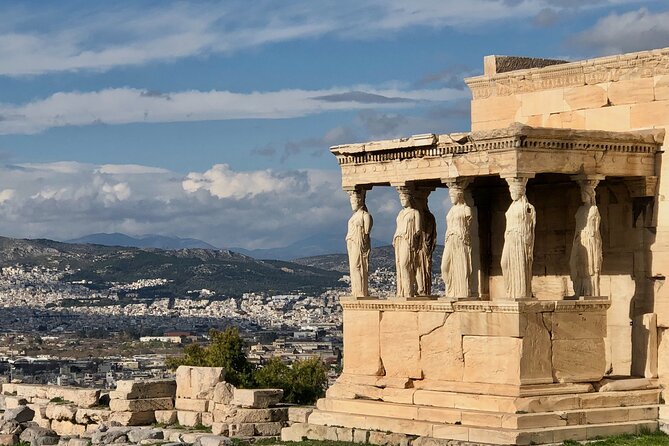
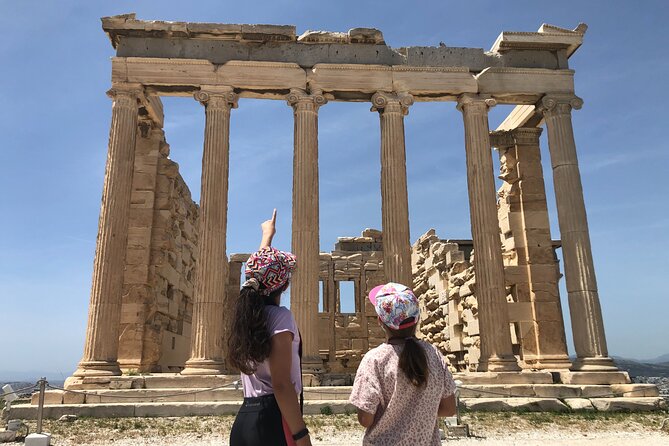
The Erechtheion is often the most photogenic stop, thanks to its Caryatids, the female-shaped columns supporting one of its porches. The building looks elegant, but its religious role was complex.
It was dedicated to several figures, including Athena, Poseidon, and Erechtheus, a mythological king of Athens. The guide explains how several traditions came together in one building, which helps account for its unusual plan and uneven appearance.
The sacred olive tree is another key part of the story. It is tied to the contest between Athena and Poseidon for the protection of Athens. The myth says Athena’s gift of the olive tree helped win the city, and the tree became a symbol of prosperity and divine favor.
The Caryatids are easy to photograph, but do not rush past the explanation. The guide can point out why this monument differs so much from the more regular Parthenon. It is a place where myth, worship, architecture, and civic identity meet.
The stop is listed at about 10 minutes, so you will get an introduction rather than a long architectural seminar. If you want time for careful photography, the tour’s finish on the Acropolis gives you a chance to return to your favorite views after the group portion ends.
Looking down at the Odeon of Herod Atticus
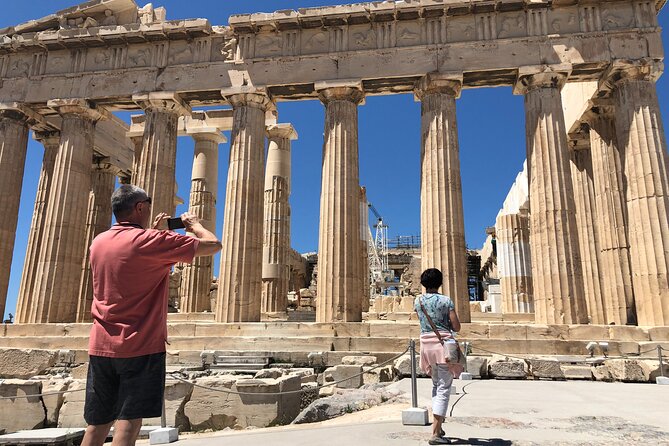
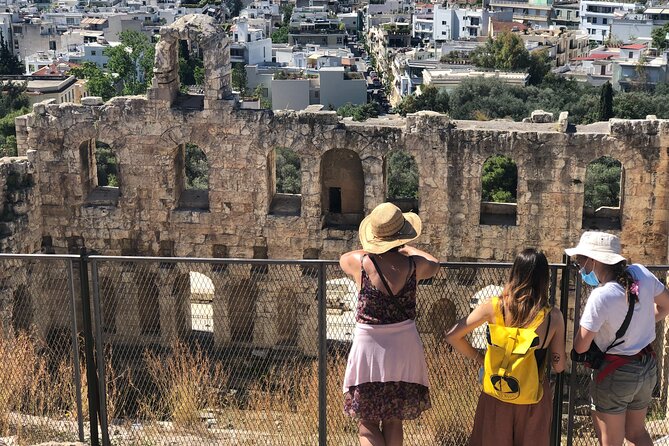
From the Acropolis, you can see the Odeon of Herod Atticus below. Built by the Roman governor Herod Atticus and dedicated to his wife, Regilla, it had room for about 5,000 spectators.
The guide explains that this is not merely an ancient ruin. It is fully restored and still used for performances during the Athens Festival. That living connection gives the site a different feel from a building known only through archaeology.
The short stop helps place the Acropolis in the wider performance culture of Athens. The hill was a religious center, but the city below also gathered for music, drama, and public events. Looking down into the Odeon makes that connection easy to picture.
Because the tour lasts about two hours, you should expect an exterior explanation rather than a concert visit or a full tour inside the auditorium. The value comes from seeing how the building fits into the city around the Acropolis.
The Temple of Asclepius and ancient healing
The Temple of Asclepius is a smaller stop, lasting about five minutes, but it adds a useful subject that many first visits overlook: medicine.
Asclepius was the god of healing, and the guide explains how ancient Athenians treated patients and what kinds of offerings they left in thanks. These offerings give a personal side to ancient religion. People did not come only for grand civic ceremonies. They also came with pain, hope, and gratitude.
This is a good example of why a guide helps. A foundation or small sacred area can look insignificant when you are focused on the Parthenon. Once you know that people came here seeking health, the remains carry a more direct human meaning.
The explanation is short, so you will not receive a full study of ancient medicine. Still, it broadens the visit beyond temples and military victories.
The Theatre of Dionysus and the birth of drama
The Theatre of Dionysus Eleuthereus sits on the southern slope of the Acropolis. It is one of the oldest theaters in the world and was built in marble, with space for around 17,000 spectators.
Its location used the slope of the hill to help with seating and acoustics. The guide explains how the position allowed large crowds to hear performances, then connects the theater with the first presentations of works by Euripides, Aeschylus, Sophocles, and Aristophanes.
This is one of the most important stops for understanding Athens as a cultural center. The city’s achievements were not limited to temples and military power. Drama was part of public life, civic debate, religion, and competition.
The theater stop also gives the tour a strong ending. You have seen sacred buildings, royal myths, healing practices, imperial changes, and public entertainment. Together, these places show a city concerned with gods, politics, beauty, health, grief, humor, and memory.
What the $44.03 price includes
At $44.03 per person, this is a guide fee rather than an all-in Acropolis ticket. You pay for the official Spanish-language guide, the wireless audio system, the guided route through the listed monuments, and state taxes.
The entrance ticket is extra. That matters because the total cost is higher than the advertised tour price, and you need valid admission to join the visit. The exact ticket arrangements are not handled by the tour fee, so read the booking details carefully and plan for that separate expense.
I think the price is reasonable if you want context in Spanish and would otherwise spend time trying to piece the site together alone. The value is strongest for first-time visitors, families who want a clear explanation, and anyone interested in mythology and architecture rather than quick photographs.
It is less compelling if you already know the Acropolis well or prefer wandering without a schedule. Two hours also means the guide must keep moving. You will hear the major ideas and see the key monuments, but you will not get an exhaustive study of every carved fragment.
Timing, comfort, and group size
The 8:30 a.m. start is one of the best practical features. Athens can become very hot, and the route includes exposed stone and open viewpoints. Several accounts of the visit praise guides for keeping explanations engaging even in intense heat, but good footwear, water, and sun protection remain important.
The experience requires moderate physical fitness. You walk the entire route, and there are uneven surfaces around an ancient site. Transfers are not included, so you must reach the meeting point yourself.
The maximum group size is 27. That is not an intimate private tour, but the audio system should make it easier to hear the guide. It also means the pace is set for the group. If you need a long pause at each monument, you may prefer a self-guided visit.
Service animals are allowed, and the meeting point is near public transportation. The tour ends at the top of the Acropolis, not back at the original meeting point, so plan your next activity from there.
Who should book this Spanish-language visit
I would choose this tour if you want the Acropolis to make sense, not merely appear in your holiday photographs. It is particularly well suited to Spanish-speaking visitors who want mythology, architecture, and later history explained in one continuous visit.
It also works well for families. The strongest guides use questions, stories, and visual details to keep children involved, and one family continued with the same guide for another visit. That does not guarantee your guide will be Efi, but it shows how much the quality of the storytelling can shape the day.
The tour is a good match for you if:
- You prefer Spanish explanations.
- You are visiting the Acropolis for the first time.
- You want the major monuments covered in two hours.
- You appreciate a guide who can explain both ancient and later uses of the buildings.
- You are comfortable walking in heat and on uneven stone.
- You want free time for photographs after the formal visit.
I would look elsewhere if you need a private group, hotel transfers, a very slow pace, or admission bundled into one price. You should also avoid assuming that a particular guide will lead the tour. Efi receives especially warm praise, but Ari, Simon, Maria, and Elfi are also named as strong guides, and assignments can vary.
Should you book this Acropolis tour?
Book it if you want a focused, Spanish-language introduction led by an official guide who can connect the Parthenon to the rest of the hill. The route covers the essential monuments and adds details about ancient theater, healing, mythology, war, and later religious use.
Before paying, remember that $44.03 does not include Acropolis admission. Arrive at the Dionysiou Areopagitou meeting point for the 8:30 a.m. start, wear shoes suited to uneven ground, and leave room in your schedule after the tour for photographs from the summit.
For a first visit, the combination of an early start, strong storytelling, audio equipment, and a finish on top of the Acropolis makes this a sensible choice. It gives you the framework you need, then leaves you free to look around on your own.
FAQ
Is the Acropolis entrance ticket included?
No. Admission to the Acropolis is not included in the $44.03 tour price. You need a separate entry ticket to take part in the visit.
What language is the tour conducted in?
The tour is conducted exclusively in Spanish with an official tourist guide.
How long does the tour last?
The guided visit lasts approximately two hours.
What time does the tour begin?
The tour begins at 8:30 a.m.
Where does the tour meet?
The meeting point is the Greek National Tourism Organisation Information Point at Dionysiou Areopagitou 18, Athens 117 42, Greece.
Where does the tour finish?
The visit ends at Theorias 21, on top of the Acropolis. You can remain there afterward for free time and photographs.
Is transportation included?
No. The entire visit is on foot, and transfers are not included.
Just added in Athens
- Athens hotels to Athens airport Private departure transfer★ 5.0 · 285 reviews
- Athens: Half-Day Morning Catamaran Cruise with Meal & Drinks★ 4.9 · 221 reviews
- Argolis: Full-Day Tour in Mycenae & Nafplio★ 4.2 · 350 reviews
- Athens: Riviera Catamaran Cruise with Meal and Drinks★ 5.0 · 345 reviews
- Athens: Delphi, Corycian Cave, and 300 Battlefield Day Trip★ 4.8 · 344 reviews
- 3-Day Classical Greece Tour: Epidaurus, Mycenae, Nafplion, Olympia, Delphi★ 4.5 · 342 reviews
- Best of Athens Half Day Private Tour★ 5.0 · 353 reviews
- Electric Bike Tour of Athens by Night★ 5.0 · 355 reviews
Acropolis & Athens Highlights, compared.
Acropolis & up to 5 Archaeological Sites Combo Pass
Read our review →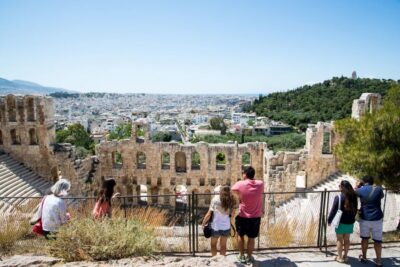
Acropolis, Parthenon & Acropolis Museum Guided Tour
Read our review →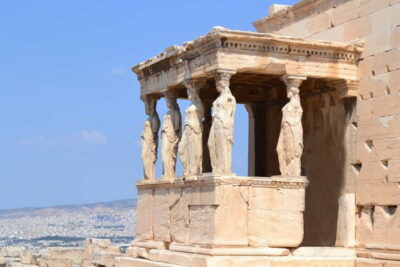

Acropolis monuments & Parthenon Walking Tour with Optional Acropolis Museum
Read our review →
Athens All Included: Acropolis and Museum Guided Tour with Ticket
Read our review →
Acropolis Museum Ticket with optional Audio Guide
Read our review →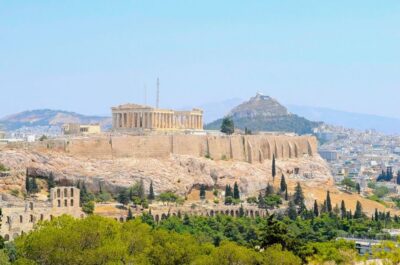
Acropolis Ticket & Optional Self-Guided Audio Tours
Read our review →Browse the lists this tour appears in